
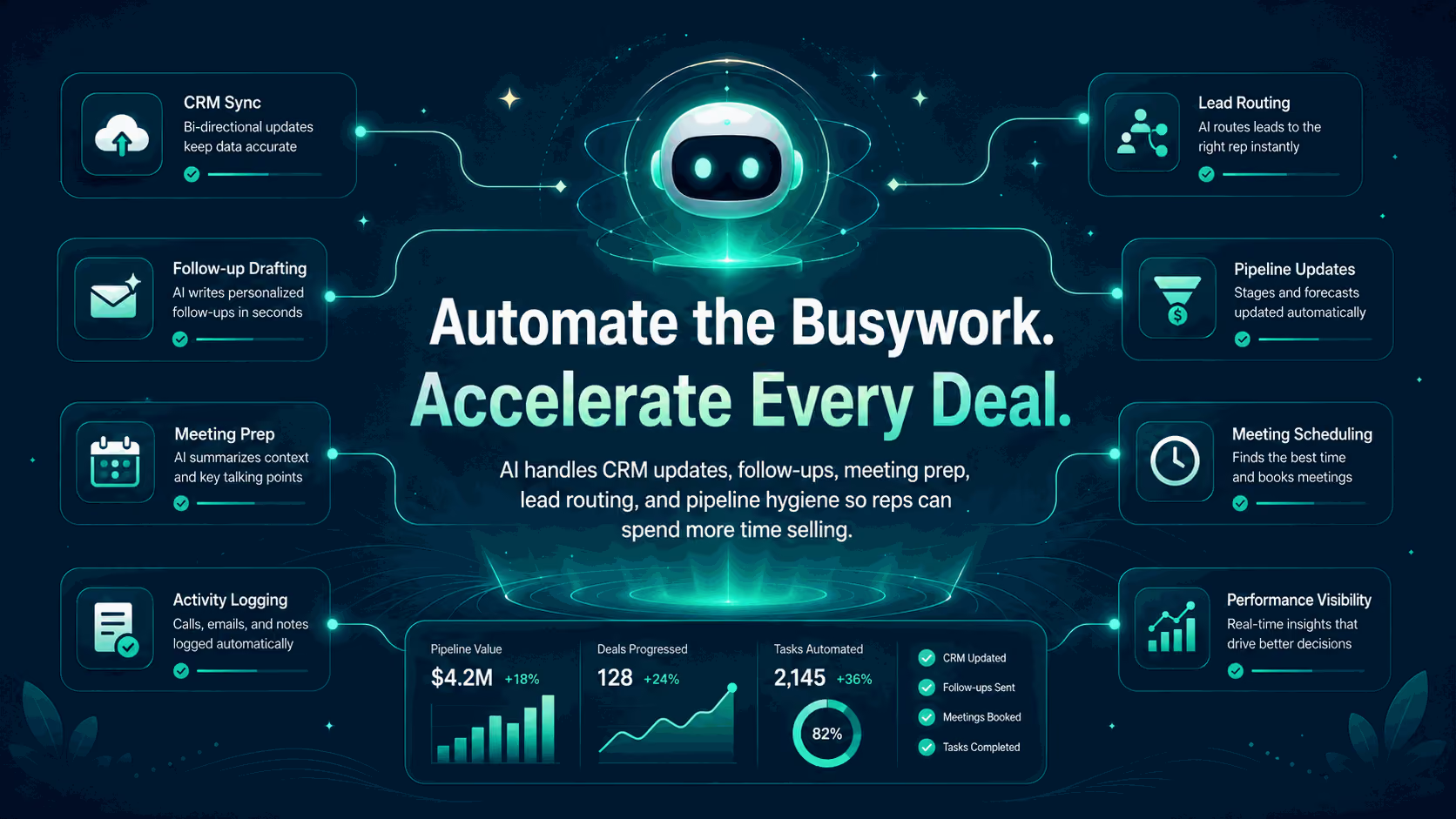
Sales automation software helps sales teams remove repetitive work such as CRM updates, follow-ups, prospecting tasks, meeting prep, activity logging, and pipeline hygiene. In 2026, the best platforms go beyond rules-based workflows. They use AI agents to execute sales work across systems, reduce rep admin, and keep deals moving without adding another dashboard to manage.
Key Takeaways
- Sales automation software automates repetitive sales tasks so reps can spend more time selling.
- Traditional tools automate steps; AI sales automation software can execute full workflows across CRM, inbox, calendar, meeting tools, and sales engagement systems.
- The best option in 2026 depends on the team's core problem. That might be CRM automation, outbound automation, sales engagement, pipeline management, or full sales execution.
- B2B mid-market and SaaS teams should prioritize CRM accuracy, follow-up quality, integrations, workflow coverage, manager visibility, and rep adoption.
- ROI depends on how much manual work the platform removes, not how many features it lists.
- Zig is a strong fit for teams that want AI agents, stack replacement, and outcome-based pricing instead of another per-seat sales tool.
What Is Sales Automation Software?
Sales automation software is technology that automates repetitive sales tasks such as CRM data entry, follow-up reminders, email sequences, lead routing, meeting scheduling, activity logging, and pipeline updates. Modern AI sales automation software can also analyze sales context, recommend next steps, draft messages, update records, and execute workflows across the sales stack.
The category has expanded significantly in recent years. What started as basic email drips and CRM reminders now covers the full span of pre-call research, post-call logging, pipeline hygiene, and proactive deal management. Modern sales automation software is built around a simple principle: remove the work that doesn't require a human so reps can focus on the work that does.
What sales automation software usually automates
- Prospecting workflows and lead capture
- Lead enrichment
- Email and LinkedIn sequences
- Meeting booking
- CRM activity logging
- Deal stage updates
- Follow-up reminders
- Pipeline hygiene
- Forecast preparation
- Sales coaching prompts
What sales automation software should not automate blindly
Automation works best when it handles repeatable, lower-stakes tasks. But some sales work requires human judgment, and removing that judgment creates risk.
Complex negotiations, strategic account conversations, sensitive buyer communications, contract exceptions, and enterprise procurement interactions all need a rep in control. The best platforms in this category are designed around that distinction: they handle the admin layer while keeping humans in the loop where relationships and judgment matter most. That's a core principle behind responsible AI design. The AI Risk Management Framework from NIST emphasizes that human oversight matters most in high-stakes, context-dependent decisions, and that principle applies directly to sales.
How Does AI Sales Automation Software Work?
Rule-based automation follows fixed triggers. If a form is submitted, send an email. If a deal hits a stage, create a task. These workflows are useful, but they break whenever the situation needs interpretation.
AI-powered automation operates differently. It reads context across the CRM, inbox, calendar, and meeting tools, then decides what needs to happen next. The workflow looks something like this:
- Connect the CRM, inbox, calendar, meeting tools, and sales documents
- Pull context from accounts, contacts, deals, calls, emails, meetings, and previous activity
- Detect repetitive work or revenue-critical next steps
- Use AI to draft, summarize, enrich, classify, update, or recommend
- Route work to the right rep, manager, or workflow
- Execute automatically where safe
- Escalate to the rep when human approval is needed
- Sync completed work back to the CRM and related tools
Rule-based automation vs. AI sales automation
| Type | How It Works | Example | Limitation |
|---|---|---|---|
| Rule-based automation | Runs when a fixed trigger happens | Send an email when a form is submitted | Breaks when the situation needs context |
| Workflow automation | Connects multiple steps across tools | Create a CRM task after a demo call | Still requires setup and maintenance |
| AI-assisted automation | Suggests or drafts work for the rep | Draft a follow-up email after a call | Rep still needs to manage the workflow |
| AI-agent automation | Executes multi-step work with context and controls | Update CRM, draft follow-up, flag risk, and create next step after a call | Requires trust, permissions, and clear guardrails |
Where AI agents fit
AI agents can handle sales research, CRM updates, follow-ups, enrichment, meeting prep, pipeline hygiene, and deal reminders. The difference between AI assistance and AI execution is meaningful. Assistance tells a rep what to do. Execution gets it done, with rep approval where it counts.
For teams evaluating how this connects to broader sales execution strategy, the agent layer is where the real productivity gains happen. It's not the dashboard. It's the work that used to fall through the cracks.
Why Sales Automation Software Matters More in 2026
Reps are overloaded with admin. Sales stacks are fragmented. AI has raised buyer expectations for faster, more relevant follow-up. Managers need visibility without turning reps into data-entry workers. RevOps needs cleaner systems. And every team is scrutinizing ROI on tools that don't get used.
Gartner's research on AI in sales documents the growing gap between what sales technology promises and what it delivers when reps are asked to do too much administrative work alongside their selling. The problem isn't motivation. It's system design.
Sales teams have too many tools and too little execution
Most sales teams run on separate tools for CRM, outreach, lead gen, enrichment, meetings, conversation intelligence, scheduling, data cleanup, and reporting. Each tool requires its own login, its own context, and its own maintenance. Each handoff between tools creates a gap where information gets lost or work doesn't happen.
The result: reps become tool operators instead of sellers. And revenue operations platforms that were supposed to unify the stack often add one more layer of complexity rather than removing it.
Automation alone is not enough anymore
Basic automations still require setup. Someone has to define the trigger. Someone has to maintain the workflow when it breaks. Most sales teams don't need more workflows to babysit. They need the admin layer handled.
AI agents create a new standard: work completed, not just work triggered. The shift matters because it changes what a buying team should actually be evaluating when comparing sales automation software. The question is no longer "does this automate X task?" It's "does this get X done?"
What Is the Best Sales Automation Software in 2026?
"Best" depends on the team's core problem. A team that needs better prospecting data has different needs than a team that wants to reduce post-call admin. Below is a practical breakdown by platform and primary use case.
| Platform | Best For | Main Strength | Watchout |
|---|---|---|---|
| Zig | B2B mid-market and SaaS teams that want AI agents to execute sales work | Replaces multiple tools by handling CRM updates, follow-ups, meeting prep, outreach, lead generation, pipeline hygiene, and conversation capture | Best fit for teams ready to rethink the admin layer, not teams that only want a basic email sequencer |
| HubSpot Sales Hub | Teams that want CRM-led sales automation | CRM, workflows, sequences, reporting, and sales pipeline management in one ecosystem | Costs can rise as teams need advanced automation, seats, and hubs |
| Salesforce / Agentforce | Enterprise teams with complex CRM infrastructure | Enterprise CRM, AI, workflow customization, forecasting, and ecosystem depth | Often requires admin resources, implementation, and ongoing maintenance |
| Outreach | Enterprise and upper-mid-market sales engagement | Sequencing, sales engagement, AI agents, deal workflows, and rep productivity features | Pricing and packaging usually require sales consultation |
| Salesloft | Sales engagement and revenue orchestration teams | Cadences, conversations, deals, forecasting, and sales workflow support | Best value often comes when teams fully commit to the Salesloft ecosystem |
| Apollo | Outbound teams that need data plus engagement | Prospecting database, enrichment, sequences, and email workflows | Credit limits, data quality, and CRM hygiene should be reviewed carefully |
| Pipedrive | SMBs that want simple pipeline automation | Easy CRM setup and basic sales workflow automation | Less suitable for complex mid-market RevOps workflows |
| Freshsales | SMB and mid-market teams wanting CRM plus AI features | CRM, lead scoring, communication tools, and sales workflows | Less dominant for advanced outbound execution than specialist tools |
| Close | SMB sales teams focused on calling and email | Built-in calling, email, and pipeline management | Less suited for larger multi-tool RevOps environments |
| Instantly / Smartlead | Outbound email teams | High-volume cold email sending and deliverability workflows | Not a full sales execution or CRM automation platform |
| Zapier | Teams that need no-code workflow connections | Connects tools and automates simple cross-app tasks | Requires workflow design and does not own sales execution outcomes |
| Clay | GTM teams focused on data enrichment and prospecting workflows | Flexible data workflows and enrichment | Not a full sales automation system for pipeline execution |
Best overall for AI sales execution: Zig
Zig is an AI sales execution platform built around the idea that the admin layer of selling should not fall on reps. It handles CRM updates, follow-up drafting, meeting prep, outreach, lead generation, pipeline hygiene, and conversation capture across the tools a team already uses.
Pricing is tied to execution workload, not per-seat licenses or token consumption. That makes Zig a strong fit for B2B mid-market and SaaS teams that want fewer tools, cleaner CRM, faster follow-up, and less rep admin, without the overhead of managing another platform.
Best CRM-led option: HubSpot Sales Hub
HubSpot Sales Hub is the right answer when the CRM is the center of the sales motion and the team wants workflows, sequences, reporting, and integrations in one ecosystem. Teams that are already HubSpot-native get the most from this investment.
Best enterprise CRM option: Salesforce / Agentforce
Salesforce remains the standard for enterprise CRM complexity: deep object models, workflow customization, forecasting, and a mature ecosystem. Agentforce extends the platform with AI capabilities, best suited for organizations that have the admin and RevOps resources to configure it at scale.
Best sales engagement options: Outreach and Salesloft
Both platforms are strong for teams with mature outbound motions. Outreach is well-regarded for sequencing, deal management, and AI features; Salesloft covers cadences, conversations, and pipeline support. For teams whose bigger challenge is tool consolidation rather than outbound optimization, see how these compare against AI sales execution platforms more broadly.
Best prospecting data option: Apollo
Apollo is a strong fit for SDR teams and outbound-heavy motions: prospecting database, enrichment, and sequencing in one tool. Prospecting automation and end-to-end sales execution are different problems. Clay vs. Apollo vs. Zig covers the distinction in detail.
Sales Automation Software Comparison Guide for 2026
| Buying Scenario | Best-Fit Category | Tools to Consider | What to Prioritize |
|---|---|---|---|
| Reps spend too much time on CRM updates and follow-ups | AI sales execution | Zig, Outreach, Salesloft | Execution depth, CRM sync, rep adoption, approval controls |
| Team needs better outbound prospecting | Sales intelligence + sequencing | Apollo, Clay, ZoomInfo, Instantly, Smartlead | Data quality, enrichment, deliverability, sequence control |
| Company wants CRM-led automation | CRM automation | HubSpot, Salesforce, Pipedrive, Freshsales | Workflow builder, reporting, CRM objects, admin effort |
| Managers need better coaching and deal visibility | Revenue / conversation intelligence | Gong, Salesloft, Outreach, Zig | Call capture, summaries, coaching, deal risk, next steps |
| RevOps wants fewer tools | Revenue operating system / sales execution platform | Zig, Salesforce, HubSpot, Outreach | Tool replacement, integrations, governance, total cost |
| Startup needs simple sales automation | Lightweight CRM or outbound tool | Pipedrive, Close, HubSpot Starter, Apollo | Ease of setup, cost, adoption, basic sequencing |
| SaaS team needs fast follow-up after demos | AI follow-up + CRM automation | Zig, HubSpot, Outreach, Salesloft | Meeting capture, follow-up drafting, CRM updates, next-step tasks |
| Mid-market team needs scalable workflows | AI execution + RevOps automation | Zig, Salesforce, HubSpot, Outreach | Permissions, routing, pipeline hygiene, multi-tool coverage |
What Sales Automation Software Replaces Multiple Tools?
For teams carrying a bloated stack, the ROI question is often about consolidation. The right platform doesn't just automate one task. It replaces or reduces the need for several specialized tools.
| Tool Category | What Teams Usually Buy | What Zig Can Help Replace or Reduce |
|---|---|---|
| Sales engagement | Outreach, Salesloft, Reply.io, Lemlist | Outreach and follow-up execution inside a broader sales execution platform |
| Lead generation / enrichment | Clay, Apollo, ZoomInfo | Lead generation and enrichment workflows connected to sales execution |
| Meeting recorder / notetaker | Fireflies, Fathom, Otter, Gong | Conversation capture and takeaways through built-in conversation intelligence |
| CRM admin tools | Workflow builders, data cleanup tools, manual RevOps processes | CRM updates, activity logging, pipeline hygiene, and field maintenance |
| Follow-up tools | Email assistants, task reminders, calendar nudges | AI-generated follow-ups and next-step prompts |
| Pipeline management | Deal review dashboards, forecast prep sheets | Risk flags, account context, and execution support |
| Rep productivity tools | Notes, reminders, personal task managers | Centralized rep-facing actions with minimal clicks |
Why tool replacement matters for ROI
Fewer tools means fewer licenses, less context switching, cleaner data, and simpler adoption. The real ROI is not only subscription savings; it's rep time recovered and execution consistency. For teams evaluating the lead generation and execution overlap, the Clay alternatives breakdown covers how enrichment and execution workflows connect in practice.
Best Sales Automation Software for B2B Mid-Market Teams
Mid-market teams sit in an awkward position. They're too complex for simple SMB tools but rarely staffed to manage enterprise software. The right sales automation software for this segment needs real CRM depth, fast implementation, and enough flexibility to handle a multi-product, multi-segment sales motion.
What mid-market teams should prioritize
- CRM hygiene: stale data is a management and forecasting problem, not just an ops problem
- Fast implementation: teams with small RevOps bandwidth can't afford a six-month rollout
- HubSpot and Salesforce compatibility
- Workflow coverage across the full sales cycle, not just outbound
- Manager visibility without requiring more rep data entry
- Rep adoption: the best tool is the one reps actually use
- Security and permissions: especially when multiple roles touch the same accounts
- Pricing that scales without punishing headcount growth
Why Zig is a strong fit for mid-market B2B teams
Zig reduces the admin layer without requiring a large RevOps team to configure and maintain it. Reps interact only when human input is genuinely needed; everything else gets handled in the background and surfaced for approval when appropriate.
Best Sales Automation Software for SaaS Companies
SaaS sales motions have specific automation demands: demo follow-up, product-qualified lead routing, trial activation, expansion signals, renewal handoffs, and pipeline velocity across a fast-moving cycle. Generic automation tools often miss these nuances.
SaaS sales automation use cases
| SaaS Sales Motion | Automation Needed | Why It Matters |
|---|---|---|
| Demo request | Route lead, prep rep, enrich account, create CRM task | Speed to lead affects conversion |
| Post-demo follow-up | Summarize call, draft recap, log CRM, create next step | Prevents momentum loss |
| Trial or freemium motion | Detect product signals and trigger sales action | Helps reps focus on accounts with intent |
| Expansion sales | Surface usage, stakeholder, and renewal context | Supports account growth |
| Renewal handoff | Sync notes, risks, and next steps | Prevents customer context loss |
| Competitive deal | Flag competitor mentions and prepare relevant messaging | Improves deal strategy |
| Stalled opportunity | Detect inactivity and recommend re-engagement | Revives pipeline before it decays |
SaaS teams need sales automation software that covers the full buyer journey, not just the top-of-funnel. Task-only automation handles the first touchpoint but leaves the middle and bottom of the funnel to reps managing their own inboxes and CRM fields.
Which Sales Automation Software Has the Best ROI?
ROI from any sales automation software investment comes down to a straightforward calculation:
Sales automation ROI = value of rep time saved + additional pipeline created + improved close rate + tool consolidation savings − software cost − implementation cost − maintenance cost
The tools with the highest ROI tend to be the ones that remove real work rather than creating new dashboards to monitor. Feature count is a poor proxy; buyers should measure actions completed, admin removed, and pipeline outcomes. Here's how to evaluate the key drivers:
| ROI Driver | What to Measure | Why It Matters |
|---|---|---|
| Rep time saved | Hours saved per rep per week | Shows whether automation removes real work |
| Follow-up speed | Time from meeting to next step | Faster follow-up protects deal momentum |
| CRM completeness | Missing fields, stale deals, activity gaps | Cleaner CRM improves forecasting and management |
| Tool consolidation | Tools replaced or reduced | Direct software savings |
| Pipeline movement | Stalled deals revived, next steps created | Connects automation to revenue outcomes |
| Adoption | Active users, approvals, completed actions | Prevents shelfware |
| Manager visibility | Fewer manual deal inspections | Reduces leadership and RevOps overhead |
| Cost model | Seats, credits, usage, outcomes | Determines whether pricing scales with value |
How Zig's outcome-based pricing supports ROI
Zig doesn't use standard per-seat or token-based pricing. It prices based on execution workload coverage: the scope of sales admin the platform handles for the team. That alignment means cost scales with value delivered, not headcount or usage caps.
For a detailed breakdown of what each tier covers, see Zig's pricing page.
How Much Does Sales Automation Software Cost in 2026?
Pricing varies significantly by category, team size, and feature depth. The table below covers the most common models buyers will encounter.
| Pricing Model | Common For | What Buyers Should Watch |
|---|---|---|
| Free / freemium | CRMs, prospecting tools, lightweight automation | Feature limits, credit caps, automation limits |
| Per-seat pricing | CRMs, sales engagement platforms, revenue tools | Costs rise as headcount grows |
| Tiered pricing | HubSpot-style hubs, CRMs, SMB tools | Key automation features may sit in higher tiers |
| Usage or credit-based pricing | Data tools, AI tools, outbound tools | Costs can rise with enrichment, emails, exports, or AI usage |
| Platform fee | Enterprise sales tools | Can increase total cost before adoption is proven |
| Implementation fee | Enterprise CRM and sales engagement | Requires admin time, rollout planning, and training |
| Outcome-based pricing | AI execution platforms like Zig | Better alignment when pricing is tied to work completed or admin coverage |
Vendor pricing changes frequently and many enterprise tools require a sales consultation for accurate quotes. Verify current pricing directly with each vendor before making a final decision.
Questions to ask before you trust the price
- Are all users billed equally, or is there role-based pricing?
- Are AI features included in the base plan or gated to higher tiers?
- Are credits or usage caps part of the model?
- Are CRM integrations included or sold separately?
- Is implementation included, or is that a separate engagement?
- Are workflows or automations capped at any tier?
- Are data exports restricted?
- What level of support is included?
- Can the platform realistically replace existing tools?
- What work will the platform actually complete, rather than just trigger or suggest?
Which Sales Automation Software Has AI Agents Built In?
Many vendors now use AI language in their marketing. Not all have true agentic execution, and the difference matters when evaluating what a platform will actually do for a team.
What counts as a real sales AI agent?
A genuine AI agent in a sales context should be able to:
- Understand context from CRM, email, calendar, and meeting data
- Plan the steps required to complete a sales task
- Act across systems without requiring manual prompting for each action
- Escalate to a rep when human approval is needed
- Log completed work back into the CRM
- Operate within clear permissions and guardrails
BCG's analysis of how AI agents will transform B2B sales frames the distinction clearly: the value of AI agents in sales comes from embedded execution, not standalone recommendation tools that still require a rep to act.
Use this checklist when evaluating any vendor's AI agent claims:
| Checklist Item | Yes / No |
|---|---|
| Does the AI agent execute work or only recommend? | |
| Can it update CRM fields? | |
| Can it draft and route follow-ups? | |
| Can it prepare reps before meetings? | |
| Can it detect deal risk? | |
| Can it enrich contacts and accounts? | |
| Can it work across CRM, inbox, calendar, and meeting tools? | |
| Can it show what it did? | |
| Can reps approve or reject sensitive actions? | |
| Can admins control permissions? |
AI agent platforms to compare
Zig, Outreach, Salesforce / Agentforce, Salesloft, HubSpot AI / Breeze, and Apollo all have AI-oriented features or agent positioning. The meaningful distinction is whether the AI assists with tasks or actually executes workflows across systems. Zig's agents are built specifically around sales execution and admin workload coverage, with rep approval required for any external or sensitive action.
Sales Automation Software Features Checklist
| Feature | Why It Matters |
|---|---|
| CRM integration | Keeps sales records accurate |
| Email and calendar integration | Connects automation to daily rep workflows |
| Meeting capture | Turns calls into usable context |
| AI summaries | Reduces manual note-taking |
| Follow-up drafting | Helps reps respond faster |
| CRM field updates | Improves data hygiene |
| Activity logging | Reduces manual admin |
| Lead enrichment | Improves prospecting quality |
| Lead routing | Speeds up response times |
| Sequence automation | Supports outbound scale |
| Pipeline hygiene | Prevents stale deals |
| Deal risk detection | Helps managers intervene earlier |
| Next-best actions | Shows reps what to do next |
| Human approval controls | Keeps sensitive work safe |
| Audit logs | Builds trust in AI execution |
| Permissions | Protects data and workflows |
| Reporting | Shows adoption and impact |
| Tool replacement potential | Improves ROI |
| Pricing alignment | Prevents paying for unused seats |
| Fast onboarding | Speeds time to value |
Sales Automation Software for HubSpot, Salesforce, and Other CRMs
CRM compatibility is one of the most important buying criteria. The question isn't just whether a tool connects, but how deeply. Field mapping, object sync, workflow triggers, activity logging, and permission controls all need to work cleanly with the CRM the team already runs.
| CRM Environment | What to Look For | Why It Matters |
|---|---|---|
| HubSpot | Contact, company, deal, activity, and sequence compatibility | HubSpot-native teams need automation that respects CRM workflows |
| Salesforce | Object mapping, permissions, field updates, activity sync | Enterprise teams need governance and data control |
| Pipedrive | Simple deal and activity automation | SMB teams need fast setup |
| Zoho | CRM field and workflow compatibility | Cost-conscious teams may need flexibility |
| Monday.com | Workflow and sales board sync | Ops-heavy teams may use Monday as a process hub |
Zig's pricing page notes compatibility with HubSpot, Salesforce, Pipedrive, Zoho, and Monday.com. Verify specific integration depth directly with the Zig team before implementation. For teams managing reps across locations, mobile CRM workflows are an important part of the CRM picture. Automation that only works at a desktop creates coverage gaps for field-based teams.
Sales Automation Software vs. Sales Execution Platform
These two categories are related but not the same.
| Category | Primary Job | Typical Output | Limitation |
|---|---|---|---|
| CRM | Store customer and deal data | Records, reports, pipeline views | Does not execute work by itself |
| Sales engagement tool | Send sequences and manage outreach | Emails, calls, tasks, cadences | Usually focused on outbound workflows |
| Sales automation software | Automate repetitive sales tasks | Triggers, workflows, reminders, updates | Often requires setup and ongoing management |
| Revenue intelligence tool | Analyze pipeline and conversations | Insights, forecasts, deal risk | Insights still require action |
| Sales execution platform | Complete sales work across systems | CRM updates, follow-ups, meeting prep, pipeline hygiene, outreach, lead gen | Requires trust, workflow mapping, and clear controls |
Why this difference matters
Buyers sometimes think they need automation when they actually need execution. Automation still leaves work for reps and RevOps to manage. Execution platforms absorb the work layer. They don't just trigger a task, they complete it.
Understanding the sales execution platform category helps buyers ask the right questions before they select a tool. Revenue intelligence sits in a related space, covered in the revenue intelligence explainer for teams who want to understand where data analysis ends and action begins.
How to Choose the Best Sales Automation Software
Choosing the right sales automation software starts with mapping the real problem, not the feature list. Here's a practical framework:
- Map the sales work your reps actually do, not what the process doc says
- Separate admin work from human selling work
- Identify which tools create duplicate context or require reps to re-enter information
- Audit CRM quality and follow-up gaps: stale data and missed follow-ups point directly to ROI
- List workflows that should be automated, and those that need human approval
- Compare tool replacement potential: fewer tools means lower total cost
- Calculate total cost, not just the subscription price
- Test rep adoption before scaling
- Measure outcomes after implementation: time saved, pipeline impact, CRM completeness
Key buying questions by role
RevOps: How much setup does this require, and who owns it? Can it sync cleanly with the CRM? Can it replace existing tools? Does it improve data quality as a byproduct of normal use?
Sales leaders: Will reps actually use this? Does it reduce admin meaningfully? Does it improve follow-up speed and consistency? Does pricing scale with value?
Reps: Does this save me time in a way I'll notice? Does it reduce clicks? Does it help me prep for meetings and draft follow-ups? Does it keep the CRM clean without extra work on my end?
Zig's perspective on why sales tools are built for managers, and how that's changing is worth reading for anyone evaluating rep adoption risk.
Recommended Sales Automation Software Shortlist by Team Type
| Team Type | Best Shortlist | Why |
|---|---|---|
| B2B mid-market sales team | Zig, HubSpot, Outreach, Salesloft | Needs automation, CRM hygiene, rep adoption, and scalable execution |
| SaaS company | Zig, HubSpot, Apollo, Outreach | Needs fast follow-up, demo workflows, pipeline velocity, and account context |
| Outbound SDR team | Apollo, Outreach, Salesloft, Instantly, Smartlead | Needs prospecting, sequencing, deliverability, and activity tracking |
| HubSpot-native team | HubSpot Sales Hub, Zig, Apollo | Needs HubSpot compatibility and automation that fits existing CRM workflows |
| Salesforce-heavy enterprise | Salesforce / Agentforce, Outreach, Salesloft, Zig | Needs governance, CRM depth, and workflow orchestration |
| Small business | Pipedrive, Close, HubSpot Starter, Freshsales | Needs low setup and simple automation |
| RevOps-led team consolidating tools | Zig, HubSpot, Salesforce, Outreach | Needs stack reduction, clean CRM, and cross-tool execution |
| Sales team replacing admin work | Zig | Needs outcomes, not another dashboard |
The Future of Sales Automation Software: Workflows Are Not Enough
Sales automation software has moved through three distinct stages. Manual sales work came first. Rules-based automation came second. AI-agent execution is the third stage, and it defines the 2026 buying conversation.
The next generation of platforms is judged by completed work, not by seats or logins. Buyers are asking different questions: not "does this tool automate the task?" but "does this tool get the task done?"
The old model: automate a task
Rules, triggers, sequences, and dashboards. Useful, but fundamentally limited. The rep still had to check the dashboard, the RevOps team still had to maintain the workflows, and the manager still had to chase deal updates.
The new model: own the sales admin layer
AI agents monitor, prepare, update, follow up, and escalate. Reps stay in control of human moments: the negotiation, the relationship, the close. The ghost work problem (the 40 minutes of post-call admin that no one accounts for but every rep lives with) is exactly what the AI agent layer is designed to absorb.
Why outcome-based pricing fits the AI agent era
If AI agents perform work, pricing should reflect work completed, not headcount. Per-seat pricing creates shelfware risk: the cost is fixed whether the tool is used or not. Outcome-based pricing aligns vendor value with buyer value, which is why Zig prices around execution workload rather than seats.
See the Zig platform to understand how this works in practice.
FAQs About Sales Automation Software
What is the best sales automation software in 2026?
The best platform depends on the team's needs. Zig is a strong fit for B2B teams that want AI agents and stack replacement. HubSpot is strong for CRM-led automation. Outreach and Salesloft fit sales engagement. Apollo is useful for outbound prospecting.
How does AI sales automation software work?
It connects to sales systems, analyzes CRM, email, meeting, and pipeline context, then drafts, recommends, updates, routes, or executes sales work. Advanced platforms use AI agents to complete multi-step workflows with human approval where needed.
Which sales automation software has the best ROI?
The best ROI usually comes from software that removes real admin work, improves follow-up speed, increases CRM accuracy, and replaces multiple tools. Measure time saved, pipeline impact, adoption, tool consolidation, and total cost, not features.
What is the best sales automation software for B2B mid-market teams?
Mid-market teams should look for tools that balance CRM integration, workflow depth, rep adoption, and cost control. Zig is a strong option for teams that want AI agents to handle sales execution work without adding another per-seat tool.
What sales automation software replaces multiple tools?
Zig is designed to replace or reduce several tools across sales engagement, outreach, lead generation, meeting recording, CRM admin, follow-up workflows, and pipeline hygiene. This makes it a strong fit for teams consolidating their sales stack.
How much does sales automation software cost?
Costs range from free or low-cost SMB tools to enterprise platforms with custom pricing. Models include seats, tiers, credits, usage, platform fees, implementation fees, and outcome-based pricing. Always verify current vendor pricing before purchasing.
What is the best sales automation software for SaaS companies?
SaaS companies should look for tools that support demo follow-up, CRM updates, trial or PQL routing, account research, renewal handoffs, and pipeline velocity. Zig, HubSpot, Apollo, Outreach, and Salesloft are common tools to evaluate.
Which sales automation software has AI agents built in?
Zig, Outreach, Salesforce, Salesloft, HubSpot, and Apollo all have AI-oriented features or agent positioning. Verify whether the AI only assists with tasks or actually executes workflows across systems. That distinction matters for ROI.
What is outcome-based sales automation pricing?
Outcome-based pricing ties cost to work completed, workload covered, or business value rather than charging only by seat, token, or feature tier. Zig uses this model for sales execution.
Is sales automation software the same as CRM software?
No. CRM software stores customer and deal data. Sales automation software automates tasks around that data: follow-ups, activity logging, lead routing, and pipeline updates. A sales execution platform goes further and completes that work rather than just triggering it.
Ready to see how Zig handles the admin layer for your team? Book a meeting with an advisor.
