
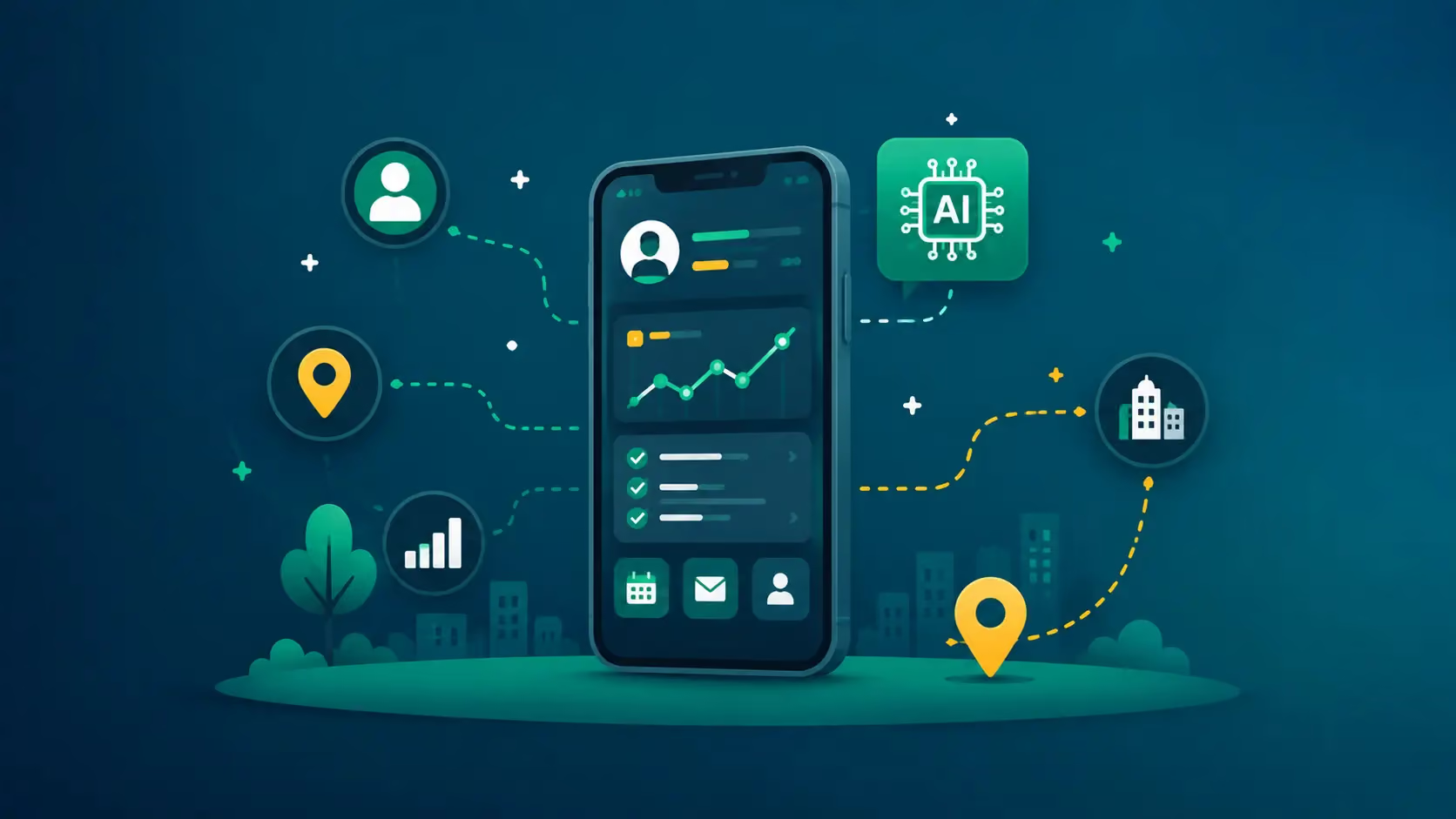
For years, "mobile CRM" meant a CRM app squeezed onto a phone screen. Reps could check contacts, update deals, log calls, and maybe create tasks between meetings. But the work still depended on the rep remembering what happened, typing notes into fields, and cleaning up the CRM later.
AI is changing that. A true mobile-first sales workflow lets reps move deals forward from wherever they are: after a call, in a car, between meetings, at a conference, or inside Slack. The best mobile-first CRM experience is becoming less about tapping through fields and more about commanding an AI sales assistant to update, summarize, follow up, schedule, and prep.
This article breaks down what a mobile CRM for sales reps looks like in 2026, why the traditional CRM app on a phone is no longer enough, and which tools are best for sales teams that need to execute from anywhere.
TLDR:
The best mobile CRM in 2026 is not just the one with the cleanest app. It is the platform that lets reps execute sales work from anywhere. Traditional options like Salesforce, HubSpot, Pipedrive, Zoho, Freshsales, and Bitrix24 give reps access to contacts, deals, tasks, and call logs from their phones. Zig goes further by giving reps AI agents that can work from mobile, voice, text, Slack, email, or phone calls to handle CRM updates, meeting prep, follow-ups, lead generation, and pipeline actions.
Key takeaways
- A mobile CRM should do more than let reps view data. It should help them act on deals in the moment.
- Traditional CRM apps on mobile are useful for contact access, deal views, task management, call logging, and pipeline updates.
- AI is reshaping what a mobile sales tool can do: voice commands, call summaries, CRM update automation, sales follow-up automation, and next-step execution instead of manual data entry.
- Zig is best positioned for teams that want mobile-first sales execution, not just a CRM mobile app.
- Salesforce, HubSpot, Pipedrive, Zoho, Freshsales, and Bitrix24 are strong options when teams want a traditional CRM with mobile access.
- Reps who travel or meet customers in person need fast deal prep, hands-free updates, call-based context capture, and follow-up automation.
What is mobile CRM?
Mobile CRM is CRM software that lets sales teams access and manage customer relationships from a phone or tablet. Traditional CRM apps on mobile usually include contact records, deal pipelines, task lists, call logging, notes, email tracking, notifications, and basic reporting.
In 2026, the definition is expanding. A modern sales CRM mobile app should not only show reps what is in the CRM. It should help reps update records, prepare for meetings, trigger follow-ups, schedule next steps, and keep pipeline data current while they are away from their laptop.
Why traditional mobile CRM apps are not enough anymore
Mobile access still leaves reps doing manual admin
A CRM app on a phone can make data entry easier, but it still requires reps to stop selling and fill out fields. That is the core problem.
Forrester has reported that CRM adoption is high while satisfaction remains low. For sales teams, one common reason is that CRM still depends on reps keeping records current manually. Trying to update CRM from phone after every meeting does not fix that burden. It shrinks the screen. Consider what happens after a routine sales interaction:
- After a customer call, the rep still has to summarize the conversation.
- After an in-person meeting, the rep still has to remember next steps.
- After a conference conversation, the rep still has to create the contact.
- After a deal changes, the rep still has to update stage, amount, close date, next step, and notes.
A CRM app on a phone moves those tasks from a laptop screen to a smaller screen. It does not remove them.
Sales work happens outside the CRM
Sales work now happens across phone calls, email, Slack, WhatsApp, LinkedIn, Zoom, meetings, notes, calendars, and voice memos. A CRM for Slack, a CRM for field sales reps, a CRM that captures what happens in email threads and on calls: that is what teams actually need. Most CRM apps on mobile reflect what is already in the system. They do not pull in what is happening outside it.
Reps need execution, not another small screen
This is the key argument. Mobile-first does not mean "CRM, but smaller." It means reps can move work forward from wherever they are, with fewer taps and less manual cleanup. The goal of sales enablement is to reduce the friction that keeps sellers from selling. A CRM app that still requires five fields and three taps per update is not reducing friction. It is relocating it.
How AI is changing mobile CRM
AI lets reps update CRM by voice or text
An AI mobile CRM can turn natural-language commands into structured CRM actions. Instead of opening the app, finding the account, and editing fields, a rep can say or type something like:
"Update Acme to proposal sent, add next step for Friday, and draft a follow-up about the procurement questions."
The AI translates that into CRM field updates, tasks, and a follow-up draft. No tapping through menus. No forgetting to log the call two hours later.
AI can summarize calls and update records automatically
AI sales tools increasingly use call recordings, notes, and CRM context to write back outcomes, update pipeline fields, and trigger follow-ups. As AI-powered marketing and sales capabilities mature, the gap between "tool that records a call" and "tool that acts on what was said" is closing fast. A transcript is not the same as execution. The stronger workflow is: summarize the call, identify next steps, update structured CRM fields, draft the follow-up, and schedule the next action.
AI can prepare reps before meetings
Mobile deal prep is where AI adds the most value for reps on the go. Before a call or in-person meeting, the rep should get:
- Account summary
- Recent interactions
- Open objections
- Stakeholders
- Deal risks
- Suggested questions
- Similar closed-won deals
- Recommended next step
That context should arrive before the rep walks in, not after they get back to a laptop and search the CRM.
AI can handle follow-ups while context is still fresh
The best follow-up happens right after the conversation. AI can draft the recap, add action items, schedule reminders, update the CRM, and prepare the next message before the rep is back at a desk.That is the difference between a follow-up sent 20 minutes after the meeting and one sent 20 hours later.
AI can work inside Slack, WhatsApp, email, and phone calls
This is where the conversation expands beyond apps. If a rep spends half the day in Slack and the other half on calls, the most useful sales tool is the one that meets them in those channels. Zig's AI agents can be commanded from desktop, mobile, voice, text, Slack, email, or a phone call, which means the CRM gets updated regardless of which channel the rep is working in.
What makes a CRM truly mobile-first?
It works where reps already communicate
A true mobile-first CRM should support workflows across mobile app, voice commands, SMS or text, Slack, WhatsApp (if relevant to the sales motion), email, phone calls, calendar, and CRM. If the rep has to leave the channel they are in to update the CRM, that is not mobile-first.
It reduces taps, fields, and context switching
The fewer manual steps required, the more likely reps are to use it. Every extra field, every extra tap, every context switch from the conversation app to the CRM app is a place where updates get delayed or skipped.
It updates the system of record automatically
Mobile-first CRM should improve CRM hygiene, not create another inbox of pending updates. The CRM should reflect what happened in the meeting, on the call, or in the Slack thread without waiting for the rep to transcribe it.
It prepares reps before action is needed
The system should surface context before the meeting, not after the deal has already moved. A CRM app that only shows what the rep already logged is a mirror. A mobile-first platform that surfaces prep, risks, and recommendations is a tool.
It keeps deals moving after conversations
Follow-ups, next steps, reminders, and CRM changes should happen while the conversation is still warm. If the system waits for the rep to do it manually, deals go quiet.
Best mobile CRM and mobile-first sales tools in 2026
|
Tool |
Best for |
Mobile strength |
Limitation to mention |
|
Zig |
AI mobile sales execution |
Commands from mobile, voice, text, Slack, email, and phone calls; handles CRM updates, prep, and follow-ups |
Best fit for teams ready to automate sales execution, not just view CRM records |
|
Salesforce |
Enterprise mobile CRM |
Scalable CRM app, Salesforce ecosystem, Agentforce AI |
Can be heavy for teams that want simpler mobile execution |
|
HubSpot |
SMB and mid-market CRM |
Contacts, deals, tasks, email tracking, and call logging on mobile |
Mobile app still reflects a CRM-centered workflow |
|
Pipedrive |
Visual pipeline management |
Simple mobile deal tracking and pipeline views |
Less robust for AI execution across channels |
|
Zoho CRM |
Budget-friendly mobile CRM |
Broad CRM functionality and mobile access |
Can require configuration across Zoho ecosystem |
|
Freshsales |
Mobile CRM with communication tools |
Contact/deal management and AI-assisted sales features |
May not replace full sales execution workflows |
|
Bitrix24 |
All-in-one mobile CRM |
CRM, tasks, communication, and collaboration |
Can feel broad or complex depending on team needs |
|
Monday sales CRM |
Flexible mobile sales workflows |
Customizable sales tracking and work management |
More workflow system than AI sales execution layer |
|
Close |
Inside sales teams |
Calling, email, SMS, and sales communication |
Better for inside sales than complex field sales execution |
|
AI voice / sales agents |
Call-driven CRM updates |
Can summarize calls, update CRM notes, and trigger follow-ups |
Quality depends on CRM integration depth and whether the tool updates structured fields |
1. Zig: best mobile-first AI sales execution platform
Most CRM apps on mobile give reps a smaller version of the desktop experience. Zig gives reps an AI team that executes from wherever they are. That makes Zig the stronger fit when the problem is not mobile CRM access, but delayed updates, late follow-ups, and lost context after calls or meetings.
That is a different value proposition. Instead of asking reps to update the CRM from their phone, Zig lets reps tell the system what happened, and AI agents handle the rest: CRM updates, follow-up drafts, meeting prep, scheduling, pipeline hygiene, and deal revival.
Zig is an AI sales execution platform where reps can command work from desktop, mobile, voice, text, Slack, email, or a phone call. The platform's AI agents find leads, prepare meetings, run follow-through, update the CRM, and surface similar deals, effectively giving each rep an AI executive assistant that works across every channel they use.
Zig is also not a black-box automation tool. It keeps reps in control where it matters: uncertain CRM updates, outreach drafts, and deal actions are surfaced for review, and external emails always require explicit rep approval.
Why Zig is different from a mobile CRM app
A traditional CRM app asks the rep to update the system. Zig lets the rep tell the system what happened (by voice, text, Slack, or any channel), then handles the work around it. Reps can update CRM by voice after a meeting, send a text command from a cab, or fire a Slack message between calls.
Traditional CRM workflow on mobile: Open app, find account, edit fields, add note, create task, draft follow-up, schedule next step.
Zig mobile-first execution: Tell Zig what happened. Zig updates the CRM, drafts the follow-up (with rep approval for external sends), schedules the next step, prepares future context, and keeps pipeline hygiene intact.
The difference is who does the work.
Best for
- B2B sales teams with mobile or traveling reps
- Field sales reps who meet customers in person
- AEs who need fast deal prep before calls
- SDRs who need mobile prospecting and follow-up
- Sales reps who hate CRM admin
- RevOps teams that need cleaner CRM data
- Sales leaders who want faster follow-up and pipeline accuracy
- Teams that use Slack, email, phone, and CRM throughout the day
Potential limitation
Zig is best for teams that want AI to execute sales work, not teams that only need a basic CRM app for viewing contacts and tasks. If you just need a mobile contact list, a traditional CRM mobile app will do the job.
See how Zig helps reps update CRM, prep for meetings, and follow up from anywhere.
2. Salesforce: best enterprise mobile CRM
Salesforce remains a strong option for enterprise teams that need a mature CRM ecosystem, mobile access, and AI capabilities through Agentforce and the broader Salesforce platform.
What it covers well:
- Enterprise CRM
- Mobile app
- Slack-connected CRM workflows
- Agentforce AI
- Custom workflows
- Large sales orgs
Limitation: Salesforce can be more system-heavy than some teams want. Mobile access is strong, but sales teams may still need adoption support and automation to reduce manual CRM work on the go.
3. HubSpot: best mobile CRM for SMB and mid-market teams
HubSpot's mobile app gives reps access to contacts, deals, tasks, email tracking, and call logging on iOS and Android. For teams already in the HubSpot ecosystem, it is a natural mobile extension.
What it covers well:
- Easy CRM adoption
- Contact and deal management
- Tasks
- Email tracking
- Call logging
- Sales and marketing alignment
Limitation: HubSpot's mobile experience is useful, but it is still mostly a CRM app. Teams looking for autonomous CRM updates and AI-led sales execution may need additional tooling.
4. Pipedrive: best mobile CRM for visual pipeline management
Pipedrive is a strong fit for teams that want simple pipeline visibility and deal management from a phone. Its visual pipeline view translates well to mobile.
What it covers well:
- Visual pipeline
- Simple deal tracking
- Mobile access
- SMB sales teams
- Ease of use
Limitation: Pipedrive is not primarily a sales execution platform across voice, Slack, WhatsApp, phone calls, and automated CRM updates.
5. Zoho CRM: best budget-friendly mobile CRM
Zoho regularly appears in CRM roundups as a strong option for teams that want broad functionality at a more accessible price point.
What it covers well:
- Budget-friendly CRM
- Mobile app
- Broad feature set
- Zoho ecosystem
- Smaller teams
Limitation: Zoho may require configuration to create a smooth mobile-first sales execution workflow. The breadth of the Zoho ecosystem is a strength for some teams and a setup challenge for others.
6. Freshsales: best mobile CRM with built-in communication features
Freshsales is a strong value option with built-in automation and AI-assisted sales features through Freddy AI.
What it covers well:
- Contact and deal management
- Communication tracking
- AI-assisted insights
- Automation
- Value-oriented teams
Limitation: Freshsales is still a CRM system. For teams that want AI agents to execute work across multiple channels, Zig or dedicated AI sales tools may be stronger.
7. Bitrix24: best all-in-one mobile CRM and collaboration platform
Bitrix24 positions CRM on mobile as something that should let teams act on data, not just access it. That framing is right. Whether the all-in-one approach fits depends on whether your team wants breadth or depth.
What it covers well:
- CRM
- Tasks
- Collaboration
- Communication
- All-in-one work management
Limitation: All-in-one platforms can become broad and complex. Teams should evaluate whether reps will actually use the mobile workflows day to day.
8. Monday sales CRM: best for customizable mobile sales workflows
Monday is flexible and visual, with strong work-management roots. It fits teams that want to build custom sales tracking on top of a broader workflow platform.
What it covers well:
- Custom workflows
- Visual boards
- Sales tracking
- Team collaboration
- Mobile access
Limitation: It is useful for work management, but teams may need extra automation to handle call-based CRM updates, AI follow-ups, and mobile deal prep.
9. Close: best mobile sales tool for inside sales communication
Close is a communication-first sales CRM built around calling, email, and SMS. For inside sales teams that live on the phone, it is a natural fit.
What it covers well:
- Calling
- SMS
- Inside sales workflows
- Fast rep communication
Limitation: Close may be less relevant for complex field sales teams that need AI-generated account prep, multi-stakeholder deal context, and broader pipeline hygiene automation.
Mobile CRM vs mobile-first sales execution
This is the distinction that matters most.
|
Category |
Traditional mobile CRM |
Mobile-first AI sales execution |
|
Main purpose |
Access CRM records on a phone |
Move sales work forward from anywhere |
|
Rep action |
Tap, type, update fields |
Command by voice, text, Slack, email, or phone |
|
CRM updates |
Mostly manual |
Automated or AI-assisted |
|
Follow-ups |
Rep writes manually |
AI drafts or triggers follow-up |
|
Meeting prep |
Rep searches CRM |
AI prepares context and next-best actions |
|
Pipeline hygiene |
Depends on rep discipline |
AI helps keep records current |
|
Best for |
Teams that need mobile access |
Teams that need mobile execution |
Give your reps more than a CRM app on their phone. Give them AI sales execution.
What is the best mobile CRM for B2B sales reps?
For traditional CRM needs, Salesforce, HubSpot, Pipedrive, Zoho, Freshsales, and Bitrix24 are all strong options depending on company size, budget, and existing stack. Any of them works as a CRM for field sales reps who mainly need contact access and deal views on the go.
For teams that want a truly mobile-first sales workflow, Zig is the strongest fit because it lets reps trigger work from mobile, voice, text, Slack, email, or phone calls while AI agents handle CRM updates, meeting prep, follow-ups, and execution.
Which CRM has the best mobile app for AEs and SDRs?
It depends on what the rep actually needs to do on the go:
- Salesforce: best for enterprise AEs in a Salesforce ecosystem.
- HubSpot: best for SMB and mid-market teams that want an easy CRM app on mobile.
- Pipedrive: best for simple deal tracking.
- Close: best for inside sales communication.
- Zig: best for AEs and SDRs who want AI to reduce admin and execute from mobile commands.
How can sales reps update CRM without opening a laptop?
Several workflows make this possible in 2026:
- Voice command after a meeting
- Text command to an AI assistant
- Slack message to update deal status
- Call recording summary written back to CRM
- Email thread summarized into account notes
- Mobile note converted into CRM fields and tasks
Zig is especially relevant here because it can be commanded from mobile, voice, text, Slack, email, or phone calls and is designed to update CRM records and run follow-through without requiring the rep to open a CRM app.
Is there a CRM that updates itself from sales call recordings?
Yes, many modern sales tools can summarize sales calls and sync information back to the CRM, but the quality depends on the depth of integration and whether the tool only creates notes or actually updates structured fields.
It helps to understand the difference between levels of call-to-CRM automation:
- Basic call summary: creates transcript and notes.
- CRM sync: attaches summary to record.
- Structured CRM update: updates stage, next step, close date, stakeholders, objections, and tasks.
- Sales execution: triggers follow-up, schedules next action, and keeps pipeline hygiene current.
Most traditional CRM apps stop at the first or second level. AI-powered execution platforms aim for the third and fourth.
What mobile CRM works inside Slack and WhatsApp?
Slack support is increasingly important for sales teams because reps already use it throughout the day. WhatsApp is especially relevant for teams selling in regions or industries where buyer communication happens there.
Zig specifically supports commands from desktop, mobile, voice, text, Slack, email, and phone calls. For WhatsApp-specific workflows, teams should verify current product support before making a purchasing decision, as channel availability can vary.
The best mobile CRM is becoming an AI sales execution platform
The best mobile CRM depends on what your reps need to do on the go.
If they only need to view contacts, check tasks, and update deals from a phone, traditional CRM apps like Salesforce, HubSpot, Pipedrive, Zoho, Freshsales, and Bitrix24 may be enough.
But if the real problem is that reps forget updates, delay follow-ups, miss next steps, and avoid CRM admin after meetings, a mobile app is not enough. The better answer is mobile-first sales execution. Zig gives reps a way to command work from wherever they are, while AI agents handle the admin layer that usually waits until they are back at a laptop.
FAQs
What is the best mobile CRM in 2026?
The best mobile CRM depends on your sales motion. Salesforce is strong for enterprise teams, HubSpot is strong for SMB and mid-market teams, Pipedrive is strong for visual pipeline management, and Zoho is strong for budget-conscious teams. Zig is best for teams that want mobile-first AI sales execution, not just a mobile CRM app.
What is a mobile-first CRM?
A mobile-first CRM is designed around how reps actually work away from their desks. It should let reps update deals, access account context, prepare for meetings, trigger follow-ups, and manage pipeline from a phone, voice command, text, Slack, email, or call-based workflow.
How is AI changing mobile CRM?
AI is turning CRM on mobile from a manual data-entry app into a sales execution system. Instead of forcing reps to type notes and update fields, AI can summarize calls, update CRM records, draft follow-ups, schedule next steps, and prepare reps for meetings.
Can sales reps update CRM without opening a laptop?
Yes. Modern AI sales tools can let reps update CRM records through mobile apps, voice commands, text, Slack, email, or call summaries. Zig is built around this type of workflow, with commands from mobile, voice, text, Slack, email, or phone calls.
What is the best mobile CRM for reps who travel?
For reps who travel or meet customers in person, the best option is one that supports fast account context, voice or text updates, call summaries, sales follow-up automation, and pipeline updates. Zig is a strong fit for this use case because it focuses on mobile-first sales execution rather than simple CRM access.
Is there a CRM that updates itself from sales calls?
Many AI sales tools can summarize sales calls and sync notes to CRM. The stronger tools go further by updating structured CRM fields, creating tasks, drafting follow-ups, and triggering next steps.
What mobile CRM works inside Slack and WhatsApp?
Some sales tools support Slack-based workflows, and some support WhatsApp depending on region and integration setup. Zig supports commands from Slack, mobile, voice, text, email, and phone calls. WhatsApp support should be verified with the vendor before making a purchasing decision.
