
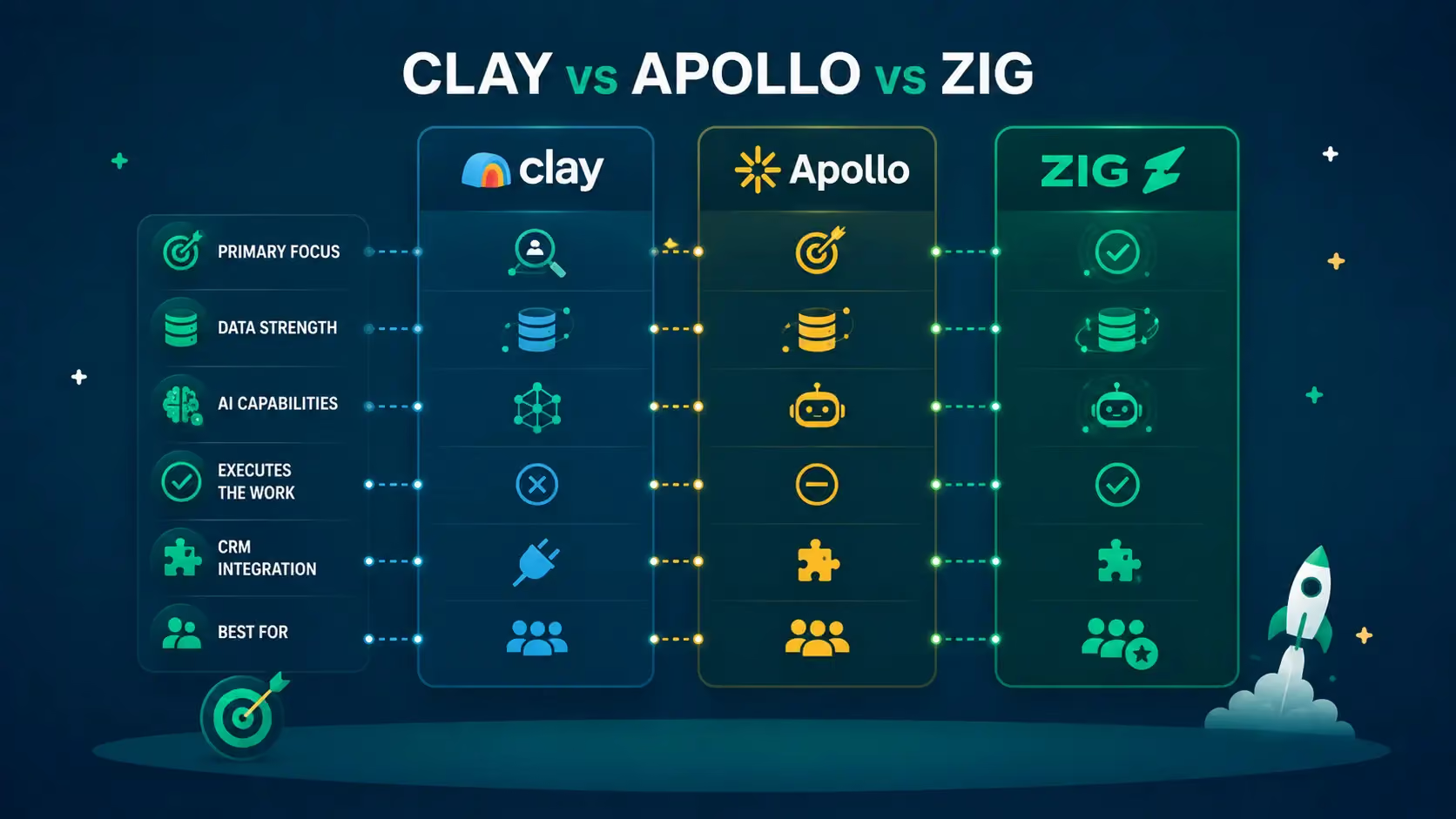
Clay and Apollo often get compared as if they solve the same problem, but they start from different assumptions.
Apollo is closer to an all-in-one sales intelligence and outbound platform. It gives teams a B2B contact database, prospecting, enrichment, and sequencing in one place. Clay is closer to a GTM workflow builder, helping teams orchestrate enrichment across multiple providers, AI research steps, and custom logic. They overlap at the edges, which is why buyers confuse them, but they’re built for different kinds of teams.
Zig sits in a related but separate category: AI sales execution. Instead of helping you find or enrich the lead, Zig helps turn that data into completed sales work, including outreach, CRM updates, follow-ups, meeting prep, and pipeline hygiene. So the useful question isn’t simply “which data tool is better?” It’s whether you need an enrichment workflow tool, a prospecting database with outreach built in, or an execution platform that makes sure enriched data actually turns into sales activity.
This comparison breaks down Clay, Apollo, and Zig across data quality, pricing, CRM enrichment, workflow coverage, integrations, and best-fit use cases.
TLDR
Clay is best for flexible enrichment workflows and data orchestration across multiple providers. Apollo is best for teams that want a built-in B2B contact database, prospecting, enrichment, and outbound sequencing in one tool. Zig is best for AI sales execution after the lead is found, including CRM updates, outreach, meeting prep, follow-ups, and pipeline hygiene.
If your problem is finding and enriching data, compare Clay and Apollo. If your problem is that reps still aren’t acting on the data, look at Zig.
Key Takeaways
- Clay and Apollo overlap in lead enrichment but aren't the same type of tool.
- Apollo positions itself as a sales intelligence platform for lead gen and email outreach, with integrations including Salesforce, HubSpot, Outreach, Salesloft, Marketo, SendGrid, LinkedIn, and email providers.
- Clay uses usage-based pricing, where actions measure platform usage and data credits buy data and AI from its vendor marketplace.
- Clay tends to fit custom enrichment cascades and GTM engineering, while Apollo fits teams that want prospecting data and engagement in one place.
- Zig fits when enrichment is only step one, and the team needs AI agents to handle execution after that.
- The best answer often isn't either-or. Many teams use Apollo as a data source, Clay for orchestration, and Zig for execution.
Clay vs Apollo vs Zig: Quick Comparison
Clay, Apollo, and Zig solve different parts of the sales workflow, so the comparison works best when you separate data, orchestration, and execution. Clay helps teams build enrichment workflows, Apollo gives teams a prospecting database with outbound tools, and Zig helps teams turn lead and deal data into completed sales work.
|
Category |
Clay |
Apollo |
Zig |
|
Core category |
GTM workflow and enrichment orchestration |
Sales intelligence, prospecting, outbound |
AI sales execution platform |
|
Best for |
Custom enrichment workflows |
Prospecting database plus outreach |
Turning sales data into completed execution |
|
Main users |
RevOps, GTM engineers, growth |
SDRs, AEs, sales teams, founders |
Reps, managers, RevOps, leaders |
|
Data approach |
Many providers and enrichment steps |
Built-in database plus enrichment |
Uses data to execute around leads and deals |
|
CRM use case |
Enrich and sync into CRM |
Enrich, export, sync into CRM |
Update CRM and maintain hygiene |
|
Outreach |
Often via integrations |
Built-in sequencing |
Outreach plus follow-through |
|
Pricing model |
Usage-based actions and data credits |
Plans with credits and seats |
Execution-based pricing |
|
Best-fit team |
Ops capacity to build workflows |
Wants fast prospecting and outbound |
Wants less admin, more completed work |
The core difference is simple: Clay and Apollo help teams get and shape data, while Zig focuses on what happens once reps are supposed to act on it.
What Is Clay?
Clay is a GTM workflow and enrichment platform for teams that want more control over how prospect and account data gets built. Instead of giving reps one fixed database and one fixed workflow, Clay lets operators combine providers, AI research steps, formulas, triggers, and integrations into custom enrichment systems.
Best For: Custom enrichment workflows, waterfall enrichment, GTM engineering, RevOps teams with workflow-building capacity, multi-provider validation, AI-assisted account research, and complex outbound personalization. It works best when the team knows the workflow it wants and has someone to build, maintain, and QA it.
Not Ideal When: You want a simple prospecting database out of the box, reps don’t have ops support, nobody wants to manage credits and providers, or the real problem is follow-through after enrichment rather than enrichment itself.
What Is Apollo?
Apollo is a sales intelligence and engagement platform for teams that want prospecting, contact data, enrichment, and outbound in one place. It’s built for speed and usability, which makes it useful when SDRs, AEs, founders, or lean sales teams need to find prospects and start outreach without building a custom enrichment workflow first.
Best For: Contact database access, prospecting, SDR workflows, email outreach, basic enrichment, and teams that want Salesforce or HubSpot sync without building complex workflows. It’s the faster path when setup speed matters more than custom control.
Not Ideal When: You need complex enrichment logic across many providers, want highly customized GTM workflows, need deeper post-meeting execution and CRM updates, or want to keep data strategy separate from outbound execution.
What Is Zig?
Zig is an AI sales execution platform for B2B teams that already have lead, account, or deal data but need more of the work around that data to get done. While Clay and Apollo help teams find, enrich, and activate prospect data, Zig focuses on the execution layer: CRM updates, follow-ups, meeting prep, outreach, lead generation support, and pipeline hygiene.
Best For: AI sales execution, CRM update automation, follow-up automation, meeting prep, lead generation paired with execution, and pipeline hygiene. It’s built for reps who hate admin, mid-market B2B teams, and revenue teams that want enriched data to turn into completed sales activity.
Not Ideal When: You only need a static contact database, the team only wants enrichment credits, the team isn’t ready to let AI handle execution, or the need is purely a spreadsheet-style enrichment builder.
Clay vs Apollo: What's the Real Difference?
Clay and Apollo both support B2B lead generation, but they start from different assumptions. Apollo assumes the team wants a searchable B2B database, enrichment, CRM sync, and outbound workflows in one platform. Clay assumes the team wants to build a more customized GTM workflow using multiple data providers, AI research, enrichment logic, CRM actions, and integrations.
Apollo is usually faster out of the box because reps can search for prospects, enrich records, add contacts to sequences, and sync with the CRM from one system. Clay gives operators more control because they can build enrichment waterfalls, call different providers, use AI research, enrich CRM data, and route outputs into other tools.
Zig is different again. It doesn’t compete as a traditional contact database or enrichment builder. It enters after lead or account data exists and focuses on whether the sales work actually gets done: outreach, follow-ups, CRM updates, meeting prep, and pipeline hygiene.
Clay vs Apollo Pricing Comparison
Pricing is where the category split becomes clearest. Clay prices around workflow usage and data access. Apollo prices around plans, seats, credits, and exports. Zig prices around sales execution workload.
As of June 2026, Clay’s pricing page shows a Free plan, a Launch plan starting at $185 per month, a Growth plan starting at $495 per month, and custom Enterprise pricing. Clay separates Actions from Data Credits: Actions measure platform work like enrichments, AI runs, CRM syncs, exports, and GTM execution, while Data Credits buy data and AI from Clay’s marketplace.
Apollo’s pricing page shows a Free plan with 900 credits per seat per year, Basic at $49 per seat per month billed annually with 30,000 credits per seat per year, Professional at $79 per seat per month billed annually with 48,000 credits per seat per year, and Organization at $119 per seat per month billed annually with a three-seat minimum and 72,000 credits per seat per year. Apollo also uses export credits when contacts leave Apollo through CSV, CRM sync, API enrichment, or other external systems.
Zig’s pricing works differently. Its Pay-as-you-go option starts at $0.25 per execution with 100 executions included. Its Growth plan is listed at $2,250 per month with 300 monthly executions, while Enterprise pricing is scoped with sales. Zig also describes pricing as a flat Platform Fee plus an Execution Charge, so the model is tied to the workload Zig absorbs rather than simply to seats, tokens, or feature access.
|
Pricing Question |
Clay |
Apollo |
Zig |
|
What Do You Mainly Pay For? |
Actions, Data Credits, and plan tier |
Seats, plans, credits, and exports |
Platform coverage and execution workload |
|
Main Cost Risk |
Multi-step workflows can use Actions and Data Credits quickly |
Credits and exports can cap prospecting or CRM sync workflows |
The team needs a clear definition of what an execution is worth |
|
Public Entry Point |
Free plan, then Launch starting at $185/month |
Free plan, then Basic at $49/seat/month billed annually |
Pay-as-you-go at $0.25/execution |
|
Scaling Factor |
Workflow complexity, enrichment volume, AI usage, CRM syncs, exports |
Seat count, credit usage, export credits, plan tier |
Execution volume, integrations, workflow scope, team complexity |
|
Best fit |
Teams that understand enrichment economics and want workflow control |
Teams that want predictable prospecting, enrichment, and outbound packages |
Teams that want sales admin and follow-through tied to executed work |
Clay and Apollo compete mostly on data economics, while Zig competes on execution economics. The cheaper option depends on whether your expensive problem is finding data, orchestrating data, or getting reps out of the manual work that happens after the data exists.
Clay vs Apollo Data Quality: Which Is Better?
There’s no universal winner on data quality because B2B contact accuracy depends on your market, region, persona, company size, job function, data type, and refresh needs. Apollo is useful when your team wants one searchable database that reps can use for prospecting, enrichment, outbound, and CRM sync. It’s especially practical when speed matters more than custom orchestration.
Clay can be stronger when the team wants to combine providers, validate records through enrichment waterfalls, use AI research, or customize enrichment around a specific ICP. Instead of relying on one database, Clay lets operators pull from many data providers and build rules around how records get enriched, verified, scored, and routed.
Zig doesn’t belong in that data-quality head-to-head as a traditional provider. Its point is that better data only matters if the team acts on it. Once the lead exists, Zig focuses on turning that data into sales activity: CRM updates, outreach, prep, follow-ups, and pipeline movement.
Clay vs Apollo vs ZoomInfo: Which Wins on Accuracy?
Accuracy depends on the segment you sell into and the type of data you need. ZoomInfo is usually evaluated as an enterprise-grade sales intelligence database. Apollo is usually evaluated as a more accessible sales intelligence and outbound platform. Clay is an orchestration layer that can combine data sources, including external providers, AI research, CRM inputs, and enrichment workflows.
Choose ZoomInfo when enterprise-grade database coverage is the priority and the budget supports it. Choose Apollo when you want prospecting, enrichment, and outreach in one platform. Choose Clay when you want to combine providers and build custom enrichment logic.
Choose Zig when accuracy is only one part of a larger execution problem. If the team already has contact or account data but reps aren’t following up, updating the CRM, preparing meetings, or keeping pipeline clean, the missing layer isn’t another database. It’s execution.
Clay vs Apollo for CRM Enrichment
Clay and Apollo overlap most clearly in CRM enrichment, but they handle it differently. Clay is the control-heavy option for RevOps teams that want to import CRM records, enrich them through custom logic, validate fields across providers, and push cleaner data back into systems like HubSpot or Salesforce. It fits teams that care about field mapping, waterfall enrichment, multi-source validation, and workflow design.
Apollo is the simpler option for teams that want built-in prospecting data, enrichment, and CRM sync without building complex workflows first. Its HubSpot CRM integration can push and pull contacts, accounts, and deals, while also pushing activities like emails, calls, meetings, tasks, and notes. Its Salesforce integration can pull leads, contacts, accounts, and opportunities into Apollo and push contacts, leads, accounts, deals, and activities back into Salesforce depending on sync settings.
Zig handles a different part of the CRM problem. Clay and Apollo help enrich CRM data before or around prospecting. Zig helps keep CRM data accurate after sales activity happens by updating records, capturing next steps, reducing manual rep updates, and keeping the CRM aligned with the actual work.
Enrichment fills the record at the start. Execution keeps it true as the deal moves.
Clay vs Apollo for HubSpot and Salesforce
Both Clay and Apollo support HubSpot and Salesforce, but they usually serve different users inside those CRM ecosystems. Apollo is often better for sales teams that want prospecting, enrichment, activity sync, and outbound workflows connected to HubSpot or Salesforce quickly. It’s built for reps and sales teams that want to find contacts, move them into sequences, sync records, and keep prospecting workflows close to the CRM.
Clay is usually better for RevOps or GTM engineering teams that want more control before data reaches the CRM or gets updated inside it. Clay supports CRM enrichment workflows with HubSpot and Salesforce, including importing CRM records, enriching them, and creating or updating records with cleaner data. That makes it stronger when the team cares about enrichment rules, field mapping, provider logic, and data governance.
Zig connects for a different reason. Rather than focusing only on enrichment before outreach, it supports execution inside or around the CRM. That means updates after calls, follow-up capture, pipeline hygiene, less manual admin, and cleaner deal context after sales activity happens.
Clay vs Apollo for Outbound Sales
Outbound is where the category split is easiest to see. Apollo is strongest when the team wants a prospecting database, enrichment, sequencing, and CRM sync in one place. Clay is strongest when the team wants custom research, multi-provider enrichment, segmentation, and personalized outbound workflows before the sequence starts. Zig is strongest when the team needs execution and follow-through after the lead is found or the prospect engages.
Use the comparison this way:
Choose Apollo For Faster Setup: You want a contact database, list building, email sequences, outreach workflows, and CRM sync working quickly.
Choose Clay For Custom Workflows: You want multi-provider enrichment, AI account research, custom segmentation, conditional logic, and room to experiment with different GTM motions.
Choose Zig For Execution Plus Follow-Through: You want outreach, CRM updates, meeting prep, follow-ups, lead generation support, and pipeline hygiene handled as part of the sales motion.
Apollo and Clay help build or activate the outbound list. Zig helps make sure the work that follows actually gets done.
Which Is More Cost-Effective: Clay or Apollo?
Cost-effectiveness depends on the workflow, not just the monthly price. Apollo may be more cost-effective when you want a simple sales intelligence and outbound platform with a built-in database, credits, sequencing, and CRM sync. It’s easier to justify when reps will live inside the tool and use the database directly.
Clay may be more cost-effective when custom workflows improve match rates, reduce manual research, or let RevOps avoid stitching together several disconnected enrichment tools. However, Clay’s cost depends on Actions, Data Credits, AI usage, provider choices, CRM syncs, exports, and workflow complexity, so teams need to understand usage before they scale.
Zig changes the frame because it becomes cost-effective when the expensive problem isn’t data access. It’s rep time. If your team is losing hours to CRM updates, follow-ups, meeting prep, pipeline cleanup, and tool switching, the comparison moves from data economics to execution economics.
Clay and Apollo help you spend better on data. Zig helps you spend less human time turning that data into sales work.
Best Lead Enrichment Tool in 2026: Clay, Apollo, or Zig?
If you only need lead enrichment, the choice is mainly Clay versus Apollo. Clay is better for custom workflows, multi-source validation, CRM enrichment, and GTM engineering. Apollo is better for teams that want built-in contact data, prospecting, enrichment, and outbound sequencing in one platform.
Zig isn’t a traditional lead enrichment tool, so it shouldn’t be judged as one. It becomes relevant when enrichment is only step one and the real goal is execution after the lead is found. If reps still need to run outreach, update the CRM, prep for meetings, follow up, and keep pipeline clean, Zig is solving the next problem in the workflow.
Best enrichment tool and best sales execution platform are different questions. Clay and Apollo answer the first. Zig answers the second.
When Should You Use Clay and Apollo Together?
Clay and Apollo don’t have to be an either-or decision. Many GTM teams can use Apollo as a contact data and prospecting source, then use Clay as the workflow layer that enriches, validates, scores, and routes leads. That setup works well when RevOps wants Clay’s flexibility but still wants Apollo’s database inside the workflow.
The trade-off is operational ownership. A Clay plus Apollo stack can support strong enrichment and outbound workflows, but someone still has to manage credits, maintain provider logic, QA the workflow, monitor CRM syncs, and make sure the sales team acts on the output.
That last gap is where Zig fits. Even a strong data stack can leave reps responsible for follow-up, CRM hygiene, meeting prep, and deal execution. If the stack produces better leads but the work still slows down after that, you don’t only need better data. You need an execution layer.
When Should You Choose Zig Instead of Clay or Apollo?
Choose Zig when the problem is execution rather than data. That usually means leads are being found, enriched, and routed, but reps still aren’t acting fast enough, CRM data goes stale after calls, follow-ups lag behind, and leaders don’t have clean visibility into whether the sales work is getting done.
That usually shows up as one or more of these signals:
- Leads are being found, but reps aren’t acting on them fast enough.
- CRM data goes stale after calls, and follow-ups lag behind.
- Leaders lack clean execution visibility, while reps spend too much time on admin.
- You want AI agents handling lead gen, outreach, meeting prep, follow-through, and CRM updates.
- You’d rather tie spend to execution workload than only pay for seats, credits, or usage.
- You already have data tools, but the work after enrichment still depends on reps doing everything manually.
The deciding factor is simple. If your problem is finding and shaping data, Clay or Apollo should be on the shortlist. If your problem is that the data sits there while reps fall behind on the work around it, Zig is the platform to evaluate.
See how Zig turns prospecting and enrichment into completed execution.
Final Verdict: Clay vs Apollo vs Zig
There’s no universal winner because Clay, Apollo, and Zig solve different parts of the sales workflow. Apollo is the best fit when you want a contact database, prospecting, enrichment, outbound sequencing, and CRM sync in one platform. Clay is the best fit when you want custom enrichment workflows, multi-provider orchestration, AI research, and more control over how leads get built and routed. Zig is the best fit when enriched leads need to turn into completed execution: outreach, CRM updates, follow-ups, meeting prep, and pipeline hygiene.
For many teams, the practical answer isn’t one tool. It’s a division of labor: Apollo for data, Clay for orchestration, and Zig for execution.
If you already have the data and the gap is the work that happens next, book a demo to see how Zig handles follow-up, CRM updates, prep, and pipeline movement.
Frequently Asked Questions
Clay Vs Apollo: Which Is Better For B2B Lead Enrichment In 2026?
Clay is better for custom enrichment workflows, waterfall enrichment, multi-provider validation, CRM enrichment, and GTM engineering. Apollo is better for teams that want a built-in B2B contact database, basic enrichment, prospecting, outbound sequences, and CRM sync in one platform.
What’s The Difference Between Clay And Apollo?
Clay is a GTM workflow and enrichment orchestration platform, while Apollo is a sales intelligence and outreach platform with a built-in contact database. Clay gives RevOps and GTM teams more control over enrichment logic, while Apollo gives reps and sales teams a faster way to find prospects, enrich contacts, and start outbound.
How Does Zig Compare To Clay And Apollo?
Zig isn’t another enrichment database. Clay helps teams orchestrate and enrich lead data, while Apollo helps teams find prospects and run outbound workflows. Zig executes the work after lead generation, including outreach, CRM updates, meeting prep, follow-ups, and pipeline hygiene.
Which Has Better Data Quality, Clay Or Apollo?
It depends on your market, ICP, region, persona, and workflow. Apollo gives teams one built-in database for prospecting, enrichment, and outbound. Clay can combine multiple providers, AI research, and enrichment steps, which may improve coverage or validation when the workflow is built well.
Which Is More Cost-Effective, Clay Or Apollo?
Apollo may be more cost-effective when you want prospecting, enrichment, outbound, and CRM sync in one simpler platform. Clay may be more cost-effective when custom workflows improve data quality, reduce manual research, or replace several disconnected enrichment tools. The right answer depends on workflow complexity, data volume, credit usage, and who will manage the system.
How Do Clay And Apollo Handle CRM Enrichment Differently?
Apollo enriches and syncs data from its built-in database into CRMs like Salesforce and HubSpot, while Clay gives RevOps teams more control over enrichment logic before or during CRM updates. Zig is different again because it helps update and maintain CRM records after sales interactions, rather than only enriching records before outreach.
Clay Vs Apollo Vs ZoomInfo: Which Wins On Accuracy?
ZoomInfo is usually evaluated for enterprise-grade database coverage, Apollo for accessible prospecting and outbound, and Clay for combining multiple providers through custom enrichment workflows. Accuracy depends on region, persona, data type, refresh needs, and how the workflow is configured.
Which Works Better With HubSpot And Salesforce, Clay Or Apollo?
Apollo is often easier for teams that want direct prospecting, enrichment, outbound, and CRM sync with HubSpot or Salesforce. Clay is better for RevOps teams that want custom enrichment, field mapping, waterfall logic, and multi-source validation before updating CRM records. Zig fits when the team needs CRM updates and sales follow-through after the activity happens.
