
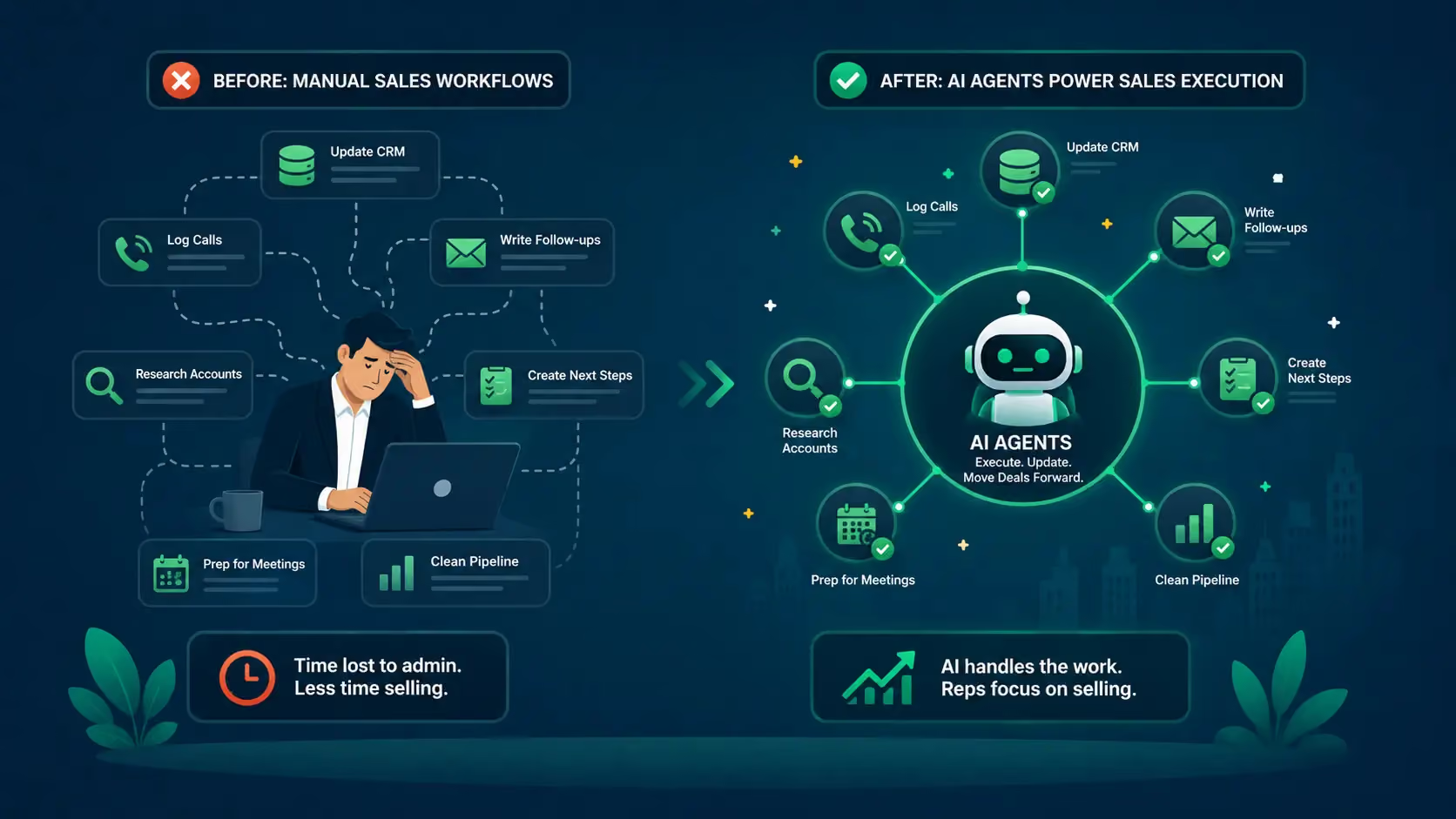
Most sales teams don’t fail because the strategy is wrong. They fail because the strategy depends on reps doing too much manual work every day.
The ICP is clear, the messaging is approved, the stages are mapped, and the forecast process looks good on paper. But then follow-ups slip, CRM updates happen late, meeting prep gets rushed, next steps go missing, and managers spend the week chasing context instead of coaching deals forward. The strategy exists, but the daily execution doesn’t hold.
That’s the gap a sales execution strategy is meant to close. It turns the plan into repeatable workflows, clear ownership, consistent follow-through, and systems that make the right action easier to complete. In 2026, AI agents are becoming a bigger part of that motion because they can take on the repeatable work around selling, including research, enrichment, outreach, scheduling, follow-ups, CRM updates, meeting prep, and pipeline hygiene.
This article breaks down what a sales execution strategy is, how it differs from sales strategy, where manual workflows break down, and how AI agents fit into the modern execution layer.
TLDR
A sales execution strategy turns sales goals into daily actions, workflows, ownership, systems, and metrics. While sales strategy defines what you’re trying to achieve and where you’ll compete, sales execution strategy defines how the team consistently does the work to get there.
AI agents are changing that model by replacing manual workflows that usually fall to reps, including CRM updates, lead research, follow-up drafting, scheduling, meeting prep, and pipeline hygiene. Zig fits this shift as an AI sales execution platform for mid-market B2B teams that want agents to execute work across existing tools instead of adding more admin to the stack.
Key Takeaways
- Sales strategy defines the market, ICP, positioning, targets, and motion. Sales execution strategy defines the daily workflows that translate pipeline into revenue.
- A sales execution strategy should cover workflows, roles, systems, enablement, metrics, inspection points, and automation rules.
- AI sales agents differ from older automation because they execute multi-step workflows, adapt within a session, and operate across GTM tasks rather than triggering one fixed action.
- In 2026, AI sales agents are increasingly used for prospecting, qualification, follow-ups, CRM updates, scheduling, and account research.
- The best execution strategy doesn't add more manual tools. It removes manual work from the system.
- We fit teams that want AI agents to handle real workflows, not just generate recommendations.
What Is a Sales Execution Strategy?
A sales execution strategy is the operating plan that turns revenue goals into daily action. It defines which workflows matter, who owns them, which tools support them, what reps need to do, what AI can handle, and how managers inspect whether the work is actually happening.
In simple terms, it’s the bridge between “here’s the plan” and “here’s how the work gets done every day.” Sales strategy points the team toward the market, ICP, positioning, and targets. Sales execution strategy makes sure prospecting, outreach, meeting prep, CRM updates, follow-ups, deal progression, pipeline hygiene, and coaching happen consistently enough to support those goals.
Sales Strategy vs Sales Execution: What's the Difference?
Sales strategy and sales execution get mixed together, but they answer different questions. Sales strategy defines where the company will win, while sales execution defines how the team will do the work consistently enough to win there.
|
Category |
Sales Strategy |
Sales Execution Strategy |
|
Main question |
Where will we win? |
How will we do the work consistently? |
|
Focus |
Market, ICP, positioning, targets, channels |
Workflows, responsibilities, tools, metrics, inspection |
|
Time horizon |
Quarterly, annual, long-term |
Daily, weekly, monthly |
|
Example |
Target mid-market SaaS in North America |
Reps get daily account lists, AI preps research, follow-ups go out within two hours, CRM updates after every call |
|
Owner |
CRO, VP Sales, founders, RevOps |
Sales leaders, RevOps, managers, enablement, reps |
|
Failure mode |
Wrong market or motion |
Good plan, poor follow-through |
A sales strategy can be right and still fail if the execution layer underneath it is weak. Strategy sets the direction, while execution turns that direction into daily workflows, ownership, inspection, and behavior.
Why Good Sales Strategies Fail During Execution
Good sales strategies usually fail for operational reasons, not because the whole plan was wrong. Reps interpret the process differently, managers inspect inconsistently, CRM fields go stale, follow-ups happen late, and playbooks sit in documents instead of showing up inside daily workflows.
The common thread is simple: the strategy breaks between the playbook and the rep’s calendar. A strong sales execution strategy closes that gap by making the right work easier to complete, track, and improve.
Why Sales Execution Strategies Are Changing in 2026
Sales execution used to depend on process docs, manager reminders, and rep discipline. That’s no longer enough because the average sales motion now runs across too many systems for humans to coordinate every handoff by hand.
Most teams already have a CRM, email, calendar, Slack, call recording, enrichment, outreach, forecasting, notes, dashboards, and spreadsheets. The issue isn’t a lack of software. It’s that reps still connect that software manually, which means follow-ups wait, CRM updates slip, meeting prep gets skipped, deal notes lose context, and RevOps often sees the damage after the deal has already drifted.
That’s why AI agents are becoming part of the execution layer. Instead of acting like another tool reps have to manage, the right agents take on repeatable workflows such as lead research, CRM updates, meeting prep, follow-ups, scheduling, and pipeline hygiene. That shift matters most for mid-market teams because they have real pipeline complexity, but usually not enough RevOps capacity to enforce every workflow by hand.
Key Elements Of A Modern Sales Execution Strategy
A modern sales execution strategy isn’t one document or a slide in the sales kickoff deck. It’s the operating system behind the sales motion: the workflows reps follow, the owners who inspect them, the tools that support them, the AI agents that take work off the team, and the metrics that show whether execution is improving.
The goal is to remove ambiguity. When ICP, ownership, stages, CRM rules, follow-up standards, and inspection rhythms are unclear, reps fill in the gaps differently. That’s when strategy turns into inconsistent daily behavior instead of repeatable sales execution.
Clear ICP And Segmentation
Define the ICP, account tiers, personas, territory rules, and the balance between expansion and new-logo sales. Without clear segmentation, reps spread effort evenly across accounts that deserve very different levels of attention.
Workflow Ownership
Every workflow needs an owner. SDRs may own first-touch and qualification, AEs may own discovery and deal progression, managers may own inspection and coaching, RevOps may own systems and data, and AI agents may own repeatable admin or research. Leadership still owns the standard, because execution breaks when ownership is implied rather than assigned.
Standardized Stages And Exit Criteria
Each pipeline stage needs required buyer evidence, CRM fields, a next step, stakeholder coverage, a follow-up action, and risk signals. Stage definitions keep the pipeline readable, while exit criteria keep it honest.
AI-Assisted Workflow Design
For each workflow, decide what a human must decide, what AI can prepare, what AI can execute, what needs approval, what gets written back to the CRM, and what should trigger a manager alert. AI works best when it has a defined role instead of being dropped into a vague process.
CRM Hygiene Rules
Spell out what gets updated and when. Every meeting should have a summary, every opportunity should have a next step, every late-stage deal should have a close plan, close-date changes should have a reason, and follow-ups should go out within a clear SLA. The CRM stays useful only when the rules are specific enough to enforce.
Follow-Up Standards
Define timing, structure, ownership, personalization, approval rules, task creation, and escalation for high-value accounts. Follow-up is high-leverage, but it gets dropped when the team treats it as a preference rather than a workflow.
Meeting Prep System
Reps shouldn’t have to search five tools before a call. A strong meeting prep system gives them account context, deal status, recent activity, open objections, stakeholders, competitor mentions, relevant closed-won examples, suggested questions, and a recommended next step.
Pipeline Inspection Cadence
Define weekly pipeline review, stale deal review, forecast review, call review, follow-up SLA review, and stage conversion review. Inspection should be a system, not a quarter-end scramble.
Tool Consolidation Plan
Identify which tools to keep, which to replace, which workflows to consolidate, which manual processes to remove, and which agents to deploy. The goal is leverage, not more logos.
Metrics And Feedback Loop
Use closed-won, closed-lost, cycle length, follow-up speed, meeting conversion, CRM completeness, rep time allocation, and AI-assisted workflow metrics to refine execution over time. The strategy should improve as the team learns where deals move, where work gets stuck, and where automation actually saves time.
How AI Agents Replace Manual Sales Workflows
The easiest way to understand AI agents in sales is to compare the manual workflow with the agent-supported version. The pattern is consistent: agents take on the repeatable work, while reps keep the judgment, relationship, and deal strategy.
|
Workflow |
Manual Process |
AI-Agent Process |
|
Lead research |
Rep searches LinkedIn, the site, the CRM, notes |
Agent researches the account, enriches data, summarizes buying context, suggests outreach |
|
Outreach prep |
Rep writes from scratch or edits templates |
Agent drafts personalized messaging from account context and history |
|
Meeting prep |
Rep scans CRM, emails, notes before the call |
Agent generates a two-minute brief with history, stakeholders, objections, questions |
|
Call summaries |
Rep writes notes after, tries to remember |
Agent summarizes the call, captures risks, prepares follow-up |
|
CRM updates |
Rep updates stage, notes, close date, tasks, usually late |
Agent writes structured updates back, with human approval where needed |
|
Follow-ups |
Rep writes recaps when time allows |
Agent drafts or triggers follow-ups while context is fresh |
|
Scheduling |
Rep sends availability, chases responses |
Agent coordinates timing, creates the meeting, updates task history |
|
Pipeline hygiene |
Manager asks reps to clean stale deals |
Agent flags missing next steps, stale opportunities, close-date pushes, declining engagement |
What's the Role of AI Agents in Sales Execution?
AI agents are best understood as execution workers, not just assistants, and the difference is more than semantic. An assistant helps a person complete a task. An agent owns a defined workflow and completes the steps toward an outcome. An AI sales execution platform coordinates agents across workflows, tools, channels, and the CRM. What separates modern agents from older tools is that they execute multi-step workflows and adapt within a session, instead of following a rigid one-step automation.
The line between the two is what makes a strategy work. Humans should stay involved wherever judgment and trust carry the deal, such as:
- Strategic account decisions, negotiation, and relationship building.
- Complex discovery and high-risk account communication.
- Pricing decisions, legal and procurement nuance, and final approval for sensitive external messages.
Agents, on the other hand, should take over the work that's repeatable, high-volume, and measurable, which makes it a poor use of a seller's time:
- Research, data entry, and CRM cleanup.
- Meeting prep, first-pass call summaries, and similar-deal retrieval.
- Follow-up drafting, task creation, reminders, and routine pipeline hygiene.
How Zig Supports a Modern Sales Execution Strategy
Zig supports a modern sales execution strategy by taking on the admin and follow-through work that usually falls between reps, managers, RevOps, and the CRM. Instead of asking reps to carry every workflow by hand, Zig acts as an execution layer for sales work such as CRM updates, follow-ups, meeting prep, outreach, lead generation, and pipeline hygiene.
The clearest way to see the fit is to map each manual workflow to the execution work Zig supports.
|
Manual Workflow |
What Zig Does |
|
Rep researches account before a call |
We prepare the meeting context |
|
Rep writes post-call notes |
We create the summary and next-step context |
|
Rep updates the CRM manually |
We update the records |
|
Rep drafts the follow-up |
We run the follow-through |
|
Manager chases stale deals |
We support pipeline hygiene |
|
RevOps cleans activity data |
We improve CRM completeness |
|
Rep searches for similar examples |
We surface similar deals |
Zig targets the workflows where strategy usually leaks. Rather than forcing teams to run separate tools for notes, research, outreach, and CRM updates, it gives revenue teams one execution layer that helps coordinate the work around the sales motion.
That makes it especially relevant for mid-market B2B teams dealing with CRM hygiene issues, heavy rep admin, slow follow-up, and tool sprawl. It’s also a fit for teams that want to replace manual workflows with AI agents without turning the CRM into the rep’s second job.
See how Zig runs sales execution as one platform.
How to Build a Sales Execution Strategy Without Bloating Your Tech Stack
Building a sales execution strategy doesn’t have to mean buying more software. In many cases, it should mean removing duplicate tools, naming the manual work, and deciding which workflows should be owned by people, systems, or AI agents.
Start by auditing the work reps still do by hand: research, enrichment, outreach drafting, meeting prep, call notes, CRM updates, follow-ups, scheduling, pipeline cleanup, and forecast inputs. You can’t remove or automate a workflow until you’ve named it. Then assign ownership for each one, including the human owner, AI owner, approval owner, system of record, and success metric.
Next, remove the overlap that adds handoffs without adding capability. That might mean a call recorder sitting next to a separate notetaker, CRM automation sitting next to a RevOps spreadsheet, or an outreach tool layered over manual follow-up templates.
Keep the CRM as the system of record, not the place reps spend their whole day. Deploy agents by workflow rather than novelty, starting where the work is repetitive, high-volume, time-sensitive, and measurable. Post-call CRM updates, follow-up drafting, meeting prep, and stale deal detection are usually strong starting points.
Set approval rules before expanding. Internal CRM updates may be safe to run automatically, while external emails to enterprise prospects may need review. Then measure execution quality on a few workflows before widening the agent footprint, because proving value first makes expansion easier to trust.
Metrics to Track in a Sales Execution Strategy
Metrics tell you whether execution is improving rather than just getting busier, and the right ones fall into four areas:
- Activity and workflow metrics show whether the daily work is happening on time, such as follow-up speed, prep completion, CRM update completion, time to next step, stale deal count, overdue tasks, and rep admin time.
- Pipeline metrics show whether that work is translating into a healthy pipeline, including stage conversion, stage aging, close-date push rate, slippage, coverage, hygiene score, forecast accuracy, win rate, and cycle length.
- AI execution metrics show whether the agents are pulling their weight, like follow-ups accepted, briefs used, CRM updates completed by AI, approval rate, correction rate, override rate, and admin hours saved.
- Rep experience metrics show whether the strategy is actually giving reps their selling time back rather than just relocating the burden, such as time spent selling versus on admin, adoption rate, manager chase-down frequency, and tools per workflow.
Common Sales Execution Strategy Mistakes
Even strong sales strategies can fail when the execution system underneath them is unclear. The problem usually isn’t that the team lacks effort. It’s that the workflows, tools, ownership, metrics, or AI guardrails don’t make the right behavior easy to repeat.
These are the mistakes to catch early, because each one creates drag between the strategy on paper and the work reps actually complete.
Confusing More Tools With Better Execution
More tools don’t automatically create better execution. They often create more tabs, more handoffs, more duplicate data, and more places for work to get stuck. Before adding another platform, identify whether the problem is missing capability or poor workflow design.
Automating Broken Workflows
AI won’t fix a workflow that’s already unclear. If the process has no owner, no trigger, no approval rule, and no clear success metric, automation will only move the confusion faster. Fix the workflow first, then decide which parts AI should prepare, execute, or escalate.
Measuring Activity Instead Of Outcomes
Emails sent, calls made, and tasks completed can show effort, but they don’t prove execution quality. Real execution shows up in next-step creation, deal movement, follow-up speed, CRM accuracy, forecast reliability, and pipeline health. Track whether the work is moving revenue forward, not just whether reps are staying busy.
Leaving AI Without Boundaries
AI agents need clear ownership, permissions, approval rules, and escalation paths. Internal updates may be safe to automate, while external messages, pricing language, legal nuance, and sensitive account communication may need human review. Without boundaries, autonomy becomes a risk instead of leverage.
Making Reps Inspect The System Instead Of Sell
AI and automation should reduce rep admin, not create another layer reps have to manage. If sellers spend more time checking outputs, cleaning up fields, and monitoring workflows than selling, the execution strategy has moved the burden instead of removing it.
Example Sales Execution Strategy for a Mid-Market B2B Team
A mid-market sales execution strategy should be specific enough to run, not just broad enough to sound right. The goal might be to improve pipeline hygiene, cut admin time, and speed up follow-up without adding more tools. From there, the team can define the workflows, owners, rules, and metrics that make execution measurable.
The target workflows could include meeting prep, post-call CRM updates, follow-up drafting, stale deal detection, lead research, and scheduling. The AE owns the relationship and deal judgment, the SDR owns first-touch and qualification, the manager owns coaching and escalation, RevOps owns CRM rules and data quality, and AI agents own repetitive prep, updates, follow-up, and hygiene work.
The operating rules should be equally clear: every meeting gets a summary, every opportunity has a next step, every follow-up draft is created within 15 minutes, every late-stage deal has a clear buyer action, every close-date push has a reason, and every stale deal triggers a recommended action.
The metrics should show whether the system is working: follow-up SLA, CRM completeness, next-step coverage, stale deal count, stage aging, forecast accuracy, rep admin time, and AI update acceptance rate.
Why Zig Is the Sales Execution Strategy Layer for AI-Driven Teams
Sales execution strategy used to mean process docs, manager reminders, CRM rules, and rep discipline. That still matters, but it isn’t enough for teams dealing with complex motions, too many tools, and constant admin drag. The work has outgrown what manual discipline can reliably sustain.
AI-driven teams need a cleaner split. Humans should own judgment, relationships, negotiation, and strategy, while agents own the repeatable work that slows reps down: research, prep, follow-up, scheduling, CRM updates, and pipeline hygiene. The CRM should stay clean without becoming the rep’s second job.
That’s the sales execution strategy Zig is built to support. It helps mid-market teams cut admin, keep pipeline moving, and turn the plan into work that actually gets done.
To see it in practice, book a demo to see how Zig helps mid-market teams cut admin and keep pipeline moving.
Frequently Asked Questions
What Is A Sales Execution Strategy?
A sales execution strategy is the operating plan that turns sales goals into daily work. It defines the workflows, responsibilities, systems, and metrics reps, managers, RevOps, and AI agents use to create pipeline, move deals forward, and hit revenue targets.
How Is Sales Execution Different From Sales Strategy?
Sales strategy defines where the company will compete, which customers it will target, and how it plans to win revenue. Sales execution defines how the team turns that plan into daily action, while keeping follow-ups, CRM updates, meeting prep, pipeline hygiene, and deal movement consistent.
How Is AI Changing Sales Execution Strategies?
AI is changing sales execution because it can take on repeatable workflows that used to depend on rep discipline alone. Instead of asking reps to manually research accounts, prep for meetings, draft follow-ups, update the CRM, schedule next steps, and clean pipelines, teams can use AI agents to complete more of that work in the background.
How Do AI Agents Replace Manual Sales Workflows?
AI agents replace manual sales workflows by taking over repetitive, high-volume tasks that require context but not constant human judgment. That includes researching accounts, generating meeting briefs, summarizing calls, updating CRM records, drafting follow-ups, scheduling next steps, and flagging stale deals.
What Are The Key Elements Of A Modern Sales Execution Strategy?
A modern sales execution strategy needs ICP clarity, workflow ownership, clear stage definitions, CRM hygiene rules, follow-up standards, meeting prep systems, pipeline inspection, tool consolidation, AI-assisted workflows, and performance metrics. The goal isn’t just to define the process. It’s to make sure the work actually gets done.
What Metrics Should You Track In A Sales Execution Strategy?
Track the metrics that show whether the team is executing, not just whether the pipeline exists. That includes follow-up speed, CRM update completion, meeting prep completion, stale deals, opportunities without next steps, close-date pushes, stage aging, forecast accuracy, win rate, rep admin time, AI update acceptance rate, and revenue influenced by AI-assisted workflows.
How Can AI Improve Sales Execution At Mid-Market Companies?
AI can improve sales execution at mid-market companies by reducing rep admin, speeding up meeting prep, improving CRM hygiene, accelerating follow-ups, detecting stale deals, and automating repeatable workflows. That matters because mid-market teams often have real sales complexity without enough RevOps headcount to enforce every process by hand.
What’s The Role Of AI Agents In Sales Execution?
AI agents act as workflow owners for repeatable sales tasks. They can research accounts, prep reps, draft follow-ups, update CRM records, schedule next steps, and flag deal risks, while humans stay focused on judgment, relationships, negotiation, and strategy.
How Do You Build A Sales Execution Strategy Without Bloating Your Tech Stack?
Start by auditing the manual workflows that slow reps down, then assign ownership, remove duplicate tools, keep the CRM as the system of record, and deploy AI agents by workflow rather than adding software randomly. From there, set approval rules and measure execution quality before expanding the stack.
