
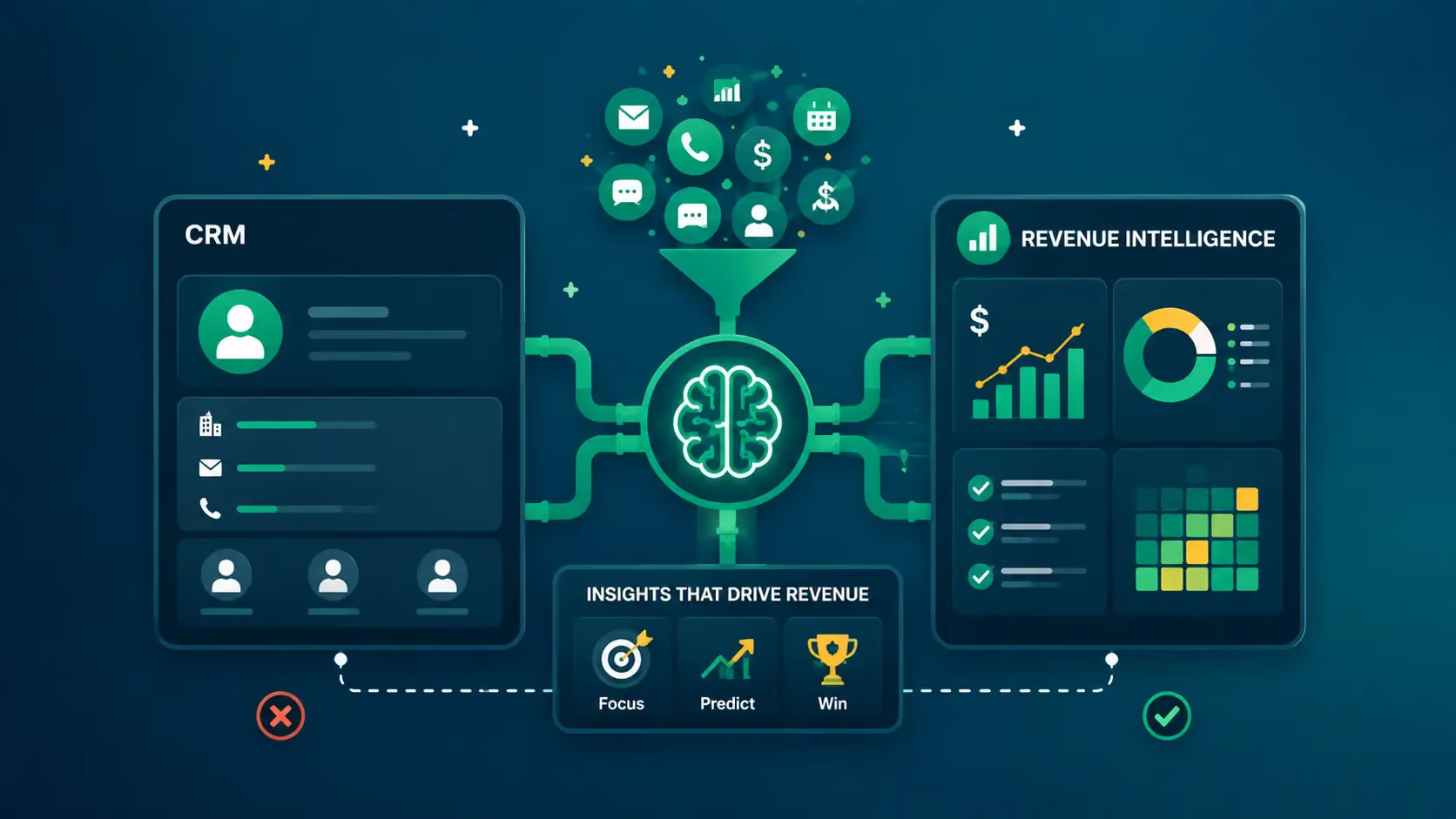
Most sales teams already have a CRM, but they still miss forecasts, lose track of deal risk, discover slippage too late, and rely on reps to manually enter the truth. CRM data is often incomplete, delayed, or optimistic. That is not a CRM failure. It is a design limitation. CRMs store what reps remember to enter. They do not capture what actually happened.
Revenue intelligence solves part of that problem by analyzing signals from calls, emails, meetings, CRM records, and buyer activity to help teams understand deal health, forecast risk, and next steps. But the category is evolving again. The next frontier is not just knowing what is happening. It is using AI to act on those insights before deals slip.
TLDR:
Revenue intelligence is the use of AI to capture, analyze, and interpret sales activity, buyer engagement, conversations, and pipeline data so revenue teams can understand deal health, improve forecast accuracy, and reduce deal slippage. CRM is the system of record. It stores contacts, opportunities, activities, and pipeline data. The intelligence layer analyzes what is happening across the revenue motion and recommends what to do next. It does not replace CRM for most teams, but it sits above or beside it. Zig extends this idea by combining sales intelligence with execution, helping teams act on revenue signals through CRM updates, follow-ups, meeting prep, outreach, lead generation, and pipeline hygiene.
Key takeaways
- Revenue intelligence helps teams understand deal health, forecast risk, buyer engagement, and pipeline movement using data from CRM, calls, emails, meetings, and sales activity.
- A CRM is mainly a system of record. An intelligence platform is a system of analysis and recommendation. CRM shows what was entered. The intelligence layer helps explain what is likely to happen and what to do next.
- Conversation intelligence focuses on calls and meetings. Revenue-focused platforms connect those conversations to pipeline, forecast, deal risk, and revenue outcomes.
- AI-powered analysis can reduce slipped deals by identifying stalled opportunities, missing next steps, weak engagement, timeline changes, and forecast risk earlier.
- Zig is the execution layer for teams that want to move from insight to action.
What is revenue intelligence?
Revenue intelligence is the use of AI and automation to collect, analyze, and interpret revenue data from CRM records, sales calls, emails, meetings, calendars, buyer engagement, and pipeline activity. The goal is to help sales teams understand which deals are healthy, which deals are at risk, what will likely close, and what actions should happen next.
In simple terms
It helps sales teams see what is really happening in the pipeline, not just what reps remembered to enter into the CRM. It turns scattered signals into a picture of deal health that managers and reps can act on.
What data does it use?
A typical platform pulls from CRM opportunity data, call recordings and transcripts, meeting notes, email activity, calendar activity, buyer engagement signals, sales rep activity, deal stage changes, historical win/loss data, forecast submissions, pipeline movement, and marketing or account engagement data where relevant. The more signals the platform connects, the more accurate the picture.
Why sales teams need revenue intelligence in 2026
CRM data is often incomplete or late
CRM accuracy depends heavily on rep behavior. If reps do not update fields, next steps, stakeholders, objections, or close dates, managers are forced to forecast from stale information. That is not a rep problem. It is a systems problem. Reps are busy selling. The CRM gets updated when there is time, which means it is usually behind. Forrester has found that CRM adoption is high, but satisfaction remains low, and for sales teams, a common reason is that the system still depends on reps keeping records current manually.
Forecasts need more than rep opinion
AI-powered analysis improves forecasting by connecting CRM data with real activity signals: meeting frequency, stakeholder engagement, email momentum, deal age, stage progression, historical patterns, and risk signals. Gartner's research on how to improve pipeline management and sales forecasting makes the same point: teams need better analytics, opportunity management consistency, and actionable metrics to improve forecast confidence. A forecast built on rep opinion and CRM stages alone is a guess. A forecast built on activity signals and deal patterns is closer to a prediction.
Deal slippage is easier to prevent when risk is visible early
These platforms can flag early warning signs that deals are in trouble:
- No recent buyer engagement
- Missing next step
- Close date pushed repeatedly
- Weak multi-threading
- No executive sponsor
- Pricing or procurement delays
- Low meeting activity
- Late-stage deals without clear buying signals
- CRM stage that does not match actual conversation
The earlier those signals surface, the more time the team has to act.
Sales leaders need coaching signals, not just activity counts
Deal and conversation analysis can help managers see what high-performing reps do differently: discovery quality, objection handling, next-step clarity, competitor mentions, stakeholder coverage, and follow-up speed. That is more useful than counting calls and emails.
RevOps needs clean, connected data
RevOps teams need reliable pipeline data to support revenue forecasting software, territory planning, sales pipeline management, and leadership reporting. Revenue operations software only works when the data feeding those processes is complete and current. When it is stale, every downstream decision is weaker.
Revenue intelligence vs. CRM: what is the difference?
|
Category |
CRM |
Revenue intelligence |
|
Primary role |
System of record |
System of analysis and recommendation |
|
Main data source |
Manually entered customer and deal data |
CRM, calls, emails, meetings, engagement, activity, and pipeline signals |
|
Main question answered |
What has been logged? |
What is really happening, what is likely to happen, and what should we do next? |
|
Forecasting |
Depends heavily on rep-entered data |
Uses AI and activity signals to detect risk and predict outcomes |
|
Deal risk |
Often visible only after manual review |
Automatically flags risk patterns |
|
Rep admin |
Requires manual updates |
Can reduce manual reporting, depending on platform |
|
Best use |
Store accounts, contacts, opportunities, and history |
Improve visibility, forecast accuracy, coaching, and deal execution |
Keep your CRM. Add the execution layer that keeps pipeline moving.
Does revenue intelligence replace CRM?
Usually, no. The intelligence layer does not replace CRM for most teams. CRM remains the system of record for accounts, contacts, opportunities, activities, and reporting. The analysis platform sits on top of the CRM or integrates with it to analyze deal activity and surface insights.
Some newer AI-native platforms may try to rethink CRM workflows, but most mid-market and enterprise teams use CRM automation and intelligence tools to improve accuracy, pipeline visibility, and forecasting rather than remove the CRM entirely. The safer path for most teams is not to replace CRM. It is to add intelligence and execution around it so the data becomes cleaner, faster, and more useful.
Revenue intelligence vs conversation intelligence
Conversation intelligence focuses on calls and meetings
Conversation intelligence analyzes sales calls and meetings. It can surface talk ratios, objections, competitor mentions, pricing discussions, buyer sentiment, rep coaching moments, next steps, and call summaries. That is valuable for coaching, deal review, and understanding what happened in a specific interaction.
The intelligence layer connects conversations to pipeline and forecast
Revenue-focused platforms use conversation data, but connect it to deal health, sales forecast accuracy, pipeline risk, and revenue outcomes.
Conversation intelligence explains what happened in the meeting. Revenue intelligence explains what that meeting means for the deal.
Why the distinction matters
A team may not need a full intelligence platform if it only wants call coaching. But if the problem is forecast accuracy, stalled deals, or pipeline intelligence, conversation intelligence alone may not be enough. The conversation is one input. The revenue picture needs all of them.
Revenue intelligence vs. sales intelligence
The sales intelligence vs revenue intelligence distinction comes down to where in the funnel each one works.
Sales intelligence helps teams find and understand prospects
Sales intelligence usually supports prospecting and account research. It includes company data, contact data, buying signals, technographics, firmographics, and intent signals. It answers the question: who should we sell to?
Revenue-focused platforms help teams manage and predict revenue
This category concentrates on active pipeline, deal progression, forecast accuracy, and revenue outcomes. It answers a different question: how likely are we to close what is already in the pipeline, and what needs to happen to improve that outcome?
|
Category |
Main purpose |
Best for |
|
Sales intelligence |
Finding and understanding prospects |
Prospecting and account research |
|
Conversation intelligence |
Understanding calls and meetings |
Coaching and meeting insights |
|
Revenue intelligence |
Understanding deal health and forecast risk |
Pipeline visibility and forecast accuracy |
|
Sales execution |
Acting on revenue signals |
Follow-ups, CRM updates, prep, pipeline hygiene |
How AI-powered revenue intelligence works
It captures sales activity automatically
AI revenue intelligence tools capture data from CRM, calls, emails, meetings, calendars, and engagement tools without waiting for a rep to log it. That automatic capture is what makes the pipeline picture more complete than CRM alone.
It normalizes and connects data across systems
The platform connects scattered signals into account, opportunity, rep, team, and forecast-level views. A single deal might have signals in the CRM, in email threads, in call recordings, and in calendar invites. The intelligence layer connects them.
It identifies patterns and risk signals
Examples of patterns these platforms can detect:
- Late-stage deals with no next meeting
- Deals stuck in stage too long
- Close dates pushed multiple times
- High-value opportunities with single-threaded engagement
- Promising accounts with declining activity
- Deals where buyer language does not match the forecast category
It predicts outcomes
Revenue intelligence software can support close probability, forecast confidence, pipeline coverage, and deal risk analysis. The strongest platforms produce close-probability scores, forecasts with confidence intervals, and explanations for each number.
It recommends next actions
This is where the category starts to approach sales execution. The platform may recommend follow-ups, manager coaching, stakeholder engagement, next meetings, or risk mitigation steps. But a recommendation is not the same as action.
The next step is execution
Insights are only useful if someone acts on them. As McKinsey's research on gen AI across the seller journey shows, AI can increase sales productivity, streamline internal processes, and support reps across the full selling motion. Most intelligence platforms stop at the recommendation. Zig does not. It handles execution work like CRM updates, follow-ups, meeting prep, outreach, lead generation, and pipeline hygiene. The difference is the gap between "this deal needs attention" and "the follow-up is drafted, the CRM is updated, and the next step is scheduled."
Best revenue intelligence platforms compared
|
Platform |
Best for |
Main strength |
Limitation to mention |
|
Zig |
Sales intelligence plus execution |
Turns revenue signals into CRM updates, follow-ups, meeting prep, pipeline hygiene, and rep admin automation |
Best fit for teams that want AI to execute, not just report |
|
Gong |
Conversation intelligence and deal insights |
Strong call analysis, coaching, and deal visibility |
More intelligence-focused than execution-focused |
|
Clari |
Forecasting and pipeline inspection |
Forecast accuracy, pipeline visibility, revenue orchestration |
May need additional tools for rep-level execution |
|
Salesforce Revenue Intelligence |
Salesforce-native analytics |
Works well for Salesforce-centered teams |
Best fit if Salesforce is already the core system |
|
Revenue.io |
Salesforce-native revenue execution |
Combines engagement, coaching, deal intelligence, and forecasting inside Salesforce |
Strongest for Salesforce-native teams |
|
People.ai |
Activity capture and relationship intelligence |
Automated activity capture and account engagement visibility |
Less focused on autonomous execution |
|
Aviso |
Forecasting and predictive analytics |
Predictive analytics, deal risk, forecasting |
May be more leadership/forecasting focused |
|
HubSpot Sales Hub |
SMB and mid-market CRM plus revenue tools |
CRM, forecasting, sequences, and pipeline management in one system |
Best if the team is in HubSpot or willing to center around it |
|
Salesloft |
Sales engagement with revenue insights |
Cadences, engagement, and rep workflow management |
Not primarily built for forecasting and pipeline risk |
|
Outreach |
Sales engagement and pipeline execution |
Enterprise outbound and engagement workflows |
May need separate forecasting or conversation intelligence |
1. Zig: best for revenue intelligence plus sales execution
Most platforms in this category tell teams what is happening. Zig helps teams do the work that changes the outcome.
Zig is an AI sales execution platform that combines sales intelligence with execution. Its AI agents find leads, prepare meetings, run follow-through, update the CRM, and surface similar deals, embedding directly into revenue workflows so the gap between insight and action closes.
Zig is not a black-box automation tool. It keeps reps in control where it matters: uncertain CRM updates, outreach drafts, and deal actions are surfaced for review, and external emails always require explicit rep approval.
Why Zig is different from classic revenue intelligence
Classic intelligence platforms surface the signal. Zig executes on the signal.
That plays out in practical ways:
- A dashboard flags that a deal is stale. Zig creates the follow-up, updates the CRM, schedules the next step, and keeps the pipeline clean.
- Analytics show that forecast confidence is low. Zig ensures next steps, stakeholder follow-ups, and meeting prep happen.
- Reports reveal incomplete CRM activity. Zig reduces the admin work that caused the missing data in the first place.
Best for
- Mid-market B2B sales teams
- Sales teams that need less rep admin
- RevOps teams that need cleaner CRM data
- Sales leaders who care about follow-through and pipeline hygiene
- Teams evaluating execution-based pricing
- Teams that want AI agents embedded into revenue workflows
- Teams that want compounding intelligence from every interaction
Potential limitation
Zig is best for teams that want AI to handle real sales execution. Teams looking only for call recording, dashboarding, or forecast analytics may prefer a more traditional intelligence tool.
See how Zig turns revenue intelligence into sales execution.
2. Gong: best for conversation intelligence and deal visibility
Gong is a strong option for teams focused on calls, coaching, and deal insights. It is one of the most recognized names in the conversation intelligence category.
What it covers well:
- Call recording and analysis
- Conversation intelligence
- Coaching
- Deal visibility
- Buyer engagement patterns
Limitation: Gong is powerful for understanding conversations and deal signals, but teams may still need additional workflow automation or execution tools to act on those insights.
3. Clari: best for forecasting and pipeline inspection
Clari is one of the clearest forecasting and pipeline visibility platforms. It captures data from existing tools like CRM and surfaces AI-powered insights for prediction and pipeline inspection.
What it covers well:
- Forecasting
- Pipeline inspection
- Deal risk
- Revenue operations
- Enterprise and mid-market revenue teams
Limitation: Clari is strong for forecasting and visibility, but teams may still need execution tooling for rep admin, follow-ups, and CRM hygiene.
4. Salesforce Revenue Intelligence: best for Salesforce-native teams
This fits best when Salesforce is the center of the revenue stack and the team wants analytics layered into the existing ecosystem.
What it covers well:
- Salesforce-native analytics
- Forecasting
- Pipeline visibility
- CRM reporting
- AI through Salesforce ecosystem
- Enterprise fit
Limitation: Best for Salesforce-centered teams. Teams that want execution across multiple tools may need a broader AI execution layer.
5. Revenue.io: best for Salesforce-native revenue execution
Revenue.io positions itself as a Salesforce-native platform that combines forecasting visibility with real-time execution data. It is worth evaluating for teams deeply committed to Salesforce who want engagement, coaching, and deal intelligence in one place.
What it covers well:
- Salesforce-native workflows
- Calling
- Engagement
- Real-time coaching
- Deal intelligence
- Forecasting support
Limitation: Strongest for teams deeply committed to Salesforce. Less relevant for teams that want a CRM-agnostic execution layer.
6. People.ai: best for activity capture and relationship intelligence
People.ai is strong for automated activity capture, contact engagement, and relationship intelligence. It helps teams see what is actually happening across accounts without relying on manual logging.
What it covers well:
- Activity capture
- Relationship mapping
- CRM data quality
- Rep productivity visibility
- Sales management insights
Limitation: Less directly positioned around autonomous follow-up execution or full sales admin replacement.
7. Aviso: best for predictive forecasting and deal risk
Aviso combines forecasting, pipeline management, conversation intelligence, predictive analytics, and AI-driven recommendations into a platform focused on prediction accuracy.
What it covers well:
- Predictive forecasting
- Deal risk analysis
- Pipeline management
- AI recommendations
Limitation: May be more focused on analytics, prediction, and recommendations than hands-on rep admin execution.
8. HubSpot Sales Hub: best for SMB and mid-market teams that want CRM plus revenue tools
HubSpot Sales Hub fits SMB and mid-market teams that want forecasting, sequences, and pipeline management built into the CRM they already use.
What it covers well:
- CRM
- Forecasting
- Pipeline management
- Sequences
- Sales and marketing alignment
- Fast time to value
Limitation: HubSpot works best when the team wants to operate inside HubSpot. Teams looking for AI execution across an existing stack may need additional tooling.
9. Salesloft: best for sales engagement with revenue insights
Salesloft is sales engagement first, with deal and pipeline insights as an adjacent capability.
What it covers well:
- Cadences
- Engagement workflows
- Rep activity
- Pipeline and conversation insights
- Enterprise sales teams
Limitation: Not primarily built for forecasting and pipeline risk. Teams that need deeper deal analysis or autonomous execution may need complementary tools.
10. Outreach: best for enterprise sales engagement and pipeline execution
Outreach sits close to Salesloft in category, with particular strength in enterprise outbound and engagement workflows.
What it covers well:
- Sales engagement
- Sequencing
- Pipeline workflows
- Enterprise outbound
- Buyer engagement
Limitation: May need separate tools for deeper forecasting, conversation intelligence, or autonomous admin execution.
How revenue intelligence improves sales forecast accuracy
It reduces reliance on manual CRM inputs
These platforms capture activity and engagement signals automatically, making forecasts less dependent on rep memory or optimism.
It identifies deal risk earlier
Deal health models can flag risk before the forecast call, not after.
It compares active deals to historical patterns
AI can compare current opportunities against closed-won and closed-lost patterns to identify which deals behave like winners and which behave like losses.
It improves forecast confidence
Intelligence platforms support more realistic forecast categories by combining CRM data, rep activity, buyer engagement, meeting momentum, and stage history. The result is a forecast built on signals, not just stages.
It creates a stronger feedback loop
When outcomes are compared against forecast assumptions, the team learns which signals actually predict revenue, and which are noise.
How revenue intelligence helps reduce deal slippage
Deal slippage usually happens when next steps are unclear, buyer engagement drops, procurement delays appear late, deals are single-threaded, close dates are unrealistic, stakeholders are missing, reps do not follow up quickly, or CRM stages do not match buyer reality.
Intelligence platforms help by surfacing those risks earlier. Zig's execution angle is that it can help with the work that prevents slippage: follow-ups, CRM updates, meeting prep, and pipeline hygiene. Seeing the risk is the first step. Doing something about it is the step that actually saves the deal.
Which revenue intelligence tools have execution-based pricing?
Most platforms in this category still use traditional SaaS pricing models, often based on seats, packages, or enterprise contracts.
Zig is a notable alternative. Instead of pricing around seats, tokens, or feature lists, Zig prices around the execution workload it absorbs for a sales team. Every plan includes full platform access with no feature gates or usage caps on features, and plans differ mainly by per-action pricing, execution volume, onboarding support, and the level of operational coverage required.
That matters for mid-market revenue intelligence buyers because per-seat pricing can penalize adoption. Execution-based pricing, sometimes called outcome-based pricing, ties cost to the admin work being handled rather than the number of seats purchased.
Does revenue intelligence replace traditional CRM?
For most teams, no. The intelligence layer improves CRM by adding analysis, automation, and predictive insight around CRM data. The CRM remains the system of record. The intelligence platform becomes the layer that helps teams understand deal risk, forecast accuracy, and next steps.
Some newer platforms are trying to rethink the CRM itself. But for most mid-market teams, the safer path is not to replace CRM immediately. It is to add intelligence and execution around the CRM so the data becomes cleaner, faster, and more useful.
Revenue intelligence is evolving into revenue execution
Revenue intelligence matters because sales teams cannot forecast accurately from stale CRM data and gut feel alone. It gives leaders a clearer view of deal health, pipeline risk, and revenue predictability.
But visibility is only the first step.
The next generation of revenue platforms will not stop at insights. They will help reps take action: update the CRM, follow up, prepare for meetings, revive stalled deals, and keep pipeline records clean.
That is where Zig fits. It turns intelligence into sales execution, helping teams move from "we know this deal is at risk" to "the next best action is already moving."
FAQs
What is revenue intelligence?
It is the use of AI to analyze sales conversations, CRM data, emails, meetings, buyer engagement, and pipeline activity so teams can understand deal health, forecast risk, and revenue outcomes.
What is the difference between revenue intelligence and CRM?
CRM is the system of record for accounts, contacts, opportunities, and activities. Revenue intelligence analyzes CRM data alongside calls, emails, meetings, and buyer engagement to identify deal risk, improve forecast accuracy, and recommend next actions.
Does revenue intelligence replace CRM?
Usually, no. It typically sits on top of or beside CRM. It improves CRM data and helps teams understand what is happening in the pipeline, but CRM remains the main system of record.
What is the difference between conversation intelligence and revenue intelligence?
Conversation intelligence analyzes calls and meetings. Revenue-focused platforms use conversation data plus CRM, email, activity, and pipeline signals to understand deal health, forecast accuracy, and revenue risk.
Why do sales teams need revenue intelligence in 2026?
CRM data alone is often incomplete, delayed, or manually entered. Intelligence platforms give teams a clearer view of deal risk, buyer engagement, forecast confidence, and pipeline health.
How does revenue intelligence reduce deal slippage?
It reduces slippage by identifying risk signals earlier: no next step, weak buyer engagement, close date pushes, missing stakeholders, stalled stage progression, or low meeting activity.
Which platform is best for mid-market sales teams?
The best platform depends on the team's main problem. HubSpot Sales Hub can fit mid-market teams that want CRM plus sales tools. Gong is strong for conversation intelligence. Clari is strong for forecasting. Zig is best for teams that want intelligence connected to sales execution, CRM updates, follow-ups, meeting prep, and pipeline hygiene.
Which revenue intelligence tools have execution-based pricing?
Zig is the clearest fit. Instead of charging for seats, tokens, or feature lists, it prices around the execution workload it absorbs, with full platform access on every plan and no feature gates or usage caps on features.
