
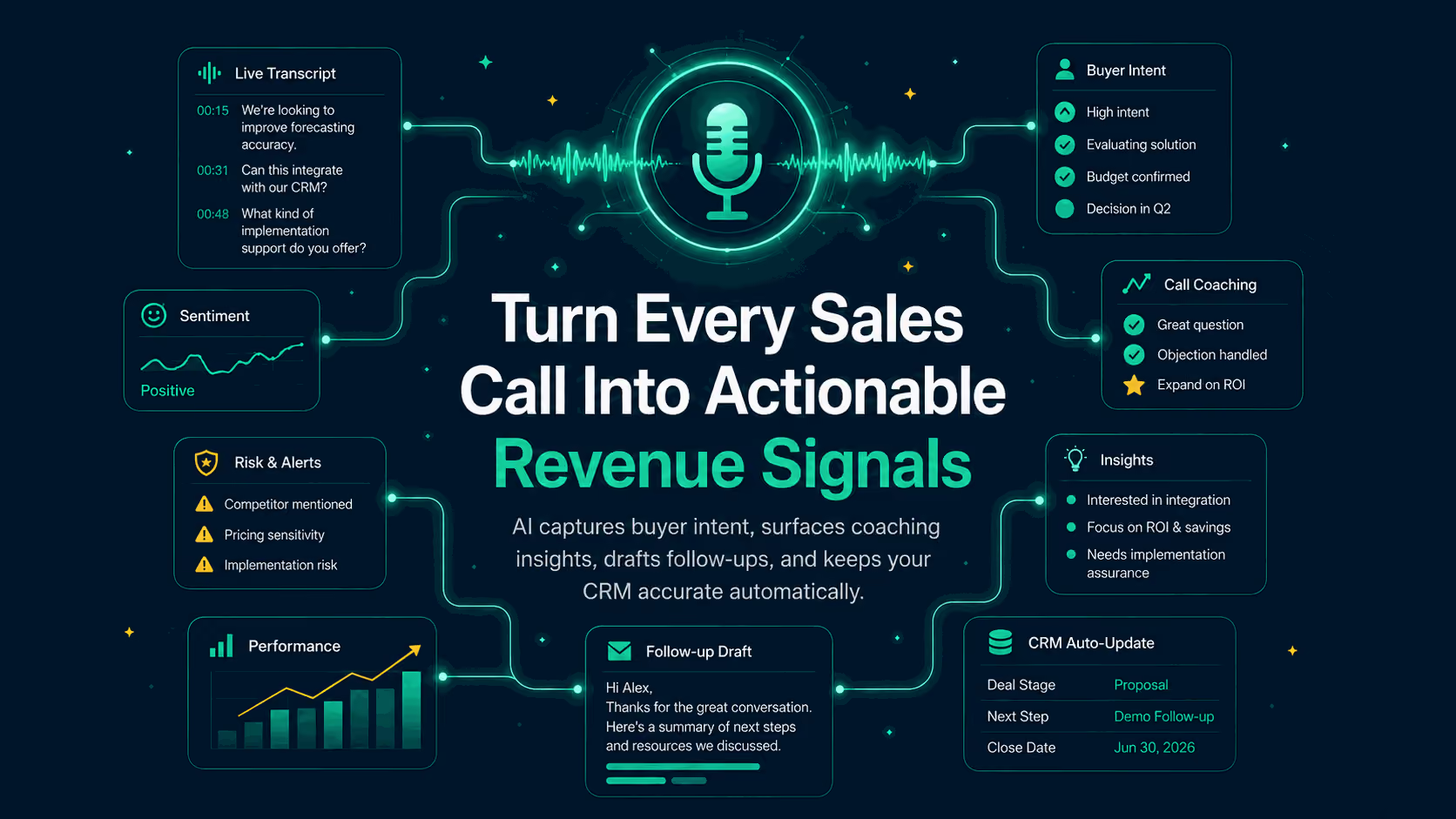
Every conversation intelligence tool can record and summarize a sales call. What separates them is what happens after the call.
Either the tool does the post-call admin for you, or it hands you a transcript and you still do it yourself.
So the real buying question is: Which one does the work instead of adding another dashboard?
This guide covers what conversation intelligence is, how it differs from call recording, how the top tools compare, and why execution (not analysis) is the line that matters.
Key Takeaways
- A transcript is a record nobody reads. Conversation intelligence turns the same calls, demos, emails, and meetings into structured CRM fields. The detail that decides a deal stops living in a rep's memory.
- Recording is passive. Conversation intelligence is active. It reads the call for you, flagging objections, buying signals, and risk while the deal is still moving. Gartner finds sellers who gather that intelligence grow their accounts 5%.
- Admin is where selling time goes to die. Reps spend 71% of their week on admin, not selling. The point of conversation intelligence is getting that time back.
- Coaching shouldn't depend on which calls a manager happened to hear. AI speech analytics shows what top reps do differently across every conversation. McKinsey documents gen AI analyzing calls to pinpoint each rep's coaching gaps.
- In 2026, execution is the whole game. Gartner projects 95% of seller research workflows will begin with AI by 2027, up from under 20% in 2024. Yet by McKinsey's count only about 20% of B2B sales organizations implement growth tech well. Either a tool acts on the insight or it leaves the rep to reconstruct the call by hand.
- "Integrates" tells you nothing on its own. Check whether the tool writes updates back into HubSpot or Salesforce instead of just reading from them, maps them to the right fields, and lets a rep approve them before they save.
- Per-seat pricing is how tools become shelfware. You pay for every rep whether they log in or not, and reps abandon anything that adds work. Outcome-based pricing charges for the work the tool replaces instead.
What Is Conversation Intelligence?
Conversation intelligence is AI software that listens to your sales calls and meetings. It writes down what was said, and pulls out the parts that matter, like what the buyer wants, what they objected to, what got promised, and what the rep should do next.
It does this automatically, for every conversation, so nobody has to re-listen to a recording or trust a rep's memory of how the call went. The output is the useful stuff a busy team would otherwise lose.
You get a summary, the action items, the CRM updates, and the deal-risk flags.
The detail that decides a deal usually disappears the moment the call ends. It might be an offhand comment about budget, a competitor's name, or the next step everyone agreed to. Conversation intelligence keeps that detail and puts it where the rest of the team can use it.
What Conversation Intelligence Actually Captures
A capable platform pulls signal from across the conversation, not just the audio:
- Call recordings and video meeting transcripts
- Email and meeting context, where available
- Buyer questions and pain points
- Competitor mentions
- Pricing objections
- Decision-maker names and roles
- Committed next steps
- Sentiment and engagement signals
The goal is to give reps and managers an accurate, shared record of what really happened rather than another archive nobody opens.
Why Conversation Intelligence Matters More in B2B Sales
Conversation intelligence matters in B2B sales because the deals are slow and complicated.
A single sale can run for months, involve five or six people, and go quiet for weeks at a time. By the time a rep circles back, half the context is gone. The CRM is out of date, the details are stuck in someone's head, and the call notes, if they exist, are sitting in a transcript nobody opens.
Most teams assume the fix is more data. It isn't.
Teams rarely lose deals because they were missing information, but because the information never turned into action. A risk flagged in a dashboard that no one acts on is the same as a risk nobody caught.
That is the whole argument for conversation intelligence in 2026. A tool that only tells you what happened adds another thing to read. A tool that acts on what happened moves the deal.
How Does AI-Powered Conversation Intelligence Work?
An AI-powered conversation intelligence first aptures the conversation and makes sense of it. Then, on the better tools, it acts on what it found. Step by step:
- The tool joins or records the sales call.
- It transcribes the conversation.
- The AI picks out the things that matter, like objections, next steps, who was on the call, buying signals, risks, and what got promised.
- It writes a summary.
- The better tools push the relevant details into the CRM.
- The most capable tools go further and draft the follow-up, create the tasks, and suggest the next move.
That last step is what's new.
For years, AI in sales just meant analysis. It told you what happened and left the doing to you. What changed recently is that the software can now carry the work forward on its own instead of handing you one more thing to review.
That is the real shift in 2026. The tools stopped reporting on the work and started doing it.
The Core AI Layers Behind Conversation Intelligence
You don't need to be an engineer to evaluate this, but it helps to know the stack:
- Speech-to-text turns audio into an accurate transcript.
- Natural language processing finds structure in the words.
- Sentiment and topic detection flags tone, themes, and engagement.
- LLM-based summarization produces readable summaries and takeaways.
- CRM field mapping routes the right details to the right records.
- Workflow automation turns insight into follow-ups, tasks, and next steps.
For sales leaders and RevOps, the layer that matters most is the last two. Plenty of tools nail transcription and summaries; far fewer reliably move that output into the systems where work actually gets done.
What Good AI Should Produce After a Sales Call
A strong platform should hand a rep a complete post-call package, not just a transcript:
- An accurate transcript and a short summary
- Buyer pain points, objections, and decision criteria
- Competitor mentions
- A drafted follow-up email
- CRM updates and a clear next-step task
- A deal-risk flag and a coaching insight
This is the line where ZIG's positioning starts: conversation intelligence shouldn't end at "here's what was said." It should end at "here's what's done, and here's what's next."
Conversation Intelligence vs Call Recording: What Is the Difference?
Call recording stores the audio of a conversation. Conversation intelligence reads that conversation and pulls out what matters, like objections, buying signals, competitor mentions, next steps, and coaching moments.
On the best tools it also acts on them.
The difference is that a recording sits there until someone plays it back. Conversation intelligence does the listening for you and tells you what to do about it.
| Capability | Call Recording | Conversation Intelligence |
|---|---|---|
| Captures audio | Yes | Yes |
| Creates transcript | Sometimes | Yes |
| Summarizes the conversation | No, unless paired with AI | Yes |
| Identifies objections | No | Yes |
| Detects buyer intent | No | Yes |
| Tracks competitor mentions | No | Yes |
| Scores rep performance | No | Yes |
| Finds coaching moments | Manual review required | Automated |
| Updates CRM | No | Often, depending on the platform |
| Drafts follow-ups | No | Advanced platforms can |
| Flags deal risk | No | Yes |
| Helps managers coach at scale | Limited | Yes |
| Turns insight into action | No | Only if paired with execution workflows |
When Call Recording Is Enough
Recording still has its place. If you just need an archive for compliance, the occasional call to review, or light coaching on a very small team, a recorder does the job. It only breaks down at scale.
Once you have several reps, complicated deals, and more calls than any manager could ever sit and listen to, a plain recording stops being useful.
When Sales Teams Need Full Conversation Intelligence
You need full conversation intelligence once the team gets bigger and the deals get harder to track. That means a growing B2B team, a manager coaching several reps, a company running heavily on HubSpot or Salesforce, or a team losing deals to messy CRM data, slow follow-up, and bad handoffs.
At that point the gap between a tool that records the call and a tool that understands it, and then acts on it, starts showing up directly in the pipeline.
Why Sales Teams Need Conversation Intelligence in 2026
Sales teams need conversation intelligence in 2026 for two reasons:
- The conversations where deals are actually won and lost contain information that almost never makes it into the CRM.
- AI has finally crossed the line from reporting on work to doing it.
Put those together and the pressure is on every role at once. Reps are buried in admin. Buyers expect fast, informed follow-up. Leaders want visibility without micromanaging. RevOps needs clean data without chasing anyone for it.
This is the year teams stop paying for tools that just generate more reports. Independent research on B2B selling points the same way.
The advantage is going to teams that put AI to work inside the actual sales motion, not teams that bolt on one more analytics screen, a pattern echoed in McKinsey's work on AI in B2B sales.
There is also a hidden cost on reps that rarely gets named. Remembering every meeting note, timeline, and commitment is real mental work, and when that load sits on the rep, time for selling shrinks.
We wrote about how reps end up running without an assistant while their CEO has one.
Sales Conversations Contain the Truth Your CRM Misses
CRM fields are usually incomplete, and reps summarize calls inconsistently. The signals that actually tell you whether a deal is real stay buried in notes and transcripts.
Think of a missing economic buyer, a next step nobody really committed to, or a competitor that came up on the call. Conversation intelligence captures those details and turns them into structured data, which is where it connects to the bigger picture of revenue intelligence.
Your CRM tells you what the rep typed. Conversation data tells you what the buyer actually said.
Managers Need Coaching Signals, Not More Call Review Homework
No manager can sit and review every call. AI can, surfacing patterns across all of them, flagging the strong and weak moments, and showing what the top reps do differently. That means coaching is based on real buyer conversations instead of the few calls a manager happened to be on.
The point isn't to replace a manager's judgment. It's to hand them the examples and patterns they would never have time to dig out by hand.
RevOps Needs Clean Data Without Chasing Reps
RevOps lives and dies by CRM hygiene, forecast accuracy, consistent follow-up, and next-step accountability. Conversation intelligence feeds pipeline reviews from what buyers actually said, not from whatever a rep remembered to type in.
That is also where it connects to the wider stack. Our breakdown of revenue operations platforms covers how teams consolidate tools to get there without adding headcount.
How Conversation Intelligence Improves Sales Coaching
Conversation intelligence improves coaching by giving managers real examples from actual buyer calls, showing patterns across the whole team, and setting a clear standard for what good looks like. Nobody has to listen to calls at random to find it.
It Shows What Top Reps Do Differently
It exposes the specific things that make a top performer good. Their talk tracks, the discovery questions they ask, how they handle objections, how they run a pricing conversation, and how they keep control of the next step.
Those are all learnable behaviors, but only once you can actually see them. It's also worth being honest about where the AI stops and the manager starts.
AI is very good at finding patterns. Knowing which behaviors are worth copying is still a human call. The best teams use the signal to sharpen their judgment, not hand it over.
It Creates Real Coaching Examples
Managers can clip and share real call snippets. New reps learn from actual deals instead of generic scripts, which shortens ramp time.
Enablement teams can build playbooks from the language buyers really use rather than the language a slide deck assumes they use.
It Makes Coaching Consistent
Scorecards, tracked terms, call outcomes, rep-by-rep visibility, and team-level patterns turn coaching from an occasional event into a system. One principle holds it together.
AI should support the manager's judgment, not replace it. It points to what's worth looking at, and the manager decides what it means.
How Conversation Intelligence Helps Close Deals Faster
Conversation intelligence closes deals faster by speeding up follow-up, sharpening the next steps, catching deal risk earlier, and keeping the CRM accurate. The result is that momentum doesn't leak away between calls.
Faster Follow-Up After Every Call
A rep shouldn't spend 30 to 40 minutes piecing a call back together from memory. AI can draft the follow-up email and the next steps while the conversation is still fresh, which is exactly when follow-up converts best.
There is one thing to design around. AI drafts tend to sound the same, competent but generic and a little flat. So the strongest setup is simple. The AI writes the draft, the rep makes it theirs.
The machine takes away the blank page, and the rep adds the voice, the specifics, and the judgment that make a follow-up actually land. Speed plus the rep's own voice is what protects momentum.
Better Deal Risk Detection
Most stalled deals show warning signs long before they die. Think a missing economic buyer, a weak next step, hesitation about budget, a competitor that came up, no clear timeline, or a buyer who has gone quiet.
Conversation intelligence flags these early and feeds them into next-step workflows, so a manager finds out about the problem now instead of in a forecast review three weeks too late.
Cleaner CRM Without Manual Data Entry
The biggest win is CRM updates that write themselves from what was said on the call. The field updates, next steps, notes, stakeholder details, and the real deal stage all get captured without a rep typing them out at the end of a long day.
This matters even more for reps who work in the field. AI-driven mobile CRM lets them update records by voice between meetings instead of saving the admin for a laptop they don't open until Friday.
Best Conversation Intelligence Tools Compared for B2B Sales Teams
The leading conversation intelligence tools are ZIG, Gong, Clari Copilot, HubSpot Conversation Intelligence, Avoma, Outreach, Chorus, Salesloft, Jiminny, and Fireflies. Most of them analyze and record calls well.
ZIG sits in its own category, because it acts on the conversation instead of stopping at the analysis.
The table below breaks down what each one is best for. Before you buy any of them, check the pricing, whether it writes data back into your CRM or only reads from it, and how deep that integration actually goes.
| Tool | Best For | Main Strength | Watchout | HubSpot / Salesforce Fit |
|---|---|---|---|---|
| ZIG | B2B teams that want conversation intelligence tied to execution | Built-in ZigScribe captures calls, creates takeaways, supports CRM updates, and helps move follow-up work forward | Best fit for teams ready to replace fragmented sales tools, not teams that only want a basic recorder | HubSpot marketplace presence; CRM/inbox connection model. Confirm Salesforce fit during sales discovery |
| Gong | Enterprise revenue teams | Deep conversation analytics, coaching, deal risk, forecasting, and revenue intelligence | Premium enterprise positioning and per-seat/platform cost concerns | Public docs reference Salesforce and HubSpot CRM integrations |
| Clari Copilot | Forecasting-focused revenue teams | Real-time battlecards, coaching, and revenue context inside Clari | Strongest when the team already uses or wants the Clari ecosystem | Strong CRM/revenue orientation; confirm exact HubSpot/Salesforce needs |
| HubSpot Conversation Intelligence | HubSpot-first sales and service teams | Native CRM context, coaching insights, call tracking, HubSpot workflow connection | Less attractive for teams not committed to HubSpot | Best for HubSpot-native teams |
| Avoma | SMB and mid-market teams | Meeting intelligence, notes, summaries, coaching, and CRM sync | May require additional tools for full sales execution | HubSpot and Salesforce support commonly listed |
| Outreach | Teams already using Outreach for sales engagement | Conversation insights connected to engagement, deal management, and CRM workflows | Best value when Outreach is already in the stack | Lists Salesforce, HubSpot, and Dynamics support |
| Chorus / ZoomInfo | Teams already invested in ZoomInfo | Conversation intelligence with revenue and contact data context | Best for ZoomInfo-heavy environments | Confirm CRM integration requirements |
| Salesloft Conversations | Salesloft users | Conversation intelligence connected to cadences and engagement | More valuable inside the Salesloft ecosystem | Confirm CRM integration requirements |
| Jiminny | Coaching-focused sales teams | Call libraries, coaching, scorecards, and collaboration | Less execution depth than an AI revenue operating system | Confirm CRM integration requirements |
| Fireflies | Teams needing affordable meeting notes | Transcription, summaries, and searchable meeting records | More meeting assistant than full sales execution platform | Confirm CRM integration requirements |
Best Overall for Conversation Intelligence Plus Execution: ZIG
ZIG isn't a single-purpose conversation intelligence tool. It's an AI sales execution platform. Its built-in feature, ZigScribe, turns sales meetings into action.
It listens to the conversation, drafts the follow-up, updates the CRM, and creates the next steps, instead of handing you a transcript to work through yourself. That is what sets it apart. Most tools tell you what happened on the call.
ZIG does the work that comes after it, which is why it fits the wider definition of an AI sales execution platform rather than a call-analysis tool. You can read more about the team and approach behind it on the about ZIG page.
Best for Enterprise Conversation Analytics: Gong
Gong is genuinely strong at call analysis, revenue intelligence, coaching, and deal risk, and it's a default choice for large revenue teams. Teams looking at Gong should weigh the cost and the implementation effort, and above all ask one question.
Do they need a tool that acts on the insight, or just one that produces it?
If the answer is execution without paying for every seat, it's worth comparing Gong alternatives before committing.
Best for Forecasting-Centric Teams: Clari Copilot
Clari Copilot is the best fit when you want conversation intelligence wired straight into forecasting and pipeline review, with real-time battlecards and coaching inside the Clari ecosystem.
It's strongest for teams already on that platform, or planning to move to it.
Best for HubSpot-Native Teams: HubSpot Conversation Intelligence
For teams already running on HubSpot CRM, HubSpot's own conversation intelligence captures what customers say directly in the CRM and supports coaching and performance tracking.
The limit shows up if you run a lot of other sales tools alongside it. At that point you usually need something that coordinates across the whole stack, not a feature tied to one CRM.
Best Lightweight Options: Avoma, Fireflies, Jiminny
Avoma is a solid pick for meeting intelligence and coaching. Fireflies handles affordable transcription and searchable notes. Jiminny is built for coaching and team feedback. All three do recording and coaching well.
Just be clear that recording and coaching is not the same thing as doing the post-call work that moves a deal forward.
Which Conversation Intelligence Tools Integrate with HubSpot and Salesforce?
Most of the leading tools integrate with HubSpot, Salesforce, or both. The word "integrates" is where you have to be careful, because it covers everything from a tool that just logs a record of the call to one that writes full updates back and forth.
Before you buy, check three things:
- Does it write data back into the CRM or only read from it?
- Does it put each detail in the right field?
- And who is allowed to see and approve what it writes?
Confirm the pricing on this while you're at it.
| Tool | HubSpot Integration | Salesforce Integration | What to Verify Before Buying |
|---|---|---|---|
| ZIG | HubSpot marketplace listing available | Confirm exact Salesforce workflow with ZIG sales team | Which CRM fields update, approval flow, call capture setup, whether follow-ups/tasks sync |
| Gong | Yes | Yes | Two-way sync, object mapping, activity logging, forecasting fields, implementation timeline |
| HubSpot Conversation Intelligence | Native to HubSpot | Depends on broader HubSpot–Salesforce setup | Whether call insights sync cleanly across both CRMs |
| Avoma | Yes | Yes | Meeting types supported, summary sync, field mapping, coaching workflow |
| Outreach | Yes | Yes | Whether conversation insights feed CRM updates and deal workflows |
| Clari Copilot | Strong CRM/revenue platform support | Commonly used with Salesforce-heavy teams | HubSpot support, sync depth, whether Clari is already in the stack |
| Salesloft Conversations | Confirm based on package | Yes for Salesforce-heavy Salesloft teams | Whether the team already uses Salesloft cadences |
| Chorus / ZoomInfo | Confirm based on package | Commonly used with Salesforce-heavy teams | ZoomInfo dependency, package requirements, CRM sync depth |
What Features Should You Look for in Conversation Intelligence Software?
Use this as a buyer checklist:
- Accurate call recording and transcription
- AI-generated summaries
- Objection and competitor tracking
- Buyer intent detection
- Call scoring and coaching workflows
- CRM integration with HubSpot, Salesforce, or your CRM of record
- Automatic CRM updates
- Follow-up drafting
- Next-step and task creation
- Deal risk alerts
- Manager dashboards
- Security, permissions, and auditability
- Human approval controls
- Outcome-based or value-aligned pricing
- Works across calls, email, meetings, and sales workflows
Prioritize Execution Over Dashboards
A dashboard only helps if someone acts on it. The trap of the last software cycle was mistaking more output for more value. Tools generated ten times the reports, summaries, and charts, while the actual work of moving deals forward stayed exactly as manual as it had always been.
Conversation intelligence should take work off your plate, not add another screen to check. The best tools push the insight straight into the sales workflow, which is the same shift behind a modern sales execution strategy, where AI does the manual steps instead of just reporting on them.
Make Sure CRM Updates Are Reviewable
One requirement is easy to miss. AI tends to tell you what you want to hear. Left unchecked, it leans agreeable, and it will confirm an optimistic read of a deal just as readily as a skeptical one.
That is why automated CRM updates need a person to approve them, a record of what was changed, and a clear sense of how sure the AI is about each one. That way a rep can catch a bad update before it skews the forecast.
This isn't red tape. It's what makes the automation safe enough to rely on.
Look for Pricing That Matches Value
Per-seat tools punish growing teams, because every new hire raises the bill whether or not they ever log in. Usage caps cause a different problem, since reps avoid a tool that might run out mid-month.
And any tool gets expensive fast when its insights never turn into action. The healthiest model charges you for the work the system actually does.
Conversation Intelligence Software With Outcome-Based Pricing
Outcome-based pricing means you pay for the work the software does, not for the number of people who can log in. Most conversation intelligence platforms charge per seat instead.
That works when everyone uses the tool every day. The problem is that many sales tools turn into shelfware, because reps quietly stop using systems that add work, and a seat nobody touches is money spent for nothing.
Outcome-based pricing changes the question. Instead of asking how many people can access the tool, you ask how much work it actually took off the team's plate.
Why Per-Seat Pricing Can Be a Problem for Sales Teams
With per-seat pricing, a bigger team always costs more, whether or not people actually use the tool. Managers pay for the visibility, and reps are the ones left doing the admin.
And when the insights never turn into completed work, that per-seat bill starts to look like a tax on a tool no one fully uses.
How ZIG Approaches Pricing Differently
ZIG has no seats, no tokens, and no usage caps. You pay for the work the system takes off your team. That suits teams who want a platform to absorb the admin and push the work forward, rather than one more license to count heads on.
You can see the details on ZIG's outcome-based pricing page.
Where Conversation Intelligence Fits in the Modern Sales Stack
Conversation intelligence doesn't stand alone. It connects to your CRM, revenue intelligence, sales engagement, sales execution, lead generation, and mobile selling.
Knowing where each one stops and the next begins is how you avoid paying for several tools that do the same job.
Conversation Intelligence vs Revenue Intelligence
Conversation intelligence analyzes what happens in sales interactions. Revenue intelligence takes that conversation data and connects it to the pipeline, the forecast, deal health, and revenue decisions.
One produces the raw input. The other is the larger system that turns those inputs into forecasting and strategy.
Conversation Intelligence vs Sales Execution Platform
Conversation intelligence tells you what happened on the call. A sales execution platform helps make the next thing happen, the follow-up, the CRM update, the next move.
That’s ZIG's core difference. It treats the conversation as the start of the work, not the end of the analysis.
Conversation Intelligence and Lead Generation Tools
Conversation intelligence captures buyer signals after a conversation. Lead generation tools build and enrich the pipeline before one. The strongest sales motions connect both ends.
That is why teams looking at the lead-gen side often compare Clay alternatives for enrichment and outreach, and weigh options like Clay vs Apollo vs ZIG when they want lead generation and execution in one place.
The Future of Conversation Intelligence: From Call Insights to AI Execution
The whole category is moving in one direction. Analyzing a call is becoming free and automatic, which means analysis is no longer where the value is. The value is in the work that follows the call, and that is the part AI is now able to do.
By 2027, Gartner expects nearly all seller research to start with AI, up from almost none in 2024. The tools that only watch and report are heading for the same place every commoditized feature ends up, taken for granted and no longer worth paying extra for.
The Problem With Standalone Conversation Intelligence
A standalone conversation intelligence tool gives you one more dashboard to read, asks a manager to interpret it, leaves the rep with the post-call admin, and still doesn't guarantee a single thing gets done. It tells you what happened.
Whether the deal moves is left to a person who has no time to move it.
The Better Model: Conversation Intelligence Inside Sales Execution
The better model builds conversation intelligence into the execution itself. Every call becomes usable context. Every next step gets easier to finish. The CRM stays clean without anyone maintaining it. Managers get visibility without chasing reps for it, and reps get to spend their time selling.
This is also the honest version of the AI-in-sales pitch. It works best when it does the busywork and frees people for the parts of the job only people can do, like judgment, relationships, and reading a room.
It works worst when it's sold as a replacement for them.
So the question to take into any demo is a simple one. Are you buying a tool that does the work, or a tool that just tells you about it? See how ZIG turns conversations into execution when you're ready to start answering it.
FAQs About Conversation Intelligence
What is conversation intelligence software?
Conversation intelligence software uses AI to record, transcribe, and analyze sales conversations. It identifies buyer signals, objections, next steps, coaching opportunities, and deal risks so teams can improve follow-up, CRM accuracy, and sales performance.
Why do sales teams need conversation intelligence in 2026?
Sales teams need conversation intelligence because buyer conversations contain critical deal information that often never reaches the CRM. AI helps capture those details, coach reps, improve follow-up, and keep deals moving without more manual admin.
How does AI-powered conversation intelligence work?
AI-powered conversation intelligence captures calls or meetings, transcribes them, analyzes the text for important signals, creates summaries, and can push insights into CRM records, coaching workflows, follow-up tasks, and deal alerts.
What is the difference between conversation intelligence and call recording?
Call recording stores the audio of a conversation. Conversation intelligence analyzes that conversation to find insights such as objections, buying signals, competitor mentions, next steps, and coaching moments.
How does conversation intelligence improve sales coaching?
Conversation intelligence helps managers coach with real examples from sales calls. It shows patterns in rep behaviour, highlights strong and weak moments, and helps teams standardize discovery, objection handling, and follow-up.
Which conversation intelligence tools integrate with HubSpot and Salesforce?
Many leading tools integrate with HubSpot, Salesforce, or both, including Gong, Avoma, Outreach, and others. ZIG has a HubSpot marketplace presence and supports CRM-connected execution workflows; teams should confirm exact Salesforce requirements during evaluation.
What is the best conversation intelligence software for B2B sales teams?
The best option depends on the team's workflow. Gong is strong for enterprise revenue intelligence, HubSpot fits HubSpot-native teams, Avoma works well for meeting intelligence, and ZIG is best for teams that want conversation intelligence connected to sales execution.
How does conversation intelligence help close deals faster?
It helps teams follow up faster, identify stalled deals, update CRM records accurately, detect objections, and act on buyer commitments before momentum is lost.
Is there conversation intelligence software with outcome-based pricing?
Yes. ZIG uses outcome/execution-based pricing rather than a traditional per-seat model, making it a strong fit for teams that want pricing tied to work replaced and sales execution value.
Responsible AI note: if you let AI update the CRM and write follow-ups, a person should still sign off before anything is saved. Set clear permissions for who can change what, keep a log of every change the AI makes, and require approval on the updates that matter.
This is the same approach the NIST AI Risk Management Framework and the OECD's trustworthy AI principles lay out, that AI systems stay traceable and a human can always step in.
If you want to see this working rather than just read about it, talk to ZIG.
