
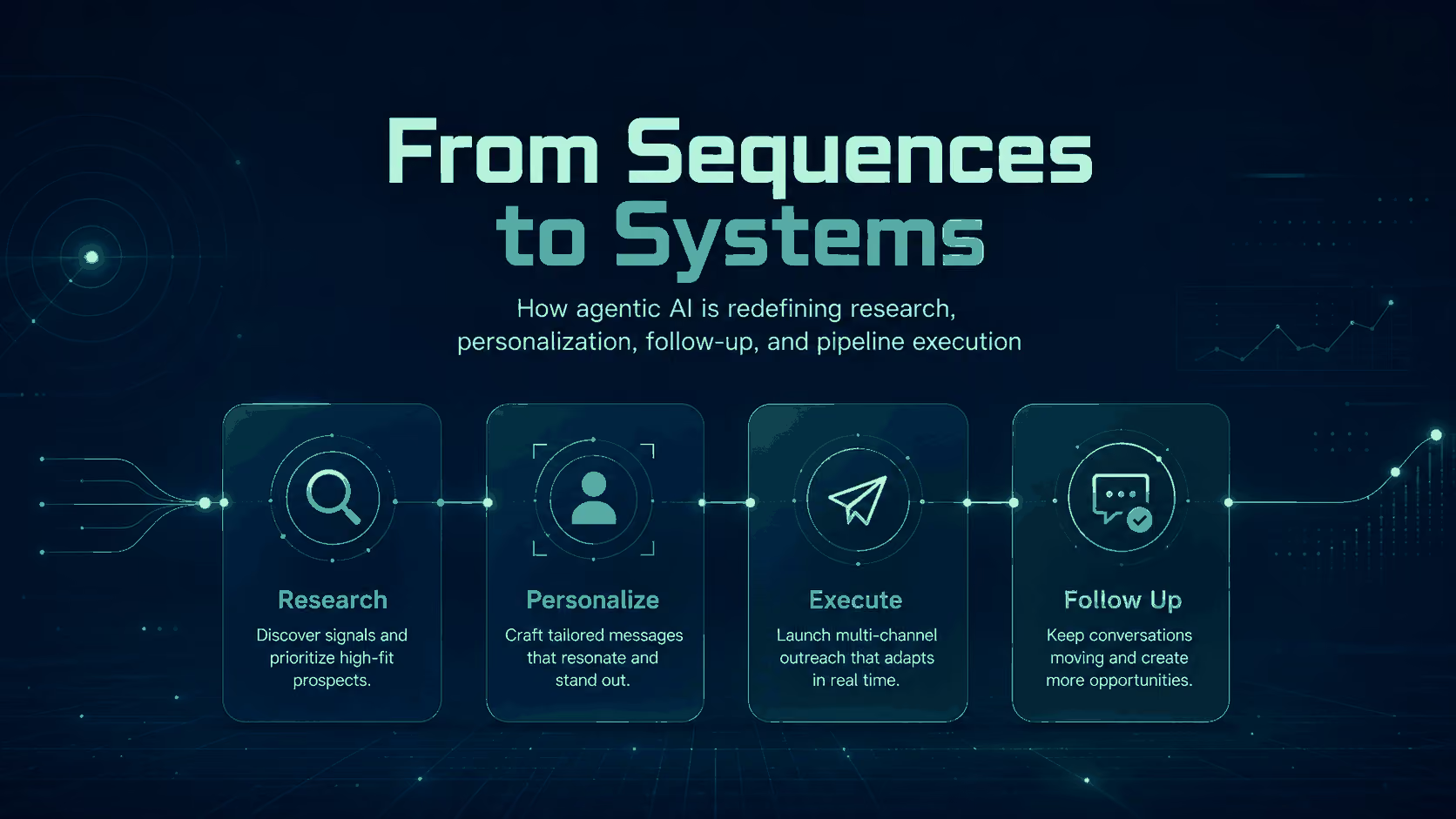
AI outbound sales uses artificial intelligence to research accounts, enrich leads, personalize cold outreach, run sequences, follow up, and move prospects into active sales workflows. In 2026, the category is shifting from simple AI-written emails to agentic AI systems that handle multi-step outbound work with human controls.
The best AI outbound platforms do not just create more activity. They help teams execute the right work, update CRM, and turn outbound signals into pipeline.
Key Takeaways
- AI outbound sales helps teams automate research, enrichment, personalization, sequencing, follow-up, and CRM updates.
- Agentic AI is changing outbound because agents can complete multi-step workflows instead of only suggesting copy.
- Traditional cold outreach can still work, but AI improves speed, relevance, prioritization, and consistency when used with strong data and guardrails.
- AI outbound is broader than an AI SDR. AI SDRs usually focus on top-of-funnel work, while AI outbound sales can include research, workflows, follow-up, CRM updates, and pipeline movement.
- ZIG is the best fit for B2B teams that want AI outbound connected to sales execution and outcome-based pricing.
- Apollo, Outreach, Salesloft, HubSpot, 11x, Artisan, Clay, Regie.ai, Instantly, Smartlead, and Reply.io are also important tools to compare.
- Teams should judge AI outbound tools by pipeline quality, reply quality, CRM hygiene, deliverability, human approval controls, and work completed.
What Is AI Outbound Sales?
AI outbound sales is the use of artificial intelligence to plan, personalize, automate, and manage outbound prospecting. It can help sales teams research accounts, enrich leads, write cold emails, run sequences, follow up with prospects, update CRM records, and prioritize the next best action.
The category is broader than "AI writes your cold email." It covers the full outbound workflow from account selection to pipeline handoff, and it can support SDRs, AEs, founders, and RevOps teams at different points in that workflow.
What AI outbound sales includes
AI prospecting and account selection. AI lead enrichment and contact discovery. AI SDR workflows. AI cold email writing and sequence creation. AI call prep and meeting summaries. AI follow-up drafting. AI CRM updates. AI pipeline hygiene. Buying signal detection and account prioritization. Meeting handoff and next-best-action routing.
What AI outbound sales should not mean
It should not mean blasting low-quality email at scale. It should not mean delegating ICP strategy to an algorithm. It should not mean sending AI-generated copy without human review on meaningful accounts. It should not mean ignoring deliverability, consent, opt-outs, or buyer relevance. The teams that get the most from AI outbound treat it as an execution assistant, not a volume machine.
Why AI Outbound Sales Matters in 2026
Outbound teams face more inbox noise, stricter deliverability expectations, higher standards for message relevance, and lower buyer tolerance for generic sequences. At the same time, SDRs are overloaded: research, enrichment, CRM work, sequencing, follow-up, and meeting prep all fall on the same person. AI outbound sales addresses that overload by automating structured execution while keeping humans focused on judgment and buyer relationships.
Gartner's work on AI SDR agents for inbound and outbound sales documents that the commercial case for AI outbound is strongest when it improves execution quality, not when it simply increases volume. That framing shapes everything in this guide.
Buyers can spot generic automation
Bad AI outbound creates the same problem as bad traditional outbound: irrelevant messages at scale. The difference is speed and volume. AI can create irrelevant messages much faster. Good AI outbound uses context, timing, and account relevance. It helps reps understand why a prospect is worth contacting before the first message goes out.
Sales teams need execution, not more tools
Most outbound teams already run on separate tools for data, enrichment, email sequencing, deliverability, CRM updates, call recording, follow-up, and reporting. Each tool creates its own handoff, its own login, and its own context gap. Revenue operations platforms that were supposed to unify the stack often add one more layer. Agentic AI should own the busywork layer, not add to it.
How Does AI Improve Outbound Sales Performance?
| Outbound Problem | How AI Helps | What to Measure |
|---|---|---|
| Reps spend too long researching accounts | AI summarizes account context, buying signals, and likely pain points | Research time saved per account |
| Lists are poorly targeted | AI enriches leads and scores fit against ICP | ICP match rate and disqualification rate |
| Messages sound generic | AI uses account, role, trigger, and pain-point context | Positive reply rate |
| Follow-ups are inconsistent | AI creates follow-up tasks and drafts | Follow-up completion rate |
| CRM data is incomplete | AI logs activity and suggests record updates | CRM completeness and stale record rate |
| Managers cannot see outbound quality | AI surfaces activity, replies, objections, and next steps | Coaching visibility and pipeline quality |
| Teams send too much low-quality volume | AI helps prioritize accounts with stronger signals | Reply quality, meetings booked, spam rate |
| SDRs get stuck in admin | AI agents handle repetitive workflow steps | Rep time saved and meetings created |
AI improves targeting
ICP matching, firmographic and technographic signals, recent company events, hiring trends, funding signals, and product usage or intent signals all help AI identify which accounts are worth pursuing and in which order.
AI improves message relevance
Personalization based on role, account context, recent signals, and buyer pain points makes AI outbound more likely to earn a reply. Strong AI personalization does not require intrusive personal details. It uses business context that the prospect would recognize as relevant. AI can generate first drafts efficiently, but human strategy still determines what makes the message worth reading.
AI improves follow-through
Consistent follow-up, next-best actions, meeting booking, CRM logging, handoff after reply, and re-engagement when prospects go quiet. This is where most outbound efforts break down: not on the first touch, but on the third, fourth, and fifth. AI that handles follow-through removes the bottleneck without requiring a manager to police every rep's task queue.
AI Outbound Sales vs. Traditional Cold Outreach: What Works Better?
| Criteria | Traditional Cold Outreach | AI Outbound Sales |
|---|---|---|
| Account research | Manual, slower, often inconsistent | Faster account summaries, signals, and enrichment |
| Personalization | High quality when done by skilled reps, but hard to scale | Scalable personalization if data and prompts are strong |
| Outreach volume | Limited by rep capacity | Easier to scale, but risky without deliverability controls |
| Follow-up | Often inconsistent | Automated reminders, drafts, and next-step workflows |
| CRM updates | Manual and often incomplete | Advanced platforms can log activity and update records |
| Message quality | Can be excellent with experienced reps | Varies by data quality, prompt quality, and human review |
| Coaching | Manager-dependent | AI can surface patterns and examples |
| Deliverability risk | Depends on process | Can increase if teams over-automate volume |
| Best use case | Strategic accounts, complex enterprise deals, high-touch selling | Scalable outbound, SDR workflows, research-heavy prospecting, repeatable motions |
| Main risk | Slow execution and inconsistent process | Generic automation, spam complaints, weak governance |
When traditional cold outreach still wins
Enterprise account strategy where a single deal justifies a highly bespoke approach. Complex buying committees that require relationship-building over months. Sensitive industries where tone and timing matter more than volume. High-stakes executive outreach where a generic sequence would close more doors than it opens. Negotiation and early relationship stages where a human voice makes the difference.
When AI outbound sales wins
Repeatable ICP with clear signals. High-volume research needs. SDR teams that run sequential outbound at scale. Mid-market SaaS demos where speed-to-follow-up matters. Follow-up-heavy motions where the risk is prospects going quiet, not the quality of the first message. Teams with dirty CRM or inconsistent processes that need structured execution, not more manual steps.
How Do Agentic AI Agents Handle Outbound Sales?
Agentic AI agents handle outbound sales by completing multi-step workflows across sales systems. They can research accounts, enrich contacts, draft personalized messages, run sequences, monitor replies, create follow-ups, update CRM, flag risks, and ask for human approval when a sensitive action needs review.
The distinction from basic automation is meaningful. An automation rule fires when a trigger occurs. An agentic AI interprets the situation, plans a sequence of steps, executes across multiple systems, and escalates when it encounters something that requires judgment.
A typical agentic AI outbound workflow
- Pull target accounts from CRM, ICP lists, or prospecting tools
- Enrich company and contact data
- Research account context and buying signals
- Prioritize accounts by fit and timing
- Draft personalized outreach
- Select or recommend the right sequence
- Send or queue messages based on approval rules
- Monitor opens, replies, meetings, objections, and opt-outs
- Route interested prospects to reps
- Log activity and update CRM
- Create follow-up tasks
- Re-engage stalled prospects when appropriate
What makes an AI agent different from an automation rule
| Type | How It Works | Outbound Example | Limitation |
|---|---|---|---|
| Basic automation | Runs a fixed rule | Add a prospect to a sequence when a form is submitted | Cannot interpret fit or context |
| AI assistant | Drafts or suggests work | Writes a cold email draft | Rep still manages the workflow |
| AI SDR | Handles top-of-funnel prospecting tasks | Researches leads, sends outreach, books meetings | Often focused on SDR work only |
| Agentic AI platform | Executes workflows across systems | Enriches lead, drafts outreach, logs CRM, follows up, and escalates replies | Needs data quality, permissions, governance, and human controls |
Where human approval should stay
Strategic account messages where a wrong claim costs a relationship. Legal or compliance-sensitive industries. Large customer expansion where tone and context matter at an enterprise level. Personalized claims that the AI cannot verify. Pricing references or commitments. Contractual or service language. Opt-out and consent handling. Any workflow where an error is expensive and human review is fast.
The NIST AI Risk Management Framework is a practical reference for teams evaluating which AI outbound workflows need human oversight and audit controls, and which can safely run with automated execution.
AI Outbound Sales vs. AI SDR: What Is the Difference?
| Category | AI Outbound Sales | AI SDR |
|---|---|---|
| Scope | Broad outbound workflow | Top-of-funnel SDR tasks |
| Main Job | Improve and automate outbound selling | Research prospects, send outreach, qualify leads, book meetings |
| Typical Users | SDR teams, AEs, RevOps, founders, sales leaders | SDR leaders, founders, outbound teams |
| Systems Involved | CRM, email, calendar, enrichment, prospecting, sequences, meetings, reporting | Prospecting data, email, LinkedIn, calendar, CRM |
| Output | Research, enrichment, messages, follow-ups, CRM updates, next-best actions, pipeline movement | Qualified meetings, replies, booked calls |
| Best Fit | Teams improving the whole outbound motion | Teams replacing or augmenting SDR prospecting work |
| Watchout | Needs governance and workflow design | Can over-focus on meetings booked without pipeline quality |
When you need an AI SDR
Small teams replacing early SDR work where a human isn't cost-effective yet. Founder-led outbound at early stage. High-volume top-of-funnel prospecting where meeting volume is the primary constraint. Tools to compare for this use case include 11x, Artisan, AiSDR, Reply.io Jason AI, and HubSpot's prospecting agent.
When you need AI outbound sales infrastructure
When the problem is bigger than top-of-funnel volume. CRM updates aren't happening, follow-ups are inconsistent, post-call work falls to reps, and pipeline hygiene is poor. The team has SDRs and wants to remove admin from their day rather than replace them. You care about tools replaced, revenue operations, and CRM data quality, not just meetings booked. This is where an AI sales execution platform is the more accurate category than "AI SDR."
How AI Personalizes Outbound Sales Messages at Scale
Data AI uses for personalization
Company size and industry. Role and seniority. Hiring trends. Tech stack signals. Funding or news events. Website messaging. Product category and likely pain points. CRM history and prior engagement. Meeting or call context from previous interactions. Pain-point patterns from similar accounts that have converted.
A warning worth noting: strong AI personalization uses business context, not intrusive personal data. Messages that reference personal details unrelated to the professional context tend to generate negative replies, not positive ones.
Good AI personalization vs. bad AI personalization
| Bad AI Personalization | Better AI Personalization |
|---|---|
| "I saw you went to X university" | "Your team is hiring SDRs across three regions, which usually creates onboarding and CRM consistency problems" |
| "Congrats on your recent post" | "Your company just launched a new mid-market offer, so outbound routing and follow-up speed may become harder to manage" |
| "I noticed we both like sales" | "Your revenue team appears to use HubSpot and multiple outbound tools, which can create duplicate records and follow-up gaps" |
| "Loved your website" | "Your pricing page suggests a demo-led sales motion, so post-demo follow-up and CRM accuracy likely matter" |
| "Quick question" with no context | "Worth comparing how much SDR time is going into research, enrichment, follow-ups, and CRM cleanup before adding another outbound tool" |
How to keep AI personalization safe
Use business context, not sensitive personal data. Verify claims before they go into a sequence. Avoid fake familiarity that a buyer would recognize as manufactured. Review messaging for high-value accounts before automating. Monitor reply quality and spam complaints consistently. Both are early signals that personalization quality is slipping.
Best AI Outbound Sales Tools in 2026
| Rank | Tool | Best For | Main Strength | Main Watchout |
|---|---|---|---|---|
| 1 | ZIG | B2B teams that want AI outbound tied to sales execution | AI agents handle outbound work alongside CRM updates, follow-ups, lead generation, meeting prep, pipeline hygiene, and outcome-based execution | More platform than needed for teams that only want a cold email sender |
| 2 | Outreach | Enterprise revenue teams running mature outbound | Agentic AI, prospecting, sales engagement, deal workflows, forecasting, and coaching in one revenue platform | Best fit for teams ready for an enterprise rollout |
| 3 | Apollo | Outbound teams that want data plus sequences | Contact database, enrichment, sequences, dialer, and prospecting workflows | Data quality, credits, and deliverability need careful testing |
| 4 | Salesloft | Sales engagement teams | Cadences, sales workflows, AI support, conversations, and pipeline management | Strongest when Salesloft is the core sales engagement platform |
| 5 | HubSpot Breeze Prospecting Agent | HubSpot-native teams | CRM-native lead research, buying signal monitoring, and outreach drafting | Best fit for teams already committed to HubSpot |
| 6 | 11x | Teams evaluating autonomous AI SDR workers | Digital workers for outbound and GTM workflows | Buyers should evaluate transparency, control, cost, and fit carefully |
| 7 | Artisan | Teams evaluating AI BDR automation | AI employee approach for outbound prospecting and outreach | Best for teams comfortable with autonomous outbound positioning |
| 8 | Clay | GTM teams that need AI research and enrichment workflows | Flexible enrichment, waterfall data, and personalized outbound inputs | Requires workflow design and maintenance |
| 9 | Regie.ai | Teams needing AI-powered outbound content and prospecting support | AI content, personalization, and sales engagement assistance | Fit depends on existing outbound stack |
| 10 | Reply.io / Jason AI | Teams that want AI-assisted outbound conversations | Email sequences, multichannel outreach, and AI sales assistant workflows | More useful inside Reply.io workflows |
| 11 | Instantly / Smartlead | Cold email teams focused on sending infrastructure | Sending, inbox rotation, deliverability workflows, and outbound scale | Not full sales execution platforms |
| 12 | Common Room / Unify | Signal-based outbound teams | Product, community, intent, and buying signal workflows | Strongest when signal coverage matches the ICP |
| 13 | ZoomInfo | Enterprise teams needing data and intent | B2B data, contact intelligence, enrichment, and intent signals | Data still needs execution and follow-up |
Best overall for AI outbound execution: ZIG
Most AI outbound tools help you send. ZIG helps you execute.
ZIG's AI agents handle the work around outbound: lead generation, enrichment, outreach drafting, follow-ups, CRM updates, meeting prep, conversation intelligence, and pipeline hygiene, all inside one execution layer rather than as separate modules to connect. The sales execution strategy article covers how this connects to the broader AI agent framework ZIG uses across the sales motion.
Pricing is tied to execution workload rather than per-seat or per-credit access. See Zig's pricing page for how execution coverage is structured. For teams comparing AI sales execution platforms more broadly, ZIG's outbound layer is one component of a full revenue operating system.
Best enterprise agentic AI platform: Outreach
Outreach now positions around agentic AI for prospecting, deal management, forecasting, coaching, and expansion. It is a strong fit for mature revenue teams that already need enterprise sales engagement and workflow orchestration at scale. For teams evaluating it against alternatives, it is best assessed as a full revenue platform rather than a point solution.
Best data plus outbound tool: Apollo
Apollo is a practical all-in-one starting point for many outbound teams: contact data, enrichment, filters, sequences, and SDR workflows in one place. Data quality, credits, and deliverability discipline are worth testing carefully before scaling volume. For a direct comparison, Clay vs. Apollo vs. ZIG covers the key trade-offs.
Best AI SDR / AI BDR options: 11x and Artisan
Both tools are often compared as autonomous SDR or BDR options. They are most useful for teams evaluating AI workers for top-of-funnel outbound. Buyers should ask specifically about control, transparency, compliance handling, and CRM visibility before committing.
Best AI research and enrichment workflow: Clay
Clay is built for GTM engineers and RevOps teams that need flexible enrichment and AI research at the data layer. It works well for technical teams comfortable with workflow design. For teams evaluating it against alternatives, the Clay alternatives article covers the options.
Best HubSpot-native AI outbound option: HubSpot Breeze Prospecting Agent
HubSpot's prospecting agent researches qualified leads, monitors buying signals, sources contacts, and drafts personalized outreach inside the HubSpot CRM environment. It is well-suited for teams already committed to HubSpot who want AI outbound without a separate platform. ZIG is also relevant for HubSpot-connected teams that need execution depth beyond prospecting. For reps managing accounts on the go, mobile CRM workflows extend this further.
Best AI Outbound Sales Platform for B2B Teams
B2B teams need more than cold email writing. AI outbound for B2B should support ICP research, account prioritization, buyer-role targeting, lead enrichment, sequencing, multi-touch follow-up, CRM updates, meeting handoffs, and RevOps visibility.
Shortlist for B2B teams:
- ZIG: best for B2B teams that want AI outbound tied to sales execution and outcome-based pricing
- Outreach: best for enterprise revenue teams
- Apollo: best for data plus outbound sequences
- HubSpot Breeze Prospecting Agent: best for HubSpot-native teams
- Clay: best for AI research and enrichment workflows
- Salesloft: best for sales engagement teams
- 11x / Artisan: best for teams testing autonomous AI SDR or BDR models
- Instantly / Smartlead: best for cold email sending infrastructure
- Common Room / Unify: best for signal-led outbound
What B2B teams should prioritize
CRM integration and write-back quality. HubSpot and Salesforce compatibility. Lead enrichment and ICP scoring. Deliverability controls and spam monitoring. Human approval workflows for sensitive outreach. Reply handling and routing. Follow-up automation that doesn't require rep management. CRM updates that happen without a desktop session. Tool replacement potential and total cost.
Best AI Outbound Sales Tool for SDR Teams
| SDR Need | Best Tools to Compare | Why |
|---|---|---|
| Find contacts | Apollo, ZoomInfo, Cognism, Lusha, LeadIQ | Data coverage and contact discovery |
| Enrich leads | Clay, Apollo, ZoomInfo, ZIG | Adds account and contact context |
| Write outbound messages | ZIG, Apollo, Outreach, Salesloft, Regie.ai, HubSpot | AI-assisted outreach and personalization |
| Run sequences | Outreach, Salesloft, Apollo, Reply.io, Instantly, Smartlead | Outbound workflow execution |
| Automate follow-up | ZIG, Outreach, Salesloft, Apollo | Keeps prospects moving after first touch |
| Update CRM | ZIG, HubSpot, Outreach, Salesloft, Apollo | Reduces manual activity logging |
| Reduce admin | ZIG | AI agents handle repetitive execution work |
| Replace SDR top-of-funnel tasks | 11x, Artisan, AiSDR | Autonomous AI SDR positioning |
| Work from mobile | HubSpot, LinkedIn Sales Navigator, CRM mobile apps | Supports reps away from desktop |
For reps working between meetings or in the field, best mobile sales apps for B2B reps covers the practical options.
AI Outbound Sales Tools With Outcome-Based Pricing
Most AI outbound sales tools charge for access: seats, credits, enrichment runs, email volume, or platform tiers. That model can make sense for teams that only need data or sending infrastructure. But if an AI platform is completing real outbound work, pricing should connect to work completed or admin workload replaced. ZIG's outcome-based model fits teams that care about execution, not logins.
| Pricing Model | Common For | Buyer Watchout |
|---|---|---|
| Per-seat pricing | CRMs, sales engagement platforms, AI SDR tools | Costs grow with headcount even when adoption varies |
| Credit-based pricing | Data and enrichment tools | High-volume outbound can burn credits quickly |
| Usage-based pricing | AI and cold email tools | Cost may spike with scale |
| Platform fee | Enterprise outbound and revenue platforms | Requires rollout and adoption to justify |
| Per-meeting pricing | Some AI SDR models | Can reward meeting volume over pipeline quality |
| Outcome-based pricing | ZIG | Best when pricing aligns with execution coverage and admin work replaced |
Why per-meeting pricing can be risky
Meetings booked are not always qualified meetings. A pricing model that rewards meeting volume creates an incentive to optimize for quantity rather than pipeline quality. Teams using per-meeting pricing should set clear qualification criteria and track pipeline created, not just meetings scheduled.
Why outcome-based pricing fits agentic AI
When AI agents are completing work rather than providing dashboard access, the pricing model should reflect work covered, tools replaced, and execution value. Per-seat pricing creates shelfware risk: the cost is fixed whether the agent is actively executing workflows or sitting idle. Zig's pricing page covers how execution workload coverage is structured across tiers.
Compliance and Deliverability Risks in AI Outbound Sales
AI outbound can damage sender reputation and deliverability quickly if teams over-automate without controls. This section covers the basics. It is not legal advice; teams with complex compliance requirements should consult legal counsel and verify current regulations in their target markets.
Cold email compliance basics
The FTC's CAN-SPAM Act compliance guide covers the key US requirements: accurate sender information, no deceptive subject lines, a valid physical postal address where required, a clear opt-out mechanism, prompt opt-out honoring, and suppression list maintenance. Teams targeting EU, UK, or Canadian contacts should also verify GDPR, PECR, and CASL requirements separately.
Deliverability basics for AI outbound
Set up SPF, DKIM, and DMARC authentication on every sending domain. Google's email sender guidelines cover bulk sender requirements for inbox deliverability, including one-click unsubscribe support for high-volume senders and spam rate thresholds that trigger filtering. Monitor domain reputation. Track bounce rates and spam complaint rates. Ramp sending volume on new domains gradually. Clean lists before campaigns and suppress bounces immediately.
Responsible AI controls
Human approval for outbound messages to strategic or sensitive accounts. Prompt and message review before scaling any new sequence. Audit logs on AI-generated CRM changes. Role-based permissions controlling what the AI can send or update without review. Data source transparency so reps understand where account context comes from. Explicit safeguards against fabricated claims or hallucinated account details. The NIST AI Risk Management Framework is the practical reference for evaluating these controls across any AI system that acts on behalf of the team.
How to Choose the Best AI Outbound Sales Platform
Choosing the right AI outbound sales platform starts with understanding which part of the outbound workflow is actually broken. A practical framework:
- Define your ICP and outbound motion before evaluating any platform
- Decide whether you need data, enrichment, sequencing, AI SDR replacement, or full sales execution
- Audit where SDRs lose time: research, CRM updates, follow-up, or all three
- Check CRM integration depth: field write-back, not just note sync
- Test personalization quality using real target accounts from your ICP
- Test data quality and email bounce rates before scaling volume
- Review deliverability controls: sending limits, domain warm-up, bounce handling
- Review human approval settings: what can the AI send or update without rep review
- Compare pricing models across the full annual cost including implementation
- Calculate tools that could be replaced and rep time saved per week
- Pilot with a small SDR group before a full rollout
- Track meetings, qualified pipeline, positive replies, CRM completeness, and rep time saved
Questions to ask vendors
- Does the AI only write emails, or can it complete multi-step workflows?
- What data sources does it use, and how fresh is the data?
- Can it explain why a specific prospect was selected or prioritized?
- Does it support HubSpot at the field level?
- Does it support Salesforce, and at which object depth?
- Can it update CRM fields, or only push notes?
- Can reps approve outbound messages before they send?
- How does it handle opt-outs and suppression lists?
- How does it protect sender reputation and deliverability?
- Does pricing depend on seats, credits, meetings, or outcomes?
- What existing tools could it replace?
- How does it measure pipeline quality rather than just meeting volume?
Final Verdict: Best AI Outbound Sales Tools by Use Case
| Use Case | Best Pick | Why |
|---|---|---|
| Best overall for AI outbound execution | ZIG | Connects outbound work to AI agents, CRM updates, follow-up, sales execution, and outcome-based pricing |
| Best enterprise agentic revenue platform | Outreach | Strong for mature teams that want prospecting, deal management, forecasting, and coaching in one platform |
| Best data plus outbound | Apollo | Combines contact data, enrichment, and sequences |
| Best HubSpot-native AI outbound | HubSpot Breeze Prospecting Agent | Works inside HubSpot CRM and prospecting workflows |
| Best AI SDR replacement model | 11x or Artisan | Strong fit for teams testing autonomous SDR/BDR workflows |
| Best AI enrichment workflow | Clay | Flexible research and enrichment workflows |
| Best sales engagement workflows | Salesloft or Outreach | Strong for teams with mature cadence processes |
| Best cold email infrastructure | Instantly or Smartlead | Useful for sending setup and deliverability workflows |
| Best signal-led outbound | Common Room or Unify | Useful when product, community, or intent signals matter |
| Best outcome-based pricing | ZIG | Pricing aligns with execution coverage rather than only access |
See the Zig platform to understand how AI outbound connects to the full execution layer.
FAQs About AI Outbound Sales
What is AI outbound sales?
AI outbound sales uses artificial intelligence to research accounts, enrich leads, personalize outreach, run sequences, follow up, update CRM, and prioritize prospects for sales teams.
How does AI improve outbound sales performance?
AI improves outbound sales by helping teams target better accounts, personalize messages faster, follow up consistently, reduce manual research, keep CRM cleaner, and prioritize prospects based on stronger signals.
What are the best AI outbound sales tools in 2026?
The best AI outbound sales tools to compare include ZIG, Outreach, Apollo, Salesloft, HubSpot Breeze Prospecting Agent, 11x, Artisan, Clay, Regie.ai, Reply.io, Instantly, Smartlead, Common Room, Unify, and ZoomInfo.
Is AI outbound sales better than traditional cold outreach?
AI outbound can outperform traditional cold outreach when it improves targeting, personalization, follow-up, and CRM accuracy. Traditional outreach still works better for strategic accounts that need human judgment and relationship context.
How do agentic AI agents handle outbound sales?
Agentic AI agents handle outbound sales by completing multi-step workflows: account research, lead enrichment, outreach drafting, sequence management, reply monitoring, CRM updates, follow-up tasks, and human escalation when needed.
What is the best AI outbound sales platform for B2B teams?
ZIG is the best fit for B2B teams that want AI outbound connected to sales execution, CRM updates, follow-up, and outcome-based pricing. Outreach, Apollo, HubSpot, Salesloft, Clay, 11x, and Artisan are also important tools to compare.
Are there AI outbound sales tools with outcome-based pricing?
Yes. ZIG uses outcome-based pricing, aligning cost with sales execution coverage and admin work replaced instead of charging only by seat, token, or feature tier.
How does AI personalize outbound sales messages at scale?
AI personalizes outbound messages by using account data, role context, buying signals, firmographics, technographics, CRM history, and relevant business triggers to draft messages for specific prospects or segments.
What is the best AI outbound sales tool for SDR teams?
SDR teams should compare ZIG, Apollo, Outreach, Salesloft, HubSpot, 11x, Artisan, Clay, Reply.io, Instantly, and Smartlead. ZIG is strongest when SDR teams want AI to reduce admin and execute follow-up, not just write messages.
What is the difference between AI outbound sales and an AI SDR?
AI outbound sales is the broader category covering outbound workflows, data, enrichment, sequencing, follow-up, CRM updates, and pipeline movement. An AI SDR usually focuses on top-of-funnel tasks: prospecting, outreach, qualification, and meeting booking.
Ready to see how ZIG executes outbound work across the full sales motion? Book a meeting to see what agentic outbound looks like in practice.
