
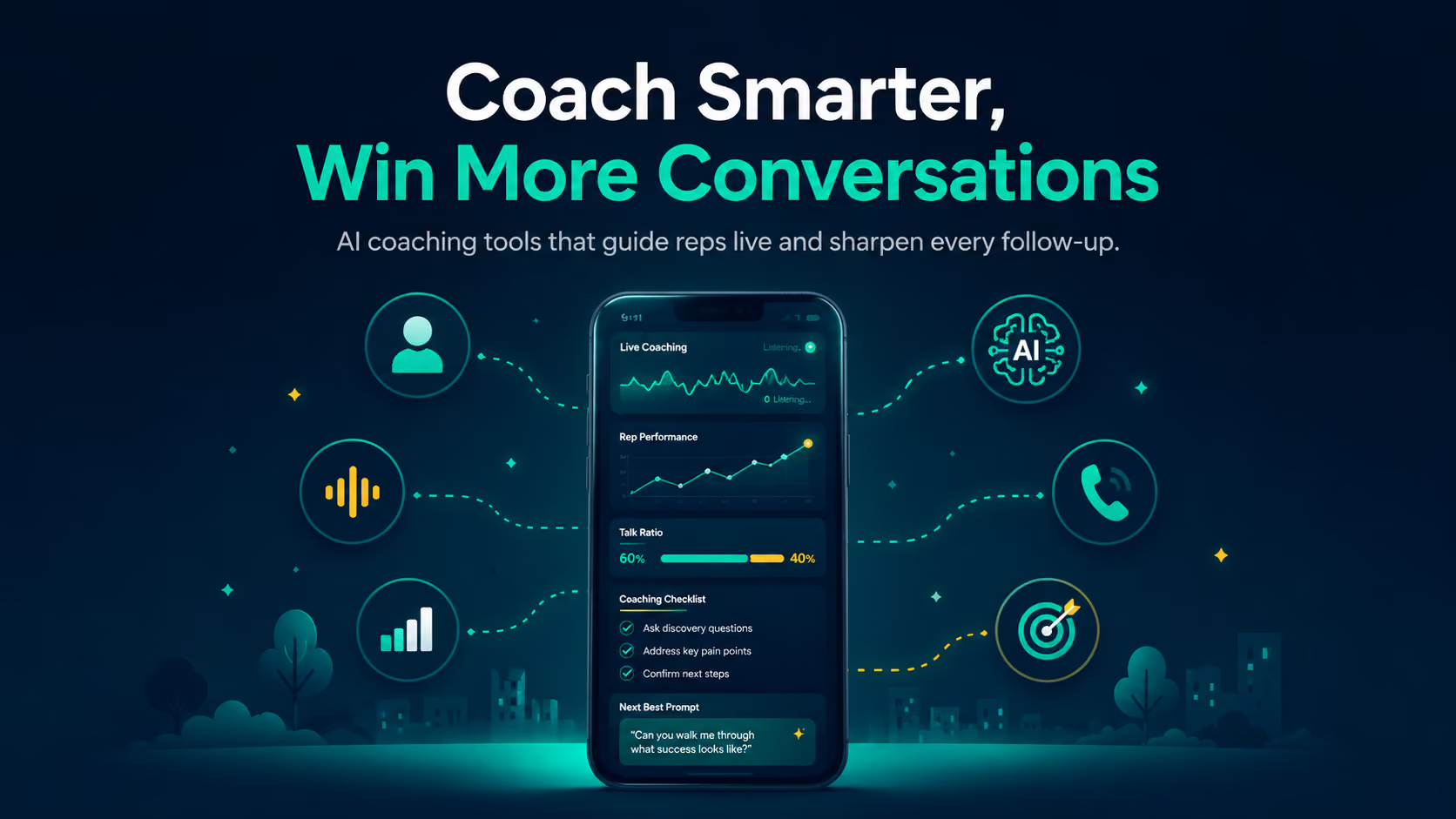
Sales coaching software helps managers review calls, identify coaching moments, improve rep behavior, and standardize what good selling looks like.
In 2026, the best tools go beyond scorecards. They capture conversations, summarize calls, surface objections, flag deal risks, recommend next steps, and push the right actions back into the CRM. ZIG stands out for teams that want coaching signals connected to execution, not another dashboard managers have to inspect manually.
Key Takeaways
- Sales coaching software helps managers coach reps using call data, scorecards, conversation intelligence, call summaries, and performance trends.
- Real-time coaching software can surface live prompts, battlecards, or risk signals during a call, but not every coaching tool offers live feedback.
- Conversation intelligence is now a core part of sales coaching because it captures the moments managers used to miss.
- The best coaching platforms do not stop at call review. They push summaries, next steps, risks, and action items back into the sales workflow.
- ZIG is a strong fit for mid-market teams that want coaching insights tied to CRM updates, follow-ups, meeting prep, and pipeline execution.
- Gong, Clari Copilot, Salesloft, Outreach, Avoma, Mindtickle, Highspot, Allego, and Modjo all serve different parts of the sales coaching market.
- Small teams should avoid buying enterprise coaching suites if they only need recording, summaries, and basic coaching workflows.
- Salesforce integration matters because coaching is more useful when call insights connect to accounts, opportunities, pipeline stage, and rep activity.
What Is Sales Coaching Software?
Sales coaching software helps sales managers review rep performance, analyze calls, surface coaching moments, track skill development, and standardize follow-up. Modern platforms often include conversation intelligence, AI call summaries, scorecards, real-time prompts, CRM sync, and coaching workflows.
The category spans a wide range, from lightweight meeting recorders to full revenue intelligence platforms. What separates useful sales coaching software from a recording tool is the layer above the transcript: objection detection, talk-ratio analysis, deal risk flags, coaching scorecards, and structured workflows that connect coaching moments to rep behavior.
| Feature | What It Does | Why It Matters |
|---|---|---|
| Call recording | Captures sales conversations | Managers can review real examples instead of relying on rep memory |
| Transcription | Turns calls into searchable text | Coaching moments become easier to find |
| AI call summaries | Summarizes what happened on the call | Reps and managers save review time |
| Scorecards | Grades calls against defined criteria | Coaching becomes more consistent |
| Talk-time analysis | Shows rep vs buyer balance | Helps managers spot conversation patterns |
| Objection tracking | Identifies recurring objections | Managers can coach messaging and positioning |
| Keyword detection | Flags competitor, pricing, budget, and timeline mentions | Important moments are easier to inspect |
| Real-time prompts | Guides reps during live calls | Reps can adjust while the conversation is still happening |
| CRM sync | Logs summaries, notes, and activities | Coaching connects to pipeline context |
| Follow-up support | Drafts or tracks next steps | Coaching turns into action |
Sales coaching software vs. conversation intelligence
Conversation intelligence captures and analyzes calls. Sales coaching software uses those insights to improve rep behavior. Some platforms do both. ZIG's distinction is that it connects conversation intelligence to execution: coaching signals become CRM updates, follow-ups, and next steps, not just scorecard entries. For teams building a shortlist, the Gong alternatives article and best conversation intelligence software comparison both cover this category in detail.
| Category | Main Job | Common Gap |
|---|---|---|
| Conversation intelligence | Records, transcribes, and analyzes sales conversations | Insights may stay disconnected from next steps |
| Sales coaching software | Helps managers coach rep behavior and skills | Coaching may stay manual if workflows are not connected |
| Revenue intelligence | Connects conversations and deal activity to pipeline risk | Often focuses on visibility more than rep execution |
| Sales execution platform | Turns insights into CRM updates, follow-ups, tasks, and next actions | Needs workflow depth and CRM write-back to work well |
| ZIG | Connects conversation intelligence to sales execution | Best fit for teams that want coaching to drive action |
What Should Sales Coaching Software Do in 2026?
The category requirements have expanded significantly. Buyers should use this list as the baseline before evaluating any platform.
| 2026 Requirement | Why It Matters |
|---|---|
| AI call summaries | Reps should not manually recreate call notes |
| Conversation intelligence | Managers need searchable call data and coaching moments |
| Real-time guidance | Reps need help during calls, not only after calls |
| Scorecards | Managers need consistent coaching standards |
| Call libraries | Teams need examples of strong discovery, objection handling, and next-step setting |
| CRM integration | Coaching context should connect to opportunities and accounts |
| Follow-up support | Call feedback should become action |
| Pipeline context | Managers should coach based on deal stage and risk, not isolated calls |
| SDR manager workflows | Frontline managers need fast review queues and coaching priorities |
| Pricing flexibility | Small and mid-market teams should avoid enterprise-only cost structures |
Best Sales Coaching Software in 2026: Quick Comparison
| Tool | Best Fit | Coaching Strength | Real-Time Feedback | AI Call Summaries | Salesforce Fit | Pricing Note |
|---|---|---|---|---|---|---|
| ZIG | Mid-market teams that want coaching plus execution | Turns call intelligence into CRM updates, follow-ups, next steps, and pipeline actions | Best framed as coaching-aware execution rather than pure live call prompting | Yes, as part of conversation-to-action workflows | Confirm exact Salesforce setup during evaluation; ZIG supports Salesforce and HubSpot write-back | Outcome-based pricing |
| Gong | Enterprise revenue teams | Deep conversation intelligence, coaching insights, call libraries, deal risk | Some real-time and near-real-time intelligence depending on package | Yes | Strong Salesforce ecosystem presence | Custom/enterprise pricing |
| Clari Copilot / Chorus | Forecast and revenue teams | Call analysis, coaching workflows, deal inspection, risk signals | Strong live and post-call coaching positioning | Yes | Salesforce workflows are common in Clari environments | Custom pricing |
| Salesloft | Sales engagement teams | Coaching tied to cadence and conversation workflows | Some live/post-call features depending on package | Yes | Strong Salesforce sales engagement fit | Custom pricing |
| Outreach | Enterprise outbound and engagement teams | Deal, sequence, and rep performance coaching | Varies by package | Yes | Strong CRM and sales engagement fit | Custom pricing |
| Avoma | Small and mid-market teams | Meeting recording, summaries, scorecards, coaching workflows | More post-call than live-call focused | Yes | CRM integrations available | More transparent lower-entry pricing |
| Mindtickle | Enablement-led sales orgs | Readiness, training, coaching, call insights, skills programs | More enablement/coaching workflow focused | Yes where conversation intelligence is included | Strong Salesforce enablement positioning | Custom pricing |
| Highspot | Enablement and content-led teams | Coaching tied to content, training, and readiness | Not primarily a live-call coaching tool | Varies by package | Strong enterprise CRM fit | Custom pricing |
| Allego | Enablement and async coaching teams | Video coaching, readiness, call review, content enablement | Not primarily live-call focused | Varies by package | CRM integrations available | Custom pricing |
| Modjo | European and SMB/mid-market teams | Call coaching, summaries, conversation review | More post-call coaching focused | Yes | CRM integrations available | Custom pricing |
| Jiminny | Teams that want coaching and call intelligence | Call recordings, coaching workflows, performance insights | More post-call focused | Yes | CRM integrations available | Custom pricing |
| Salesforce Conversation Insights | Salesforce-first teams | Native CRM-adjacent conversation intelligence | Salesforce-native context | Yes | Native Salesforce environment | Salesforce package dependent |
| HubSpot Sales Hub / Breeze | HubSpot-first small and mid-market teams | Embedded AI, summaries, CRM activity context | Limited compared with dedicated live coaching tools | Yes | Native HubSpot environment | Tier dependent |
Best overall for sales coaching plus execution: ZIG
A manager can identify a coaching moment in a call, but the team still needs the CRM updated, the follow-up drafted, the next step captured, and the opportunity kept clean. ZIG closes that gap by turning conversation intelligence into sales execution.
ZIG is the best fit when coaching needs to connect to action. Through its AI-powered Revenue Operating System, conversation intelligence feeds CRM updates, follow-ups, meeting prep, next-step tracking, pipeline hygiene, and coaching signals, all in one execution layer rather than spread across separate tools. Pricing is tied to execution workload rather than per-seat access, which matters for teams that want cost aligned to value.
This is not a traditional sales enablement LMS. It is a coaching-aware execution platform. The distinction matters because enablement tools help reps prepare; ZIG helps reps complete the next step that coaching identified.
Which Sales Coaching Software Gives Real-Time Call Feedback?
The sales coaching tools most associated with real-time call feedback are platforms that listen to live calls and surface prompts, battlecards, objection guidance, or knowledge snippets during the conversation. Teams should separate true live coaching from post-call AI coaching and call-summary automation.
Research into real-time AI sales support shows that live question detection and answer retrieval during calls can improve rep confidence and reduce reliance on memory during complex technical conversations. That research also notes that the value depends heavily on the quality of the underlying knowledge base and how prompts are surfaced without disrupting the call.
| Coaching Type | What It Does | Best Fit | Limitation |
|---|---|---|---|
| Live call prompts | Shows guidance while the rep is still on the call | Teams that want in-call support | Can distract reps if too noisy |
| Real-time answer retrieval | Finds approved answers to buyer questions during calls | Technical or product-heavy sales teams | Requires strong internal knowledge base |
| Manager live alerts | Flags calls that may need manager attention | SDR teams and call centers | Works best in high-volume environments |
| Post-call coaching | Scores calls and surfaces coaching moments after the call | Most B2B sales teams | Feedback may arrive too late for that call |
| AI call summaries | Summarizes calls and action items | Reps and managers who need faster review | Summary quality depends on transcript accuracy |
| Coaching plus execution | Turns coaching signals into CRM updates, follow-ups, and next steps | Teams that want coaching to change pipeline behavior | Needs CRM integration and workflow design |
Real-time feedback vs. post-call coaching
Real-time feedback helps during the call. Post-call coaching helps after the call. Execution support makes sure the next action happens. The best stack may include all three, but many teams only need two. ZIG's strongest claim is the third layer: post-call intelligence becomes CRM context, follow-up work, and pipeline execution, so the coaching moment is not lost to admin.
Best AI Sales Coaching Software for Mid-Market Teams
Mid-market teams need fast rollout, solid CRM sync, call summaries, manager coaching queues, and rep adoption, without enterprise-only pricing or months of implementation. ZIG wins for mid-market teams that need coaching tied to follow-up and CRM work rather than an enablement platform they need a dedicated admin to run.
| Mid-Market Need | Why It Matters | Best-Fit Tool Type |
|---|---|---|
| CRM write-back | Managers need coaching tied to opportunity context | ZIG, Gong, Clari, Salesloft |
| Call summaries | Reps need fast notes and action items | ZIG, Gong, Avoma, Clari, Salesloft |
| Coaching queues | Managers need prioritized review moments | Gong, Clari, Mindtickle, Salesloft |
| Execution after calls | Feedback should become follow-up and CRM action | ZIG |
| Affordable rollout | Teams need value without enterprise bloat | ZIG, Avoma, Modjo, Jiminny depending on needs |
| SDR coaching | Managers need call review, objection trends, and ramp support | Gong, Clari, Salesloft, Mindtickle, ZIG |
| Pipeline context | Coaching should connect to deal progress | ZIG, Gong, Clari |
| Human approval | AI should draft, not blindly act | ZIG and workflow-first platforms |
Why ZIG fits mid-market sales coaching
Mid-market teams often have managers stretched thin and reps buried in admin. Coaching breaks down when managers find issues on a call but reps still miss follow-ups or leave CRM fields blank after the conversation. ZIG helps close that loop: coach the moment, then execute the next step.
Most dashboards identify the problem. ZIG helps the team do the next thing right. That matters for mid-market RevOps and sales leadership teams who want coaching to show up in pipeline outcomes, not just review queues.
Best Sales Coaching Software for SDR Managers
SDR managers need high-volume call review without listening to every call. Objection trend spotting, talk-track inspection, rep ramp support, call libraries, scorecards, follow-up quality visibility, and CRM hygiene monitoring all matter. The tool has to help managers coach at scale.
| SDR Manager Need | Best Tool Type | Why |
|---|---|---|
| Review many calls quickly | Conversation intelligence | Finds coaching moments without listening to every call |
| Coach objection handling | Call scoring and keyword detection | Shows patterns across reps |
| Improve follow-up quality | Coaching plus execution | Turns call feedback into better next steps |
| Ramp new SDRs | Call libraries and scorecards | Shows examples of strong calls |
| Keep CRM clean | Execution platform | Makes coaching visible in pipeline data |
| Track pipeline creation | CRM-connected coaching | Connects rep behavior to opportunities |
| Reduce manager inspection time | AI summaries and coaching queues | Surfaces what needs attention first |
| Improve adoption | Assistant-style workflows | Reps benefit directly instead of feeling monitored |
SDR coaching workflows worth building
The tools matter less than the workflow around them. SDR managers getting the most from coaching software tend to build these into the weekly cadence:
- Weekly call review queue: AI surfaces the calls worth coaching, not every recording
- Objection-of-the-week library: recurring objections become team coaching content
- Missed-next-step report: flags deals where follow-up didn't happen
- Follow-up quality review: managers inspect whether AI drafts were sent and whether they were accurate
- New-rep ramp playlist: curated examples of strong discovery, objection handling, and close language
- Talk-ratio and discovery-depth review: identifies monologues and weak questioning patterns
- CRM hygiene coaching: connects post-call data quality to manager expectations
Sales Coaching Software With Conversation Intelligence Built In
Conversation intelligence has become the engine for coaching software.
The research base supports why: foundational work in conversational intelligence demonstrates that real-time spoken language understanding, speaker separation, topic detection, and event extraction are the technical layers that make coaching signals reliable. Without them, coaching relies on rep memory and manager intuition.
| Conversation Intelligence Feature | Coaching Use |
|---|---|
| Transcript search | Managers find exact moments to coach |
| AI summaries | Reps and managers review calls faster |
| Speaker separation | Managers see rep vs buyer talk patterns |
| Topic detection | Pricing, competitor, budget, and timeline moments become visible |
| Objection tracking | Managers coach recurring blocker patterns |
| Talk ratio | Managers identify monologues and weak discovery |
| Question analysis | Managers inspect discovery depth |
| Call scorecards | Teams standardize what good looks like |
| Deal risk signals | Managers coach at-risk opportunities |
| CRM sync | Coaching connects to pipeline context |
ZIG's position in this category is that conversation intelligence should not end at insight. The sales execution platform layer picks up where coaching software typically stops: turning the insight into a CRM update, a follow-up draft, or a next-step task. For teams comparing revenue intelligence tools alongside coaching platforms, the revenue intelligence explainer covers where those categories intersect and diverge.
Best Sales Coaching Software That Auto-Generates Call Summaries
AI call summaries are now table stakes. The more useful question is what a summary actually contains and what happens after it's generated.
| Call Summary Capability | Basic Tool | Strong Coaching Tool | ZIG Angle |
|---|---|---|---|
| Call recap | Summarizes the conversation | Highlights coaching moments | Turns summary into follow-up and CRM context |
| Action items | Lists next steps | Assigns owners and timing | Pushes next-step context into workflow |
| Objections | May mention objections | Tags objection patterns | Helps managers coach and reps follow up |
| CRM logging | Manual copy/paste | Auto-log or sync | Updates CRM as part of execution |
| Follow-up draft | Sometimes included | Tied to call context | Drafts the follow-up from the conversation |
| Deal risk | Rare in basic tools | Flags risk signals | Connects risk to pipeline hygiene |
What makes a call summary useful for coaching?
A useful summary captures more than what was said. It identifies what should be coached, records what the rep should do next, and preserves the right context in the CRM. A summary that doesn't change the next action is just a prettier transcript.
The sales execution strategy article explains in detail how AI agents are changing the standard for what "after the call" looks like in modern B2B sales teams.
Sales Coaching Software Comparison and Pricing
Common pricing models in this category vary widely. Buyers should understand what is included at each tier before assuming a low entry price covers the features they need.
| Pricing Model | How It Works | Watchout |
|---|---|---|
| Per-seat pricing | Pay for each user | Costs rise as more managers, reps, and viewers need access |
| Recorder-seat pricing | Pay for users whose calls are recorded | View-only users may be cheaper or free |
| Platform fee | Pay a base fee for the system | May include minimum contract size |
| Add-on pricing | Conversation intelligence, coaching, or analytics cost extra | Low entry price may not include core coaching features |
| Custom enterprise pricing | Vendor quotes based on team size and package | Harder to compare without sales calls |
| Usage-based pricing | Cost changes with call volume or workflow usage | Can be efficient if usage maps to value |
| Outcome-based pricing | Pricing connects to completed work or business value | Best when the platform performs execution work, not just analysis |
McKinsey's research on AI adoption consistently notes that AI value depends on workflow integration, not just tool purchase. Pricing models that align cost with outcomes rather than access create better incentives for vendors to make implementation work.
Which sales coaching software is most affordable for small teams?
The most affordable sales coaching software for small teams is usually a meeting-intelligence or lightweight conversation-intelligence tool. If the team also needs CRM updates, follow-up execution, and pipeline hygiene, a workflow-based platform like ZIG may create more value than a lower-cost recorder.
Tools such as Avoma, Jiminny, Modjo, Fathom, and Fireflies-style recorders can be reasonable starting points for small teams that need call summaries and basic coaching review. The point where they fall short is execution: after the summary is generated, the work of CRM updates, follow-up drafting, and next-step tracking still falls on the rep.
ZIG's outcome-based pricing is stronger for teams that want cost tied to actual sales work completed rather than seats logged in.
Which Sales Coaching Software Integrates With Salesforce?
Salesforce integration in coaching software means more than a marketplace listing. The depth of integration determines how useful coaching insights are in practice.
| Salesforce Integration Need | Why It Matters |
|---|---|
| Activity logging | Calls, meetings, emails, and tasks should appear in CRM |
| Opportunity association | Coaching insights need deal context |
| Field write-back | Summaries, next steps, and risks should update the right fields |
| Custom fields | Mid-market and enterprise teams rarely use default objects only |
| Permissions | Reps, managers, and RevOps need controlled access |
| Audit trail | Teams need to know what AI changed and why |
| Call summary sync | Managers should not chase notes manually |
| Task creation | Coaching should become next action |
| Deal-stage context | Coaching should reflect where the opportunity is |
| Admin controls | RevOps needs rules, mapping, and governance |
The NIST AI Risk Management Framework is worth reviewing when evaluating any AI-driven coaching or execution tool that writes to production CRM data. It provides a practical framework for thinking about audit trails, human oversight, and permissions controls.
For RevOps teams thinking through governance alongside stack consolidation, the revenue operations platforms article covers how coaching tools fit into broader platform decisions.
Salesforce questions to ask every vendor
- Does the tool read and write Salesforce data?
- Which objects does it support (contacts, accounts, opportunities, activities, tasks)?
- Can it update custom fields?
- Does it create tasks automatically?
- Can summaries attach to opportunities?
- Can managers filter coaching by opportunity stage?
- Does it respect Salesforce permissions?
- Does it create duplicate activity records?
- Can RevOps control field mappings?
- Is the integration native, package-based, or API-based?
For ZIG, confirm exact Salesforce object requirements during evaluation. ZIG is built to write to the CRM the team already runs, including Salesforce and HubSpot, and the mobile CRM article covers how that write-back extends to rep workflows away from the desktop.
How to Choose Sales Coaching Software
| Team Type | Best Fit |
|---|---|
| Small team needing recordings and notes | Lightweight meeting intelligence |
| SDR team needing call review and scorecards | Conversation intelligence with coaching workflows |
| Mid-market team needing coaching plus follow-up execution | ZIG |
| Enterprise team needing deep conversation analytics | Gong or Clari-style conversation intelligence |
| Salesforce-first sales engagement team | Salesloft, Outreach, Salesforce-native options, or ZIG depending on workflow |
| Enablement-led team | Mindtickle, Highspot, or Allego-style readiness platforms |
| Team with poor CRM hygiene | ZIG or another execution-focused platform |
| Team with strong managers but weak follow-through | Coaching plus execution platform |
Features to prioritize
Call summaries, scorecards, CRM write-back, coaching playlists, manager review queues, follow-up drafting, deal risk signals, security and consent controls, pricing clarity, and workflow execution. These are the features that change rep behavior. Prioritize them over dashboard breadth.
Features that sound good but often go unused
Large dashboard libraries that nobody navigates. Generic sentiment scores with no actionable coaching output. Overly complex scoring rubrics that managers don't maintain. Call libraries that are curated once and never updated. Live AI prompts that interrupt reps mid-conversation. Coaching workflows that surface insights but don't connect to CRM or next steps.
The sales automation software article covers this pattern more broadly: features that require reps to change behavior without giving them anything in return tend not to stick.
Why ZIG Is Built for Sales Coaching That Turns Into Execution
Sales coaching fails when it becomes one more dashboard managers are supposed to inspect. ZIG is built for the next step after the coaching moment. It captures the conversation, turns it into CRM context, drafts the follow-up, tracks the next step, and keeps the pipeline cleaner. That makes coaching more useful because the system helps reps act on it.
ZIG turns coaching signals into CRM updates, follow-ups, next steps, and pipeline execution. That's the distinction between coaching software that produces insights and a platform that changes what the rep does next.
The best sales coaching software doesn't just tell reps what went wrong. It helps the team do the next thing right.
For teams evaluating this category, the sales execution strategy article covers how AI agents are changing what post-call execution looks like in practice. See the platform to understand how ZIG connects coaching intelligence to the full sales motion.
FAQs About Sales Coaching Software
What is sales coaching software?
Sales coaching software helps managers review calls, analyze rep performance, identify coaching moments, create scorecards, track skill development, and improve sales conversations using conversation data.
What is the best sales coaching software in 2026?
The best platform depends on the team's need. ZIG is best for teams that want coaching connected to execution. Gong is strong for enterprise conversation intelligence. Avoma-style tools fit smaller teams that mainly need call summaries and review workflows.
Which sales coaching software gives real-time call feedback?
Real-time call feedback tools provide live prompts, battlecards, objection guidance, or answer retrieval during calls. Buyers should confirm whether a vendor offers true live feedback, near-real-time alerts, or only post-call coaching before purchasing.
What is the best AI sales coaching software for mid-market teams?
ZIG is a strong fit for mid-market teams that want AI coaching signals tied to CRM updates, follow-ups, meeting prep, pipeline hygiene, and sales execution workflows.
What sales coaching software is best for SDR managers?
SDR managers should look for conversation intelligence, call scorecards, objection tracking, AI summaries, coaching queues, and CRM integration. ZIG is especially useful when managers want coaching to lead to cleaner follow-up and pipeline execution.
Which sales coaching software auto-generates call summaries?
Many modern coaching and conversation intelligence platforms generate AI call summaries. The stronger tools also capture objections, next steps, owners, deal risks, and CRM-ready notes alongside the summary.
What sales coaching software integrates with Salesforce?
Many enterprise sales coaching and conversation intelligence platforms integrate with Salesforce. Buyers should check whether the tool can log calls, sync summaries, update fields, create tasks, map custom objects, and respect Salesforce permissions. For ZIG, confirm exact Salesforce requirements during evaluation.
Is sales coaching software the same as conversation intelligence?
No. Conversation intelligence records and analyzes sales conversations. Sales coaching software uses those insights to help managers improve rep behavior. Some platforms combine both, and ZIG extends that further by connecting coaching signals to CRM execution.
How much does sales coaching software cost?
Pricing varies significantly by vendor and model. Common models include per-seat pricing, recorder-seat pricing, platform fees, add-ons for conversation intelligence, custom enterprise quotes, usage-based pricing, and outcome-based pricing.
What should small teams look for in sales coaching software?
Small teams should prioritize call summaries, easy setup, recording quality, basic scorecards, CRM logging, transparent pricing, and simple manager workflows before buying an enterprise coaching suite.
Ready to see how ZIG turns call insights into pipeline execution? Book a demo to see the platform in action.
