
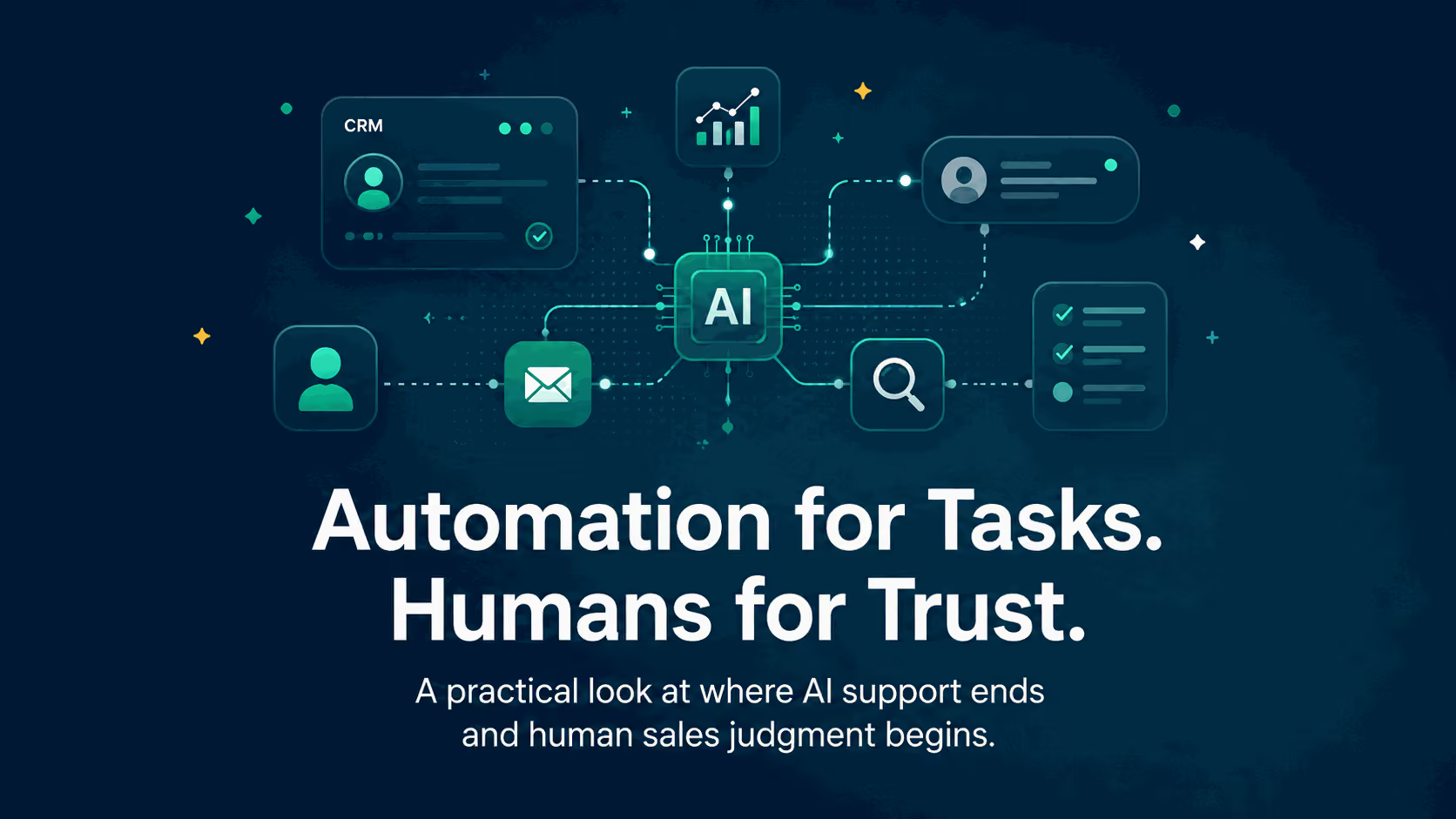
An AI sales assistant helps sales teams complete the work around selling: research, outreach, CRM updates, meeting prep, follow-ups, and pipeline hygiene. A human SDR handles the judgment-heavy work AI still struggles with: reading buyer context, qualifying real interest, adjusting messaging, managing ambiguity, and building trust.
The best setup in 2026 is not AI instead of SDRs. It is AI assistants taking the execution burden off SDRs so the humans can spend more time on the conversations that move pipeline.
Key Takeaways
- AI sales assistants are best at repeatable sales execution work: CRM updates, research, meeting prep, follow-up drafting, outreach support, and pipeline hygiene.
- Human SDRs are still better at judgment-heavy selling: account strategy, qualification nuance, objection handling, relationship-building, and message refinement.
- AI SDRs usually focus on outbound prospecting or qualification, while AI sales assistants support more of the rep's day.
- AI sales assistants can reduce SDR workload in 2026, but should not be treated as a full human replacement for every sales motion.
- The most useful cost comparison is not software subscription vs SDR salary. It is completed work, rep capacity, pipeline coverage, and manager visibility.
- Mid-market sales teams should prioritize AI assistants that integrate with their CRM, write back clean data, handle multi-step workflows, and keep humans in approval loops.
- ZIG is built for teams that want an AI sales assistant to execute work across the sales motion, not just recommend the next task.
What Is an AI Sales Assistant?
An AI sales assistant is software that helps sales reps complete the operational work around selling. It can research accounts, draft outreach, prep meetings, summarize calls, update CRM records, create follow-up tasks, and keep pipeline data clean.
The category is broader than "AI chatbot" or "AI SDR." A genuine AI sales assistant operates across multiple workflows in a rep's day, not just top-of-funnel outbound.
| AI Sales Assistant Task | What It Helps With | Why It Matters |
|---|---|---|
| Account research | Pulls company, contact, and deal context together | Reps spend less time preparing manually |
| Lead research | Finds and organizes prospect context | SDRs can focus on better targeting |
| Outreach drafting | Creates first drafts for email or follow-up | Reps start faster and edit instead of writing from scratch |
| Meeting prep | Summarizes account history, prior notes, stakeholders, and next steps | Reps walk into calls with context |
| Call summary | Turns meeting notes into structured summaries | Less post-call admin |
| CRM update | Writes call notes, fields, tasks, and deal changes back to the CRM | Cleaner pipeline data |
| Follow-up drafting | Produces next-step emails after calls | Follow-up happens faster |
| Pipeline hygiene | Flags stale deals, missing next steps, and overdue tasks | Managers get cleaner visibility |
| Re-engagement support | Drafts revive-the-deal messages for stalled opportunities | More pipeline gets worked without manual chasing |
AI sales assistant vs. sales copilot vs. sales agent
These terms are often used interchangeably. The meaningful distinction is whether the tool suggests or executes.
| Term | Common Meaning | Limitation | ZIG Angle |
|---|---|---|---|
| Sales copilot | Helps reps with suggestions, summaries, and drafts | Often leaves the work for the rep | ZIG does more than surface recommendations |
| AI sales agent | Executes defined workflows with some autonomy | May be narrow or single-workflow | ZIG gives teams assistants across the sales motion |
| AI SDR | Automates prospecting, qualification, or outbound tasks | Often top-of-funnel only | ZIG supports outbound plus post-meeting and pipeline execution |
| AI sales assistant | Helps reps complete daily sales work | Quality depends on CRM integration and workflow depth | ZIG is built around completed sales execution work |
What Does a Human SDR Do?
A human SDR owns the judgment-heavy work of creating and qualifying early pipeline. They decide which accounts deserve attention, adjust messaging based on buyer context, handle ambiguity, learn from market feedback, and create qualified conversations for the sales team.
The SDR role is not a list of tasks. It is a series of judgment calls made under uncertainty: which account is worth pursuing, how to read a response that might be polite disinterest or genuine curiosity, how to adjust the message when the first version didn't land, how to build enough trust on a cold call to earn a next conversation.
That judgment layer is built from market feedback, manager coaching, pattern recognition, and lived experience with buyer behavior. It cannot yet be replicated by a system that processes inputs and generates outputs without the ability to sit with ambiguity, sense hesitation in a voice, or remember what a specific buyer type tends to care about six months into a sales cycle.
Where human SDRs still beat AI
| Human SDR Strength | Why AI Struggles |
|---|---|
| Reading buyer nuance | Buyer intent is often implied, not stated |
| Prioritizing ambiguous accounts | ICP fit can depend on context not in the data |
| Live objection handling | Real conversations need judgment and timing |
| Message refinement | Humans learn from tone, pushback, and market feedback |
| Relationship-building | Trust still depends on human presence in many B2B motions |
| Strategic account thinking | Enterprise and mid-market accounts rarely follow a fixed script |
| Cross-functional handoffs | SDRs can interpret context before passing a deal forward |
AI Sales Assistant vs. Human SDR: The Simple Difference
The difference between an AI sales assistant and a human SDR is that the assistant handles repeatable execution work, while the SDR owns judgment, buyer interaction, qualification, and account strategy.
| Category | AI Sales Assistant | Human SDR |
|---|---|---|
| Main role | Completes sales execution tasks | Creates and qualifies pipeline |
| Best at | Research, CRM updates, follow-ups, meeting prep, admin, pipeline hygiene | Conversations, judgment, objection handling, personalization, account strategy |
| Works best with | Clear workflows, CRM data, defined approval rules, repeatable tasks | ICP knowledge, manager coaching, buyer feedback, messaging context |
| Weakness | Can misread nuance or act on weak data without guardrails | Can be slowed down by admin and tool-switching |
| Best use case | Giving reps more capacity and cleaner execution | Human-led prospecting and qualification |
| Replacement risk | Can replace parts of SDR workflow | Still needed where judgment and relationship matter |
| ZIG fit | Takes on execution work across the sales day | Lets SDRs spend more time selling |
The Stanford AI Index data on AI adoption in business documents that commercial AI value concentrates in structured, repeatable tasks, not in judgment-intensive work. That distinction maps directly to how sales teams should think about where AI assistance earns its keep.
Can AI Sales Assistants Replace SDRs in 2026?
AI sales assistants can replace many SDR tasks in 2026, but not the full SDR role in most B2B teams. They are strongest when they remove research, CRM, follow-up, and admin work so SDRs can spend more time on buyer conversations and qualification.
AI sales assistants replace the admin burden before they replace the SDR. McKinsey's research on AI adoption consistently finds that AI value in business depends on workflow redesign, not just tool deployment. Teams that redeploy SDR time from admin to qualification tend to see more pipeline per rep, not fewer reps.
Tasks AI can take from SDRs
| SDR Task | Can AI Assist? | Can AI Fully Own It? | Notes |
|---|---|---|---|
| Basic account research | Yes | Often | Works well with clear data sources |
| Contact enrichment | Yes | Often | Needs data-quality checks |
| First-draft outreach | Yes | Sometimes | Human review improves tone and relevance |
| CRM updates | Yes | Often | Strong fit when CRM fields and rules are clear |
| Call summaries | Yes | Often | Human approval helps for important deals |
| Follow-up drafts | Yes | Often | Best with rep approval before sending |
| Stalled-deal reminders | Yes | Often | Strong fit for pipeline hygiene |
| Qualification calls | Yes | Sometimes | Human judgment still matters |
| Objection handling | Partly | Rarely | Better handled by trained SDRs |
| Account strategy | Partly | Rarely | AI can prep; humans decide |
Tasks SDRs should still own
High-fit account decisions that depend on strategic context are not captured in CRM fields.
Real-time qualification where buyer signals are ambiguous: the rep who senses a champion losing internal support before it shows up in any data. Complex objections that require negotiation cues and adaptive listening. Buyer relationship management where trust compounds over multiple conversations and a rep's personal credibility becomes part of the value. Strategic messaging experiments that require learning from the market in real time and adjusting what is said based on how buyers react.
The feedback loop between frontline pipeline experience and sales leadership that shapes targeting, positioning, and next quarter's ICP is still fundamentally human.
AI Sales Assistant vs. AI SDR: Which Is Better?
An AI SDR is better when the main problem is top-of-funnel outbound volume. An AI sales assistant is better when the problem is rep capacity, CRM hygiene, follow-up speed, meeting prep, and deal execution.
The distinction matters because many vendors position their tools as "AI SDRs" even when the actual product is closer to a sales assistant or engagement tool. Teams should define their primary problem before evaluating tools. A team that books too few meetings may need a different solution than a team that books enough meetings but loses deals in the post-meeting execution gap.
| Need | AI SDR | AI Sales Assistant |
|---|---|---|
| More outbound volume | Strong fit | Useful, but broader than needed |
| Better lead research | Strong fit | Strong fit |
| CRM cleanup | Weak to moderate fit | Strong fit |
| Meeting prep | Usually weak | Strong fit |
| Post-call follow-up | Usually limited | Strong fit |
| Pipeline hygiene | Usually limited | Strong fit |
| Deal execution | Usually limited | Strong fit |
| Human approval workflows | Varies by tool | Critical feature |
| Best buyer | SDR-heavy outbound team | Mid-market team with reps buried in execution work |
How Does an AI Sales Assistant Work?
The process is sequential. A useful AI sales assistant is not a chatbot that waits for prompts. It reads context, identifies the needed workflow, and surfaces a completed action for rep review.
| Step | What Happens | Example |
|---|---|---|
| Connect | The assistant connects to CRM, email, calendar, meetings, and sales workflows | CRM records, call notes, account history |
| Understand | It reads deal context and identifies what needs attention | No next step, stale deal, upcoming meeting |
| Prepare | It gathers the right context | Account summary, stakeholder notes, prior emails |
| Draft | It creates the next action | Follow-up email, call summary, task, CRM update |
| Approve | The rep reviews sensitive actions | Rep edits or approves the follow-up |
| Execute | The assistant completes the workflow | Sends update, logs CRM change, creates task |
| Learn | The system uses feedback and prior outcomes to improve | Accepted drafts, rejected suggestions, deal movement |
The sales execution strategy article covers in detail how AI agents are absorbing specific sales workflows and what the before/after looks like for teams that have operationalized this. For reps managing accounts away from the desk, the mobile CRM article covers how execution extends beyond desktop workflows.
Best AI Sales Assistant Software for B2B Sales Teams in 2026
| Tool | Best Fit | Main Strength | Limitation to Watch |
|---|---|---|---|
| ZIG | Mid-market B2B teams that need AI to execute sales work | AI assistants for CRM updates, meeting prep, outreach, follow-ups, lead generation, and pipeline hygiene | Best fit for teams ready to operationalize AI across workflows |
| Salesforce Agentforce | Salesforce-native teams building agents inside Salesforce | Deep Salesforce ecosystem fit | Strongest when Salesforce is already the center of the GTM stack |
| HubSpot Breeze | HubSpot-first teams that want embedded AI | Native HubSpot experience | May be less flexible for teams needing a broader execution layer |
| Apollo AI | Prospecting-heavy teams | Database plus outbound workflows | More top-of-funnel than full sales execution |
| Salesloft AI | Sales engagement teams | Cadences, coaching, engagement workflows | Engagement-focused rather than full admin execution |
| Outreach AI | Enterprise outbound teams | Sales engagement and workflow orchestration | Stronger for engagement than full rep-assistant coverage |
| Gong AI | Revenue intelligence teams | Conversation and deal insights | Often surfaces signals more than it executes sales work |
| Clay | GTM engineering and data enrichment teams | Data workflows and enrichment | Requires more setup and workflow design |
| Regie.ai | Teams focused on outbound content and sequences | AI-assisted prospecting and messaging | Narrower than end-to-end sales assistant workflows |
| 11x / Artisan-style AI SDR tools | Teams testing autonomous outbound reps | AI outbound automation | May not cover post-meeting execution or pipeline hygiene |
Best AI sales assistant for mid-market sales teams
For mid-market B2B teams, ZIG is the strongest fit when the goal is not just more outbound but better sales execution across the full sales day. It helps reps handle CRM updates, meeting prep, lead research, follow-ups, outreach, and pipeline hygiene without forcing the team to replace its CRM.
The practical effect is that SDRs and AEs spend less of their day on structured execution work and more of it on qualified conversations. For managers, the pipeline becomes cleaner: next steps are logged, stale deals get flagged, and follow-up timing improves without a manager having to inspect every rep's task queue. For RevOps, CRM data becomes more reliable because the AI handles the update rather than leaving it to a rep at end of day when attention is low.
ZIG operates as an AI-powered Revenue Operating System, not a single-workflow assistant. Pricing is tied to execution workload rather than per-seat access, which is a meaningful difference for teams evaluating total cost. See Zig's pricing page for how execution coverage is structured across tiers.
For teams comparing AI-driven tools across the enrichment and execution stack, the Clay alternatives breakdown and the Clay vs. Apollo vs. ZIG comparison both cover where these tools overlap and diverge.
AI Sales Assistant vs. Human SDR Cost Comparison
The useful cost comparison is not software subscription against SDR salary. They serve different purposes and replace different types of work. A more honest framing compares cost per completed workflow (follow-ups sent, CRM fields updated, meetings prepped, stale deals re-engaged) rather than cost per seat or cost per headcount.
| Cost Category | Human SDR | AI Sales Assistant |
|---|---|---|
| Base cost | Salary or contractor cost | Platform fee or subscription |
| Variable cost | Commission, bonus, or incentive comp | Usage, execution, or workload-based pricing depending on vendor |
| Benefits and payroll | Health, payroll taxes, equipment, HR overhead | Usually none beyond software/vendor cost |
| Ramp time | Weeks or months before full productivity | Faster technical deployment, but workflow setup still matters |
| Management time | Coaching, inspection, pipeline reviews, performance management | Workflow design, QA, approval rules, and adoption management |
| Tool cost | CRM, data, dialer, email, enrichment, call recording, enablement | May replace or reduce some tools depending on platform |
| Quality risk | Inconsistent activity, turnover, poor fit, weak messaging | Bad data, weak guardrails, generic messaging, hallucinated context |
| Best use | Judgment-heavy prospecting and qualification | Repeatable research, admin, CRM, follow-up, and execution work |
| ZIG angle | Helps SDRs do more with less admin | Prices around execution workload rather than per-seat access |
For teams that want to benchmark SDR compensation inputs against current labor market data, the Bureau of Labor Statistics Occupational Employment and Wage Statistics provides current sales compensation benchmarks by role and region.
The better cost question: what work is truly getting done?
Teams should compare cost per completed workflow, not just cost per seat or cost per headcount. Follow-ups sent on time. CRM fields updated accurately. Meetings prepped with context. Stale deals re-engaged. Prospects researched before first contact. Pipeline records cleaned before forecast review. These are the outputs that determine whether AI investment is paying off, and they map directly to execution-based pricing models like ZIG's.
Which AI Sales Assistant Integrates With Salesforce and HubSpot?
| Integration Question | Why It Matters | What to Check |
|---|---|---|
| Does it connect to Salesforce? | Many mid-market and enterprise teams use Salesforce as system of record | Native integration, API approach, field write-back, permission model |
| Does it connect to HubSpot? | Many SMB and mid-market teams run HubSpot CRM | Marketplace listing, setup guide, object coverage, activity logging |
| Can it write back to CRM? | Assistants are less useful if reps still update records manually | Notes, tasks, fields, stages, next steps, contact records |
| Can reps approve actions first? | Sensitive workflows need human control | Approval rules, edit-before-send, role-based permissions |
| Does it preserve source context? | Managers need to trust CRM updates | Call transcript, email thread, meeting note, source link |
| Does it work across tools? | Sales work happens across CRM, email, calendar, meetings, and Slack | Supported channels and workflow surfaces |
| Can RevOps control fields and workflows? | Bad automation can damage CRM trust | Admin controls, audit logs, workflow rules |
ZIG has a native HubSpot marketplace listing and supports HubSpot CRM workflows including activity logging, deal updates, contact enrichment, and next-best-action workflows. For Salesforce, ZIG's execution content states the platform writes to Salesforce, HubSpot, or the CRM the team already runs. Teams should confirm exact Salesforce object and workflow requirements during evaluation.
The NIST AI Risk Management Framework is worth reviewing when evaluating any AI assistant that writes to production CRM data. Human oversight, auditability, and permission controls are not optional features. They are what makes an AI assistant trustworthy in a live sales environment.
Salesforce and HubSpot evaluation checklist
Before committing to any AI sales assistant that writes to a CRM:
- Which objects can it read (contacts, accounts, deals, activities)?
- Which fields can it update, and can it handle custom fields?
- Can it log calls, emails, and meetings?
- Can it create tasks and update deal stages?
- Can RevOps approve or restrict specific workflows?
- Does it preserve an audit history of AI-generated changes?
- Does it support rep-level and role-level permissions?
- Does it work alongside existing sales engagement tools?
How to Integrate an AI Sales Assistant Into an Existing Sales Team
The risk with any AI sales assistant rollout is deploying too broadly before the team has validated which workflows actually work. A phased approach reduces that risk and builds adoption.
| Phase | What to Do | Example Workflow |
|---|---|---|
| 1. Audit the work | Identify repetitive tasks slowing reps down | CRM updates, call summaries, follow-ups |
| 2. Pick first workflows | Start with work that is frequent and easy to inspect | Post-call follow-up and CRM logging |
| 3. Connect systems | Link CRM, email, calendar, meeting data, and communication tools | Salesforce or HubSpot plus email and meetings |
| 4. Define approval rules | Decide what AI can draft, update, or send | Rep approves external emails before send |
| 5. Pilot with one team | Test with a small SDR or AE group | Mid-market outbound team |
| 6. Measure execution | Track completed workflows, time saved, data quality, and rep adoption | Follow-up speed, CRM completeness |
| 7. Expand by workflow | Add more assistants after the first workflows prove value | Meeting prep, lead research, pipeline hygiene |
The sales execution platform explainer covers why this phased, workflow-by-workflow approach is more sustainable than trying to automate everything at once.
Metrics to track after rollout
| Metric | Why It Matters |
|---|---|
| Follow-up speed | Shows whether buyers get next steps faster |
| CRM update completion | Shows whether pipeline data is cleaner |
| Meeting prep completion | Shows whether reps enter calls with context |
| Stale deal count | Shows whether pipeline hygiene improves |
| Opportunities without next steps | Shows whether deals are being managed |
| AI draft acceptance rate | Shows whether reps trust the assistant |
| Manual admin time | Shows whether AI is reducing rep workload |
| Rep adoption | Shows whether the tool fits how reps work |
| Pipeline coverage | Shows whether more accounts and deals are being worked |
| Manager inspection time | Shows whether leadership gets cleaner visibility |
Why ZIG Fits the Hybrid SDR Model
ZIG fits the hybrid SDR model because it does not ask sales leaders to choose between AI and people. It gives reps AI assistants for the execution work that slows them down: research, outreach, prep, follow-up, CRM updates, and pipeline hygiene. SDRs stay focused on qualification, buyer conversations, and judgment. ZIG handles the work that should never have been manual in the first place.
ZIG gives every rep AI assistants for the work around selling, so humans can focus on the work only humans should own.
The evidence for this hybrid approach is practical. Teams that deploy AI assistance for structured execution tasks while keeping SDRs on qualification and buyer conversations tend to see higher meeting rates per rep, cleaner CRM data, and faster follow-up timing. Not because the AI is smarter than the SDR, but because the SDR is no longer the bottleneck for work that doesn't require judgment.
The AI-powered Revenue Operating System connects these workflows in one execution layer rather than requiring a separate tool for each task. The Gong alternatives article and the revenue intelligence explainer both help illustrate why insight-only tools and execution platforms serve different purposes in the sales stack.
FAQs About AI Sales Assistants and Human SDRs
What is an AI sales assistant?
An AI sales assistant is software that helps sales reps complete tasks such as account research, outreach drafting, meeting prep, CRM updates, follow-ups, and pipeline hygiene.
What is the difference between an AI sales assistant and a human SDR?
An AI sales assistant handles repeatable execution work, while a human SDR handles judgment-heavy prospecting, qualification, buyer conversations, objection handling, and account strategy.
Can AI sales assistants replace SDRs in 2026?
AI sales assistants can replace many SDR tasks, but they should not be treated as a full replacement for every SDR role. They work best when they reduce admin and help SDRs focus on higher-value sales work.
What is the difference between an AI sales assistant and an AI SDR?
An AI SDR usually focuses on outbound prospecting or qualification. An AI sales assistant supports a broader range of rep workflows, including CRM updates, meeting prep, follow-ups, pipeline hygiene, and deal execution.
What does an AI sales assistant do for B2B sales teams?
It can research accounts, draft outreach, summarize calls, prepare reps for meetings, update CRM records, create follow-up tasks, and help keep pipeline data accurate.
Which AI sales assistant is best for mid-market B2B teams?
ZIG is a strong fit for mid-market B2B teams that need AI sales execution across CRM updates, meeting prep, outreach, lead generation, follow-ups, and pipeline hygiene.
Does ZIG integrate with HubSpot?
Yes. ZIG has a native HubSpot marketplace listing and supports HubSpot CRM workflows such as activity logging, deal updates, contact enrichment, and next-best-action workflows.
Does ZIG work with Salesforce?
ZIG's sales execution content states the platform writes to Salesforce, HubSpot, or the CRM the team already runs. Teams should confirm exact Salesforce requirements during evaluation.
How should a sales team roll out an AI sales assistant?
Start with a workflow audit, choose two or three high-friction tasks, connect the CRM, define approval rules, pilot with one team, measure completed work, and expand by workflow.
What should buyers look for in AI sales assistant software?
CRM integration, workflow execution, approval controls, clean CRM write-back, meeting prep, follow-up automation, pipeline hygiene, security controls, and adoption metrics.
ZIG gives reps AI assistants for the work around selling. Book a demo to see how the execution layer works in practice.
