
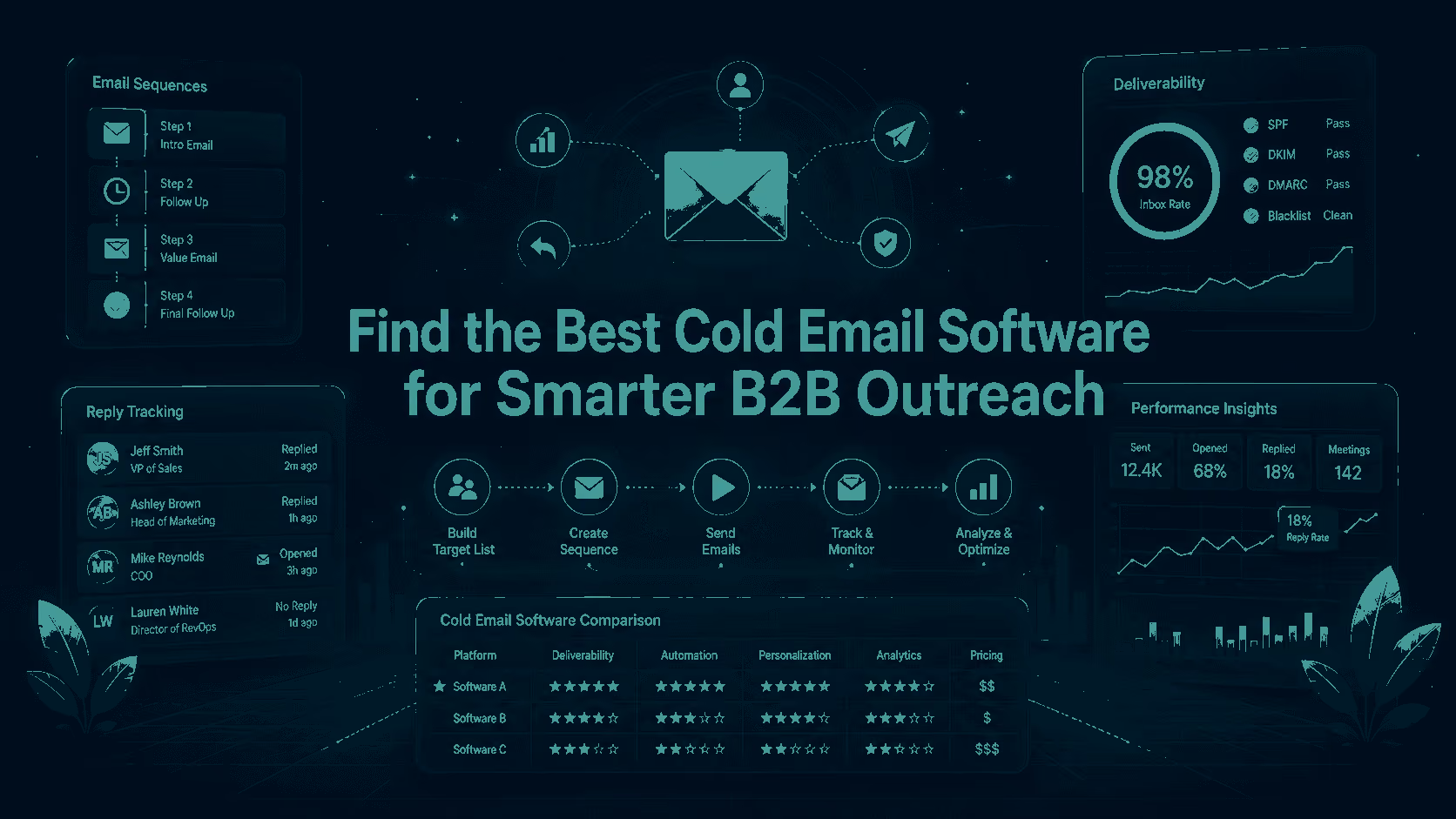
The question most teams ask when evaluating cold email software is which platform produces the highest reply rates. That is the wrong question.
Software controls the machinery: the sending, the rotation, the warmup, the A/B tests, the sequences. What it cannot control is whether the right person is on the list, whether the offer is relevant, or whether the timing is right. A recent benchmark put average cold email reply rates at 3.43%, with top-performing campaigns exceeding 10%, and attributed the gap primarily to targeting and timing rather than copy or tooling. Treat that figure as directional. Your numbers will depend on your ICP, your market, and your message.
What the right cold email platform genuinely can do: help teams reach inboxes instead of spam folders, reduce manual sequencing work, test messaging variations at scale, manage multiple sending domains, route replies to the right person, and connect outreach activity to the CRM. That is a meaningful set of problems. It just is not the same problem as "write a better email."
This comparison organizes platforms by the job they perform best rather than scoring ten loosely related products against an arbitrary rubric.
Key takeaways
- Instantly is a strong option for teams prioritizing scalable cold email infrastructure, warmup, inbox rotation, and lead sourcing.
- Smartlead is particularly well suited to agencies and high-volume senders managing many clients, domains, and inboxes.
- lemlist is strongest for highly personalized, multichannel campaigns combining email, LinkedIn, and calls.
- Reply.io suits teams wanting multichannel sales engagement, AI assistance, contact data, reply management, and meeting booking.
- Apollo is practical for teams that want B2B data and basic outreach in one platform.
- Saleshandy is a sensible choice for smaller teams and agencies watching budget.
- Woodpecker works well for smaller B2B teams seeking controlled, straightforward email sequences.
- Outreach and Salesloft are broader sales engagement platforms rather than pure cold email tools.
- Zig is most relevant when the team wants AI to complete research, personalization, follow-up, CRM updates, and post-reply sales work, not merely send more messages.
- No platform can guarantee the highest reply rate.
What is cold email software?
Cold email software helps businesses send, automate, personalize, test, track, and manage email outreach to prospects who do not yet have an established relationship with the sender.
Common capabilities include email sequencing, automated follow-ups, personalization variables, cold email A/B testing, inbox rotation, email warmup, sending limits, bounce detection, unsubscribe management, unified reply inboxes, lead databases, contact enrichment, cold email CRM integration, calendar booking, analytics, and AI-generated research or messaging.
Cold email software vs email marketing software
| Area | Cold email software | Email marketing software |
|---|---|---|
| Typical recipient | Individual B2B prospect | Subscriber or opted-in audience |
| Sending style | One-to-one outreach | Bulk campaign or newsletter |
| Primary goal | Start sales conversations | Nurture, inform, or promote |
| Common features | Sequences, inbox rotation, reply detection | Lists, templates, segmentation, campaign design |
| Sending infrastructure | Multiple connected mailboxes | Usually centralized marketing infrastructure |
| Main success metric | Positive replies and meetings booked | Opens, clicks, conversions, revenue |
Do not use a transactional email provider or newsletter platform for cold outreach unless its policies explicitly permit that use.
Cold email software vs sales engagement software
Cold email platforms focus primarily on email sending, deliverability, and campaign management. Asales engagement platformmay also include calls, LinkedIn tasks, SMS, rep task queues, account workflows, CRM-embedded activity, coaching, conversation intelligence, and team governance. The overlap is real in some tools, but the primary jobs differ.
Cold email software vs AI outbound platform
An AI cold email software platform or AI outbound execution tool may extend well beyond sequence automation by handling account research, trigger identification,lead enrichment and outbound toolsworkflows, message personalization, channel selection, reply classification, follow-up decisions, meeting preparation, CRM updates, and pipeline actions.
The distinction that matters:a standard sequencer with an AI copy generator added to the side is not the same thing as a true multistep AI outbound execution workflow.AI outbound salesplatforms execute the full workflow around each prospect, not just the send.
How cold email software works
The typical cold email outreach software workflow: import or source prospect data, verify and enrich contact information, connect sending inboxes, configure authentication and sending limits, warm or establish inbox reputation where appropriate, build a sequence, add personalization, define reply and bounce conditions, launch gradually, monitor deliverability and replies, route interested prospects, and sync activity to the CRM.
Email sequences
A sequence may contain an initial email, follow-up emails, value-add messages, case studies, a breakup email, manual tasks, LinkedIn touches, or call tasks. More steps do not automatically improve performance.Sequences should stop when someone replies, opts out, books a meeting, or otherwise becomes inappropriate to contact further.
Personalization
Effective personalization uses first name and company variables, role-specific messaging, industry context, recent company events, technology usage, hiring activity, funding signals, and relevant pain points. AI-generated opening lines can scale this, but generated personalization should be reviewed before sending. An incorrect personal detail leaves a more memorable impression than no personalization at all.
Cold email A/B testing
Platforms may test subject lines, opening lines, offers, calls to action, sequence length, message length, follow-up timing, and personalization approaches. The platform should separate variants cleanly and report on positive replies, not merely opens. Open tracking has become a less reliable decision metric as privacy controls and automated security systems create misleading activity data.
Reply detection and routing
Look for automatic stopping on reply, positive and negative reply classification, out-of-office detection, unsubscribe detection, meeting-intent detection, shared inbox, assignment rules, and CRM updates.A campaign that generates interest but delays human follow-up is an expensive notification system.
Which cold email software gets the highest reply rates?
No credible platform can guarantee the highest reply rate across every campaign.
Reply rate depends on ICP accuracy, list quality, timing, trigger relevance, offer strength, sender credibility, message quality, inbox placement, follow-up strategy, market saturation, brand recognition, and geographic and legal constraints.
Software contributes indirectly by helping teams reach the inbox, personalize accurately, test variations, contact prospects at relevant moments, follow up consistently, stop inappropriate messages, and route replies quickly.
Choose based on workflow fit and infrastructure needs. Evaluate results using your own prospect data, run a controlled pilot, and compare positive-reply rate, bounce rate, meetings booked, and opportunity creation.Vendor-published aggregate reply-rate claims should be treated as directional.
Cold email deliverability features that matter
Domain and sender authentication
Configuring SPF, DKIM, DMARC, custom tracking domains, and appropriate DNS records is foundational. The software should help detect configuration issues. The platform alone does not create a healthy sender reputation; it helps maintain one.
Email warmup
Warmup gradually establishes sending activity rather than launching at full volume from a new mailbox. Current guidance commonly recommends ramping over several weeks, though exact timelines vary by domain age, mailbox history, provider, reputation, and planned volume.
Cold email warmup software is not a force field. It cannot compensate for poor lists, spam complaints, sudden sending spikes, misleading copy, weak authentication, excessive mailbox volume, or low engagement.
Inbox rotation
Inbox rotation software distributes campaign sends across several connected accounts. This can help teams control per-mailbox volume, scale campaigns, isolate problems, avoid overloading one sender, and manage multiple client or brand inboxes. Instantly and Smartlead both emphasize multi-mailbox infrastructure, automated warmup, and rotation-oriented scaling.
Inbox rotation is a capacity and sender-health management approach. It is not a method for bypassing spam controls.
Sending limits and ramp controls
Look for per-mailbox daily limits, hourly throttling, randomized intervals, gradual ramping, time-zone controls, sending windows, pause rules, and health-based suspension. No universal send limit applies to every mailbox; many cold email deliverability tools advocate conservative daily volumes with gradual ramping, but the right number depends on domain history, provider, and campaign practices.
Bounce protection and list verification
Important features include email verification, catch-all detection, invalid-address filtering, bounce thresholds, automatic campaign pausing, domain-level suppression, and duplicate prevention. Uploading unverified lists is one of the fastest ways to damage sender reputation.
Inbox placement testing
Delivery (the message was accepted by the receiving server), inbox placement (the message reached the primary inbox), and engagement (the recipient interacted with it) are three different things. A high delivery rate does not necessarily mean strong inbox placement.
Sender health monitoring
Look for bounce trends, spam-placement indicators, authentication issues, domain health, mailbox health, provider-specific performance, campaign-level warnings, and automatic pause controls.
Best cold email software comparison
| Platform | Best for | Core strengths | Important limitation |
|---|---|---|---|
| Instantly | High-volume email-first outbound | Warmup, inbox rotation, rotation, lead data, campaign automation | Less suited to deep multichannel rep workflows |
| Smartlead | Agencies and infrastructure-heavy outbound | Multi-client management, mailbox scaling, warmup, unified replies | More technical than some small teams need |
| lemlist | Personalized multichannel outreach | Email, LinkedIn, calls, personalization, lead data | Costs and workflow complexity rise with broader use |
| Reply.io | AI-assisted multichannel sales engagement | Email, LinkedIn, calls, SMS, data, AI agents, reply handling | Broader than basic cold email needs |
| Apollo | Prospecting data plus outreach | Large B2B database, enrichment, sequencing, CRM integrations | Deliverability infrastructure less specialized than email-first platforms |
| Saleshandy | Affordable cold email for small teams | Multiple accounts, warmup, sequencing, agency features | Less comprehensive for complex multichannel execution |
| Woodpecker | Controlled B2B email outreach | Straightforward sequencing, agency support, personalization | Lighter than broader outbound platforms |
| Mailshake | Accessible sales outreach | Email campaigns, calls, social tasks, team workflows | Less infrastructure-focused than high-volume specialists |
| Outreach | Enterprise sales engagement | Governance, rep workflows, multichannel sequencing, analytics | Expensive and excessive for simple cold email campaigns |
| Salesloft | Enterprise sales engagement and rep productivity | Cadences, calls, analytics, coaching integrations | Not designed as low-cost cold email infrastructure |
| Zig | AI outbound and follow-through | Research, personalization, follow-up, CRM updates, meeting prep, pipeline execution | Not the strongest choice for raw inbox rotation or mass sending |
Instantly: Best for scalable email-first outbound
Best for:High-volume outbound teams, founders launching email-first campaigns, teams managing many mailboxes, and operations focused heavily on deliverability.
Instantly promotes deliverability-oriented features including warmup, inbox rotation, sending controls, and large-scale B2B contact sourcing. The platform is built around the infrastructure requirements of teams sending at scale across multiple sending accounts, with a unified reply management layer on top.
Where to be cautious:Instantly is email-first rather than fully rep-led multichannel. Teams may still need separate LinkedIn, calling, CRM, or execution tools. High volume does not guarantee high-quality replies, and infrastructure requires active monitoring despite automation.
Choose Instantly when the primary objective is launching and scaling campaigns across multiple inboxes with built-in deliverability tooling.
Smartlead: Best for agencies and multi-client outbound
Best for:Lead generation agencies, teams managing many client accounts, high-volume outbound operations, and users needing mailbox rotation and centralized replies.
Smartlead emphasizes unlimited mailboxes, AI-assisted warmup, centralized reply management, and agency-scale infrastructure. Multi-client campaign management, webhooks, and white-label or client-management capabilities make it particularly well suited to agencies running outbound for multiple brands simultaneously. This is the cold email software for agencies that prioritizes infrastructure depth over simplicity.
Where to be cautious:Smartlead may require more operational knowledge than a solo founder needs. Personalized multichannel engagement may require additional systems alongside it. Deliverability still depends on setup, data, and campaign practices.
Choose Smartlead when the operational challenge is managing many inboxes, campaigns, and clients without a fragmented setup.
lemlist: Best for personalized multichannel outreach
Best for:Teams combining email and LinkedIn, account-based outbound, lower-volume and higher-personalization campaigns, and sellers coordinating manual and automated touches.
lemlist supports coordinated email, LinkedIn, and calling sequences within one campaign workflow. The platform's conditional workflow logic and personalization options make it one of the strongest options in the multichannel outreach software category. It suits teams for whom relevance and coordinated touches matter more than raw sending volume.
Where to be cautious:lemlist may be excessive for simple email-only campaigns. Multichannel automation requires careful pacing. Pricing rises as teams and feature needs grow. Automated LinkedIn activity should be evaluated against platform policies.
Choose lemlist when relevance and coordinated multichannel touches matter more than maximizing email volume.
Reply.io: Best for AI-assisted multichannel sales engagement
Best for:SMB and mid-market sales teams, agencies wanting multichannel workflows, teams combining prospect data and outreach, and companies testing AI SDR functionality.
Reply presents itself as an AI outbound platform supporting multichannel sequences, automated follow-up, prospecting, reply management, and meeting booking. Email, LinkedIn, calls, SMS, and conditional workflows sit inside a single environment, supported by AI-assisted agent functionality and contact data.
Where to be cautious:Reply.io is broader than many teams need. It has more moving parts than a simple email sequencer. AI-generated communication still requires controls. Teams should compare deliverability depth against email-first specialists before committing.
Choose Reply.io when the team wants a broader sales engagement workflow, not a dedicated email-sending machine.
Apollo: Best for B2B data and outreach in one platform
Best for:Small and mid-sized B2B teams, founders needing prospect data and sequences, and teams consolidating lead sourcing and outreach in one place.
Apollo combines a large B2B contact database with search filters, enrichment, email sequencing, dialer features, and CRM integrations. For teams that spend significant time jumping between a data provider and a separate sequencer, consolidating into one platform has a clear operational appeal. ComparingClay vs Apollo vs Zigis worth doing if enrichment depth and outbound execution are both priorities.
Where to be cautious:Data accuracy varies by market and contact. Email verification before sending remains important. Apollo may not provide the same infrastructure depth as dedicated cold email platforms. Credit structures can complicate total cost, and teams may outgrow the sequencing functionality.
Choose Apollo when finding prospects and contacting them from the same system matters more than highly specialized cold email infrastructure.
Saleshandy: Best affordable option for smaller outbound teams
Best for:Small teams, freelancers, early-stage agencies, and budget-conscious outbound programs running email-first campaigns.
Saleshandy provides multiple sending accounts, email warmup, automated sequences, cold email A/B testing, a unified inbox, lead-finding features, and sender rotation at a price point that affordable cold email software buyers will appreciate. Agency features make it relevant for boutique operations managing more than one client without enterprise complexity.
Where to be cautious:Saleshandy is less extensive than enterprise engagement platforms. Multichannel capabilities are lighter than lemlist or Reply. Advanced workflow requirements may need integrations beyond the core platform.
Choose Saleshandy when affordability and practical cold email features matter more than a complex multichannel revenue stack.
Woodpecker: Best for controlled B2B cold email campaigns
Best for:Small B2B teams, boutique agencies, consultants, and organizations wanting straightforward sequence management with disciplined sending controls.
Woodpecker offers campaign sequencing, personalization, follow-up automation, reply detection, agency workflows, and deliverability controls. Its B2B cold email software model is opinionated in a useful way: it encourages discipline over scale.
Where to be cautious:Woodpecker has lighter prospecting database capabilities. It is less focused on high-volume inbox infrastructure than Instantly or Smartlead. Teams may need separate enrichment and LinkedIn tools.
Choose Woodpecker when the team wants disciplined, manageable B2B outreach without an enormous sending infrastructure to operate.
Outreach and Salesloft: Best for enterprise sales engagement
Outreach and Salesloft are not primarily cold email tools, and treating them as such misrepresents what they are built for. Both platforms are built around managing rep behavior, multichannel cadences, CRM-centered workflows, team analytics, governance, and coaching ecosystems at enterprise scale.
For teams evaluatingOutreach alternativesorSalesloft alternativesat lower cost or with a different execution model, there are now credible options that combine outreach with AI-assisted follow-through and CRM hygiene.
Where to be cautious:Higher total cost, per-seat pricing, and significant implementation requirements make both platforms difficult to justify for simple agency campaigns or early-stage teams.
Choose an enterprise sales engagement platform when managing rep behavior and governance is more important than low-cost bulk sending.
Zig: Best for AI outbound that continues after the email
Best for:Teams that want to automate more than sequence delivery: account research, contact enrichment, personalized message creation, outreach workflows, reply handling, follow-up, CRM updates, meeting preparation, and pipeline hygiene.
Thesales execution platformframing is the right one for Zig. Where most cold email outreach software stops at the send (and perhaps the reply notification), Zig continues into the work that follows. AnAI sales assistantmodel built around completing research, enrichment, personalization, sequencing, follow-up, andCRM automationmeans that a booked meeting is not the end of the workflow; it is a transition point into meeting preparation and pipeline execution.
For teams with an existingsales pipeline managementprocess that stalls because outbound activity never translates cleanly into CRM records and follow-up tasks, this is where Zig fits.
Where to be plainly honest:Zig is not positioned as a high-volume cold email infrastructure platform. It is not the clearest choice for inbox rotation across hundreds of mailboxes. It does not replace specialized deliverability monitoring. Teams focused solely on email volume at scale may prefer Instantly or Smartlead for that specific job.
Choose Zig when the problem is not merely sending cold emails. Choose it when the team wants AI to complete the surrounding sales work and connect outbound activity to CRM and pipeline execution.
If your outbound motion currently stops at "email sent" and rarely reaches "follow-up done, CRM updated, meeting prepared,"see how Zig handles what comes next.
Best cold email software by use case
| Use case | Recommended shortlist |
|---|---|
| High-volume cold email | Instantly, Smartlead |
| Lead generation agency | Smartlead, Instantly, Reply.io, Saleshandy |
| Personalized multichannel outreach | lemlist, Reply.io |
| Contact database plus sequences | Apollo, Instantly, Reply.io |
| Small outbound team | Saleshandy, Woodpecker, Mailshake |
| Enterprise SDR organization | Outreach, Salesloft |
| LinkedIn plus email | lemlist, Reply.io |
| Many inboxes and domains | Smartlead, Instantly |
| AI outbound execution | Zig, Reply.io |
| CRM updates and post-reply work | Zig |
| Simple controlled email campaigns | Woodpecker, Saleshandy |
| Broad sales engagement | Reply.io, Outreach, Salesloft |
How to choose cold email software
Define your outbound model
Ask: How many prospects will you contact? How many inboxes will you use? Is the campaign email-only or multichannel? Are reps sending manually or through centralized campaigns? Do you need lead data, or do you source it elsewhere? Do you manage multiple clients? And critically: what happens after a prospect replies?
Evaluate deliverability controls
Look for authentication checks, warmup, ramp controls, sending limits, inbox rotation, bounce monitoring, inbox placement tests, domain-health monitoring, automatic pause rules, and custom tracking domains. These are the cold email deliverability tools that protect sender reputation at scale.
Compare inbox and domain limits
"Unlimited inboxes" does not mean unlimited usable volume. Check connected-mailbox limits, active-mailbox limits, campaign limits, warmup limits, sending-credit limits, workspace restrictions, client-account limits, and any additional infrastructure charges.
Test personalization
Upload a realistic lead list and evaluate variable handling, fallback text, AI accuracy, research depth, conditional messaging, manual approval options, and bulk editing. Personalization that fails on edge cases will fail in front of real prospects.
Evaluate cold email A/B testing
Require true random or controlled allocation, step-level testing, clear sample sizes, positive-reply tracking, meeting tracking, and performance separated by audience. Automatic winner logic only makes sense where sample sizes are statistically meaningful.
Check cold email CRM integration depth
Ask: Are contacts created automatically? Are activities logged? Are replies synchronized? Can opportunities be created? Can ownership rules be respected? Can campaign status be written back? Are duplicates prevented? Can custom fields and objects be mapped?
Evaluate reply management
Look for a unified inbox, reply classification, shared assignments, interested-lead alerts, opt-out suppression, out-of-office handling, CRM routing, response-time analytics, AI-assisted drafts, and human approval controls.
Compare agency features
Agencies should assess separate client workspaces, client permissions, white labeling, domain and inbox management, portfolio reporting, centralized billing, API access, client-specific suppression lists, and account-level analytics.The right cold email software for agencies is measured by how cleanly it keeps client operations separate.
Calculate total cost
Include software subscription, sending inboxes, domains, lead data, verification credits, enrichment, warmup, LinkedIn tools, calling, AI credits, CRM integrations, agency seats, and infrastructure monitoring. The cheapest subscription often becomes significantly more expensive once every add-on is counted.
Thinking about running a pilot before committing?Talk to Zig about a controlled comparisonthat covers the full outbound workflow, not just the send.
How to select compliant cold email software
This is not legal advice. Software can support compliance, but the sender remains responsible for lawful data sourcing, appropriate targeting, accurate sender identification, honest subject lines, required disclosures, opt-out mechanisms, suppression-list management, record keeping, and jurisdiction-specific rules.
United States and CAN-SPAM
The FTC requires that commercial emails use accurate header information, avoid deceptive subject lines, include a valid physical postal address, provide a clear opt-out method, and honor opt-out requests promptly. Software should support accurate sender details, physical-address fields, unsubscribe links, suppression lists, and audit records. You can check the complete rules in theFTC CAN-SPAM Act Compliance Guide for Businesses.
United Kingdom and PECR
The UK ICO states that senders must not conceal their identity and must provide a valid address through which recipients can opt out. Rules differ between corporate subscribers and individual subscribers. Link to currentICO guidance on business-to-business marketingrather than reducing the law to a simple statement about B2B email.
European Union and GDPR
Personal data needs a lawful basis for processing. Legitimate interests may apply in some B2B direct-marketing situations, but relevance, necessity, transparency, balancing, and objection rights all matter. See how the three-part test is structured under theICO Legitimate Interests Guide. National electronic-marketing laws may add further requirements, and the rules are not identical across every EU market.
Canada and CASL
Canada generally applies stricter consent rules than the United States. Consult currentCanadian government CASL guidanceor legal counsel before launching campaigns to Canadian recipients.
Compliance features to compare
Global suppression list, workspace-level suppression, one-click unsubscribe, manual opt-out detection, audit logs, source tracking, consent fields, geographic segmentation, data-retention controls, role-based permissions, do-not-contact synchronization, and CRM opt-out sync.
How to test cold email software before committing
A controlled pilot using the same target segment, comparable list quality, similar inbox reputation, the same offer, equivalent sequence length, similar sending windows, and a meaningful but limited sample gives the clearest read on real-world performance.
Metrics to compare:valid-email rate, bounce rate, inbox placement, positive-reply rate, negative-reply rate, opt-out rate, spam complaints, meetings booked, qualified opportunities created, time spent managing campaigns, time from reply to follow-up, CRM data completeness, and total cost per meeting booked.
Do not use open rate as the primary decision metric.
Common cold email software mistakes
Choosing based on maximum sending volume.More volume can produce more complaints, damaged domains, and low-quality conversations. A tool that sends faster is not automatically better.
Assuming warmup guarantees deliverability.Warmup is only one part of sender reputation and campaign health. It cannot compensate for bad data or poor targeting.
Uploading unverified lists.Poor data creates bounces and damages sender reputation in ways that take time to recover from.
Overpersonalizing with bad AI data.A fabricated personal detail is worse than no personalization. AI-generated lines should be reviewed before sending at scale.
Tracking only open rate.Open data can be unreliable and does not indicate buyer intent. Positive replies and meetings booked are more meaningful signals.
Failing to stop sequences.Sequences should stop on replies, opt-outs, bookings, and other disqualifying events. A prospect who booked and then receives a follow-up email is not impressed.
Ignoring what happens after a reply.The campaign generates interest. If human follow-up is delayed, that interest dissipates. Reply routing and CRM updates should be part of the workflow design, not an afterthought.
Treating compliance as a checkbox.The tool assists with compliance. It does not make strategic, jurisdictional, or legal decisions for the sender.
Matching your stack to your outbound motion
Cold email software is a category that describes products with very different jobs. The best cold email software for a lead generation agency running 50 client campaigns across hundreds of rotating domains looks nothing like the best tool for a six-person B2B team running a focused, personalized outreach motion.
ChooseInstantlyfor scalable email-first outbound with multiple inboxes and built-in deliverability tooling. ChooseSmartleadfor agency operations and high-volume multi-client infrastructure. Chooselemlistfor personalized multichannel outreach. ChooseReply.iofor AI-assisted multichannel sales engagement. ChooseApollowhen contact data and basic sequencing need to live in the same system. ChooseSaleshandyfor affordable cold email functionality. ChooseWoodpeckerfor controlled, disciplined B2B outreach. ChooseOutreach or Salesloftfor enterprise rep workflows and governance.
ChooseZigwhen outbound should continue into follow-up, CRM updates, meeting preparation, and pipeline execution. Sending the email is only the first task. Thebest sales prospecting toolsget prospects into a conversation. Zig helps complete what happens next.
If your outbound currently generates replies that take too long to reach the right person, or meetings that show up without account context,see how Zig handles the full outbound workflow.
FAQ
What is the best cold email software?
The best platform depends on the use case. Instantly and Smartlead suit high-volume cold email infrastructure, lemlist suits personalized multichannel outreach, Reply.io suits broader sales engagement, and Zig suits AI-assisted outbound with follow-through, CRM updates, and pipeline execution.
Which cold email software gets the highest reply rate?
No platform guarantees the highest reply rate. Results depend on targeting, list quality, timing, offer strength, messaging, sender reputation, and inbox placement. Software improves the infrastructure and workflow around the message; it does not determine whether the message is relevant.
What is the best cold email tool for agencies?
Smartlead and Instantly are strong options for high-volume agency campaigns, while Reply.io and Saleshandy also provide agency-oriented features. Compare client workspaces, mailbox limits, reporting, and white-label capabilities for each.
Does cold email software improve deliverability?
It can help through warmup, sending limits, bounce monitoring, inbox rotation, authentication checks, and health alerts. It cannot compensate for poor data, spam complaints, or irrelevant campaigns targeting the wrong audience.
What is inbox rotation?
Inbox rotation distributes campaign messages across several connected sending accounts to control individual mailbox volume and support larger outreach operations without overloading a single sender.
Is email warmup necessary?
New or inactive mailboxes generally benefit from gradual sending rather than an immediate volume spike. Warmup should be combined with authentication, verified data, conservative volume, and relevant messaging. It is not a standalone fix for deliverability problems.
Can cold email software automate LinkedIn outreach?
Some platforms, including lemlist and Reply.io, support LinkedIn steps or tasks within multichannel outreach software sequences. Teams should verify current functionality and ensure their use complies with LinkedIn's platform rules.
Can cold email software integrate with a CRM?
Yes. Many platforms integrate with Salesforce, HubSpot, Pipedrive, and other CRMs. Cold email CRM integration depth varies from basic contact sync to activity logging, ownership routing, opportunity creation, and custom-field mapping. Check the specific integration plan requirements before assuming a feature is included.
Is cold email legal?
Cold email laws depend on the recipient's location, type of recipient, data source, message content, and applicable privacy and electronic-marketing rules. Software does not automatically make a campaign compliant.
What metrics should cold email software track?
Track bounce rate, inbox placement, positive replies, negative replies, opt-outs, meetings booked, qualified opportunities, response time, and cost per meeting. Treat open rates cautiously given how unreliable they have become as a signal of genuine engagement.
Is cold email software worth it for a small team?
Yes, when it saves time and improves consistency. Small teams should avoid paying for enterprise governance or extreme mailbox scale they will not use. Saleshandy and Woodpecker are reasonable starting points for teams that need control without complexity.
