
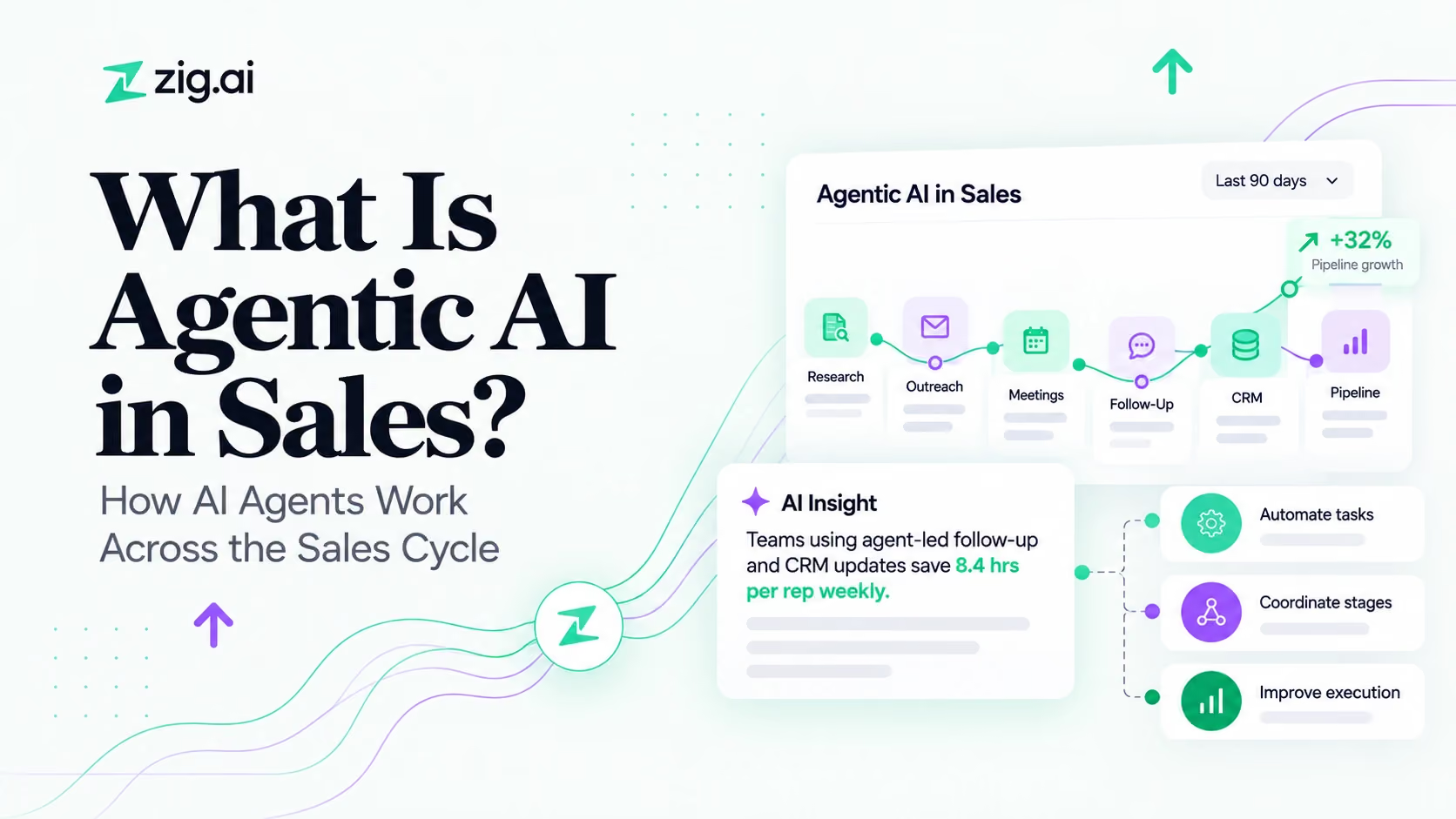
Sales teams have used AI for years, but most of those systems have played a supporting role. Predictive models score leads, generative AI drafts emails, and automation tools execute predefined rules. Agentic AI in sales introduces a different operating model: AI can participate in a multi-step workflow, use connected systems, and continue working toward an assigned objective.
That does not mean handing an AI system unrestricted control of the sales process.
A well-designed agent operates inside defined permissions, approval rules, and escalation paths. It may research an account, inspect CRM history, prepare outreach, classify a reply, update an opportunity, or schedule a meeting, while leaving sensitive buyer-facing decisions with the seller.
Zig applies this model through specialized agents across Research, Outreach, Meetings, Follow-Up, CRM Sync, and Pipeline. Instead of treating AI as a writing assistant, the system connects it to the operational work that surrounds selling.
The useful distinction is therefore not whether AI can generate content. It is determined if the system can understand context, select an appropriate next step, use the required tools, and carry the workflow forward within clearly defined boundaries.
What Does Agentic AI Mean in Sales?
Agentic AI in sales refers to AI systems that can interpret sales context, plan or select multiple actions, interact with connected tools, and execute bounded workflows toward a defined commercial objective.
Those objectives can vary widely. An agent might qualify an inbound lead, prepare a meeting, maintain CRM records, draft follow-up, identify an opportunity losing momentum, or coordinate several of those tasks in sequence.
Ordinary automation generally follows a fixed instruction. For example, a form submission may trigger a CRM task. An agentic system can examine who submitted the form, review the account, determine whether the lead fits qualification rules, retrieve previous activity, select the correct workflow, and escalate the interaction if it falls outside normal conditions.
Several characteristics distinguish an agentic sales system:
- Goal-directed execution: the system works toward an outcome rather than producing one isolated output.
- Context awareness: account, CRM, conversation, and workflow information can influence the next action.
- Multi-step execution: later actions depend on what happened earlier.
- Tool use: the agent can interact with systems such as the CRM, inbox, calendar, and enrichment tools.
- State awareness: replies, meetings, opt-outs, and opportunity changes alter what the system should do next.
That final capability is particularly significant. A sequencer can continue sending messages according to a schedule. An agent should recognize that a prospect replied, understand what kind of reply it received, and alter the workflow accordingly.
How Does an AI Sales Agent Work?
A useful way to understand agentic AI for sales is to look at the sequence that connects an event to an outcome.
Suppose a new inbound lead arrives. The system does not need to respond immediately with a generic template. It can first gather the relevant account and contact context, inspect prior activity, determine what type of lead it is, and then decide which permitted workflow applies.
Stage | What Happens | Sales Example |
Signal | Something changes | A new inbound lead arrives |
Context | Relevant information is collected | CRM history, company, role, prior activity |
Decision | The workflow is selected | Qualify, route, nurture, or escalate |
Tool use | Connected systems are accessed | CRM, inbox, calendar |
Action | Work is completed or prepared | Draft reply, update record, schedule meeting |
Control | Approval occurs where necessary | Rep reviews external communication |
Feedback | The resulting state is observed | Buyer replies or meeting is booked |
Next step | The workflow continues | Handoff, nurture, follow-up, CRM update |
The process can continue until the objective is reached, the workflow reaches a defined boundary, or the situation requires human judgment.
That loop is what separates an agent from a one-time AI prompt. Teams evaluating this architecture can see how Zig's AI agents work across the sales cycle.
Agentic AI vs Generative AI vs Sales Automation
The concept of "agentic AI vs generative AI" can create the impression that the technologies compete with one another. They often work together.
An agentic system may use generative AI to draft a message, summarize a meeting, interpret a reply, or produce research. The difference lies in what happens around that generated output.
Capability | Rules-Based Sales Automation | Generative AI Copilot | Agentic AI Sales System |
Main function | Executes predefined rules | Creates or summarizes content | Coordinates work toward a defined goal |
Initiation | Trigger or schedule | User prompt | Event, goal, command, or workflow state |
Context | Predefined fields | Prompt context | Connected sales and account context |
Multi-step work | Fixed sequence | Usually user-directed | Coordinates dependent steps |
Tool interaction | Preconfigured | Often limited | Core capability |
Decision flexibility | Rule-based | Human decides | Chooses among permitted actions |
Human role | Configures automation | Prompts and edits | Sets permissions, approvals, and exceptions |
Sales example | Create task after form submission | Draft follow-up | Research lead, qualify, update CRM, continue workflow |
Generative AI primarily answers, What should this email say?
Agentic AI adds a broader operational layer: What should happen next, which information is required, which systems need to be used, and am I permitted to complete those actions?
AI agents and agentic AI are related, but not identical
An AI agent is a software component responsible for a particular job. Agentic AI describes the broader architecture and behavior that allow one or more agents to pursue goals through context, tool use, decisions, and execution.
A business may use one agent for inbound qualification. Another may use specialized agents for research, meetings, CRM updates, follow-up, and pipeline management.
Why Sales Platforms Use Multiple Specialized Agents
One AI agent does not need unrestricted access to every sales process. Dividing responsibilities among specialized agents can make the system easier to govern, test, and understand.
A research agent can focus on account intelligence. An outreach agent can prepare prospect communication. A meeting agent can handle preparation and conversation signals. A CRM agent can prepare structured record changes, while a pipeline agent can identify opportunities that are losing momentum.
Zig uses this multi-agent approach across Research, Outreach, Meetings, Follow-Up, CRM Sync, and Pipeline. Each agent operates within a defined part of the sales process while sharing relevant context with the broader system.
This structure can also create cleaner permission boundaries. A CRM agent might be allowed to prepare field changes without having permission to contact a buyer. An outreach agent may work only within approved messaging and sending rules.
The presence of an "AI agent" alone therefore tells a buyer very little. The permissions, context, connected tools, handoffs, and failure behavior around that agent determine how useful it will be in a real sales environment.
Where Agentic AI Fits Across the Sales Cycle
The strongest agentic AI use cases usually involve recurring work, available data, observable outputs, and clear escalation rules. Sales has many of these workflows because information constantly moves among buyers, CRM systems, email, calendars, and pipeline processes.
Sales Workflow | What an Agent Can Handle | Human Role | Useful Metric |
Account research | Gather context and enrich records | Define ICP and priorities | Research turnaround |
Outbound | Prepare outreach and classify replies | Set messaging and review sensitive actions | Qualified reply rate |
Inbound | Interpret lead context, route, and respond | Define qualification rules | Response time and conversion |
Meeting preparation | Assemble account and deal history | Lead the conversation | Prep coverage |
Meeting intelligence | Capture concerns, commitments, and signals | Interpret nuance and negotiate | Next-step completeness |
Follow-up | Prepare actions using meeting context | Approve buyer communication | Follow-up completion |
CRM administration | Prepare structured record changes | Review ambiguous updates | Record completeness |
Pipeline | Detect inactivity and missing actions | Decide deal strategy | Stale-opportunity rate |
Re-engagement | Surface dormant deals and prepare outreach | Approve strategic re-entry | Re-engagement rate |
Looking across the whole sales cycle also prevents agentic AI from becoming synonymous with automated prospecting. Outbound is one application, not the entire category.
What Is an AI SDR?
An AI SDR usually focuses on work associated with sales development. That can include prospect research, enrichment, outbound messaging, reply handling, qualification, and meeting booking.
An AI sales agent is a broader term. It may support meeting preparation, CRM administration, post-call follow-up, pipeline inspection, deal re-engagement, or other workflows outside the traditional SDR remit.
This distinction becomes useful when comparing products. A company seeking additional outbound capacity has different requirements from a RevOps team trying to reduce administrative work across several sales systems.
Zig explores these categories further in its guide to AI BDRs and modern outbound sales and its comparison of AI sales assistants and human SDRs.
How Agentic AI Changes Outbound Sales
Traditional outbound automation is generally sequence-driven. The system follows a predefined cadence until a specified event stops or changes it.
Agentic outbound can introduce more conditional behavior. The system can research the account, retrieve relevant context, prepare personalization, classify responses, and alter the workflow according to what the prospect says.
A more advanced outbound workflow might include:
- identifying accounts that meet ICP criteria
- enriching appropriate contacts
- retrieving relevant company context
- selecting an approved outreach angle
- preparing the message
- sending it or requesting approval
- classifying any reply
- stopping inappropriate sequences
- routing interested prospects
- updating the CRM
- scheduling follow-up
- handing qualified conversations to a seller
A referral to another stakeholder should not trigger the same action as an objection. An opt-out should stop outreach. A positive response may move directly to scheduling.
That conditional execution is central to agent-driven outbound sales.
Commercial email rules still apply
Giving software more autonomy does not remove the sender's legal responsibilities. The FTC CAN-SPAM compliance guide explains requirements for commercial email, including B2B messages.
An outbound agent therefore needs suppression rules and compliance logic alongside personalization and reply classification. A system that creates relevant messages but continues contacting someone who opted out is still poorly designed.
Meetings, Follow-Up, and CRM Work Belong in the Same Agentic Workflow
A large share of sales execution begins after a buyer meeting ends. The conversation still needs to become follow-up, CRM context, tasks, next steps, and pipeline activity.
An AI sales assistant can use the meeting itself as context rather than asking the rep to reconstruct everything manually. The system may capture commitments, prepare follow-up, identify fields that changed, create action items, and preserve unresolved concerns for future activity.
Zig connects its Meetings, Follow-Up, and CRM Sync agents around this sequence. Meeting context can inform summaries and next steps, while CRM changes can be prepared from what happened in the conversation.
The distinction between simple activity logging and CRM automation becomes clearer here. Logging that a meeting happened is very different from understanding what changed during that meeting and carrying those changes into the broader sales process.
Conversation data also becomes more useful when it feeds execution. Zig's guide to conversation intelligence explains how buyer signals, objections, and commitments add context beyond the transcript itself.
Agentic AI Can Continue Working After a Deal Goes Quiet
One characteristic of a true agentic workflow is persistence across changing sales states.
Imagine a meeting ends with a clear next step. The follow-up goes out, the CRM is updated, and the opportunity remains active. Several days later, the buyer stops responding.
The workflow now has new information.
A persistent sales agent can detect the inactivity, retrieve the earlier context, surface the opportunity, prepare an appropriate re-engagement action, and bring the account back to the seller's attention.
That differs from an automation that fires once and ends.
Zig's Pipeline agent is designed around this type of ongoing execution, including stalled-deal identification and preparation of the next move. The same discipline underpins effective sales pipeline management, where activity means less than evidence that the opportunity is progressing.
How Much Autonomy Should Sales AI Have?
Agentic systems do not need maximum autonomy to be useful. In many sales environments, bounded autonomy is more practical than unrestricted execution.
The following framework offers one way to think about permission levels. It is not an industry standard, but it gives buyers a clearer way to discuss what an agent is allowed to do.
Level | Agent Role | Example |
1: Observe | Detect and summarize | Identify a stalled opportunity |
2: Recommend | Suggest the next action | Recommend re-engagement |
3: Prepare | Complete draft work | Draft email and CRM update |
4: Execute with approval | Wait for authorization | Rep approves outreach |
5: Execute within policy | Act automatically inside defined rules | Route a qualified inbound lead |
6: Escalate exceptions | Stop when permission ends | Unusual pricing request goes to seller |
Different workflows can operate at different levels. Routine CRM activity may tolerate greater automation than pricing discussions. Research can run with fewer restrictions than strategic communication with a late-stage enterprise account.
Zig follows this bounded model for buyer-facing activity. Agents prepare and organize work, while sellers retain approval over external actions.
That is a more useful description than claiming an agent is simply "autonomous."
Where Agentic AI Sales Systems Fail
Agentic systems introduce different failure modes from ordinary writing tools because they interact with actual sales systems and processes.
Incorrect context
An agent may use stale CRM information or incomplete account history. The action can sound reasonable while being based on the wrong deal state.
Control: clear data precedence, source visibility, and strong CRM hygiene.
Incorrect interpretation
A buyer's reply may be classified incorrectly. A polite rejection could be mistaken for an objection worth pursuing.
Control: confidence thresholds and escalation for ambiguous intent.
Incorrect action
The interpretation may be reasonable while the selected workflow is inappropriate.
Control: bounded action sets, workflow rules, and approval requirements for sensitive situations.
Poor timing
The content itself may be acceptable, but the timing can still damage the interaction.
Control: frequency limits, state awareness, suppression logic, and account-level context.
Off-brand messaging
AI-generated outreach can drift from approved positioning or introduce claims the business would not make.
Control: messaging guidance, restricted claims, approved examples, and human review.
Tool-side errors
The system may understand the meeting correctly but update the wrong field or record.
Control: permissions, validation, logs, and review for consequential CRM changes.
Automation loops
Two connected systems can repeatedly trigger one another when neither recognizes that the other has already handled the event.
Control: event history, workflow state, idempotent actions, and clear ownership of each trigger.
These problems show why implementing agentic AI in sales is partly an AI project and partly a systems-design project.
Human-in-the-Loop Needs More Than a Label
"Human in the loop" sounds reassuring but is too vague to guide a deployment.
A meaningful control model specifies which actions require approval, who provides it, what happens if nobody responds, which workflows can proceed automatically, and which actions are permanently restricted.
The approval point should reflect the commercial risk.
A rep does not need to authorize every piece of account enrichment. A strategic message to an active enterprise buyer deserves tighter control.
Zig's company positioning follows this division of labor. The product is designed to remove execution work around sellers rather than hand over the entire seller role.
AI Sales Agents and Human SDRs Are Better at Different Work
Comparing agentic AI directly with an SDR salary oversimplifies the decision.
AI tends to perform best when the work has clear inputs, repeatable decision boundaries, and outputs that can be inspected. Humans remain stronger when the commercial environment is ambiguous, political, relationship-driven, or strategically complex.
Work Type | Stronger Fit |
Lead enrichment | Agent |
CRM activity capture | Agent |
Meeting preparation | Agent |
Routine follow-up preparation | Agent |
Pipeline hygiene | Agent |
Complex discovery | Human |
Strategic account planning | Human-led |
Negotiation | Human |
Ambiguous objection handling | Human |
Relationship development | Human |
A transactional inbound team may automate more than an enterprise seller handling a small portfolio of strategic accounts.
For labor-market context, the U.S. Bureau of Labor Statistics overview of sales occupations provides employment information across many types of sales work. It should not be used as evidence that agentic AI alone will determine future employment levels.
How Agentic AI Affects Sales Productivity
The productivity gain from agentic AI is not necessarily that sellers talk to buyers faster. It often comes from reducing the administrative chain surrounding those conversations.
Consider one meeting. Before it starts, someone researches the account. After it ends, someone records notes, updates the CRM, drafts follow-up, creates next steps, and later checks whether the opportunity is progressing.
When all of that remains manual, the customer conversation represents only part of the workload.
An agentic system can compress those administrative steps while leaving discovery, judgment, negotiation, and relationship management with the seller.
That creates a better productivity benchmark than the number of automated tasks completed.
The useful measurement is how much reliable work disappears from the seller's manual queue without reducing the quality of the sales process.
How to Measure Agentic AI in Sales
Teams should avoid measuring AI primarily by emails generated, tasks created, or automated actions completed. Those numbers can increase while commercial quality falls.
A stronger framework separates workflow efficiency, sales quality, and downstream outcomes.
Workflow metrics
These show whether the agent is performing the operational job well:
- research turnaround
- CRM update completion
- follow-up completion
- response latency
- meeting-prep coverage
- stalled-deal detection
- correction rate
- human approval rate
Correction rate is especially useful. High automation volume is not impressive when people spend significant time repairing the output.
Sales-quality metrics
These connect execution to the health of the sales process:
- qualified reply rate
- qualified meeting rate
- no-show rate
- lead-to-meeting conversion
- meeting-to-opportunity conversion
- opportunities with confirmed next steps
- CRM field completeness
Commercial metrics
These sit further downstream:
- pipeline created
- pipeline progression
- sales-cycle length
- win rate
- revenue contribution
Attribution becomes less direct as the metric moves further from the workflow. If pipeline rises after an AI rollout, marketing spend, seasonality, staffing, pricing, or lead mix may also have changed.
The closer a metric sits to the work performed by the agent, the easier it is to judge its direct contribution.
How to Choose an Agentic AI Sales Platform
The evaluation should begin with the workflow rather than a feature list.
An agentic AI sales platform should demonstrate what work it can complete, which context supports its decisions, what systems it can use, and where human approval enters.
Workflow depth
Can the platform complete connected work, or does it mainly produce recommendations for people to execute manually?
Context quality
Which account, CRM, conversation, and activity data can the agent use before making a decision?
Tool access
Which systems can the platform read and write? A logo on an integrations page does not necessarily mean the integration supports useful two-way workflows.
Autonomy controls
Can different workflows use different approval rules?
Error handling
What happens when information is missing, ambiguous, or contradictory? Failure-case demonstrations are often more revealing than successful product demos.
Governance
Can the team identify what action occurred, which agent performed it, and what approval was involved?
Economics
Understand whether pricing follows seats, workloads, executions, leads, messages, or another unit.
Criterion | What to Test | Evidence to Request |
Multi-step execution | Complete a real workflow | Live workflow demonstration |
CRM depth | Read and write behavior | Test against your CRM |
Human controls | Approval and escalation | Permission walkthrough |
Context | Account and conversation history | Context-source demonstration |
Error handling | Ambiguous input | Failure-case demo |
Auditability | Who acted and when | Logs and history |
Security | Data and access controls | Trust documentation |
Adoption | How reps work with agents | Pilot usage |
Economics | Cost at realistic workload | Full pricing model |
This type of evaluation is more useful than comparing the best agentic AI platforms for B2B sales teams according to generic AI feature counts.
Where Zig Fits in Agentic AI Sales
Zig fits most naturally when a sales organization wants AI to participate across several workflows rather than deploy one isolated AI SDR.
Its architecture spans Research, Outreach, Meetings, Follow-Up, CRM Sync, and Pipeline. That places AI before, during, and after the buyer interaction rather than restricting it to prospecting.
This model is especially relevant when sellers still spend significant time researching accounts manually, reconstructing meetings, maintaining CRM records, remembering follow-up, or finding stalled opportunities during pipeline reviews.
Zig works alongside the broader sales stack rather than positioning agentic AI as a wholesale replacement for CRM, inbox, calendar, and other systems.
Larger teams can review Zig's enterprise model, while procurement and security teams can use the Zig Trust Center during evaluation.
What Does Agentic AI Sales Software Cost?
The price of agentic AI software is more useful when compared with the work it performs than with the number of people who log into it.
Commercial structures across the category can include per-seat fees, workload pricing, usage charges, lead-volume pricing, implementation, integrations, and premium support.
Zig uses execution-based rather than per-seat pricing. Starter Team is $799 per month, Growth Team is $1,199 per month, and Enterprise uses custom pricing. Starter and Growth include unlimited users.
The wider operating cost still deserves attention. Buyers should include implementation effort, retained software, enrichment services, internal oversight, and any workflow that remains manual.
Teams can review Zig's pricing and execution capacity against the amount of work they expect the agents to absorb.
How to Implement Agentic AI in a B2B Sales Organization
A strong rollout begins with one bounded workflow that can be observed and measured clearly.
1. Choose a repeatable process
Look for work that is frequent, measurable, and reasonably easy to reverse. Post-meeting CRM updates, account research, inbound routing, follow-up preparation, and stalled-deal detection are useful examples.
2. Map the existing workflow
Document the trigger, required inputs, decisions, systems, human handoffs, and exceptions.
If the current process is poorly understood, automating it usually produces a faster version of the same confusion.
3. Define permissions
Specify what the agent can read, write, draft, send, schedule, and escalate.
Permissions should follow the workflow rather than defaulting to the widest access available.
4. Design failure behavior
Decide what happens when CRM information is missing, two systems disagree, confidence is low, or buyer intent is ambiguous.
The NIST AI Risk Management Framework provides a useful broader structure for thinking about AI reliability, monitoring, governance, and human oversight.
5. Establish a baseline
Measure the manual process before introducing AI. Useful baselines include completion time, correction rate, response latency, CRM completeness, or follow-up consistency.
6. Run a controlled Proof of Value
Give the agent real work inside limited boundaries and track both successful completion and correction requirements.
A workflow is not successful simply because the AI can complete it technically. Employees should not spend comparable time repairing the result.
7. Expand one workflow at a time
Broaden the system when the initial workflow is reliable. Do not grant additional autonomy simply because the agent performed well in an unrelated part of the sales process.
Enterprise teams evaluating a larger rollout can review Zig's enterprise deployment approach.
Agentic AI in Sales Is an Operating Model, Not a Writing Feature
The clearest explanation of what is agentic AI sales is operational rather than promotional.
Agentic AI begins when software can participate in a stateful, multi-step sales workflow. It interprets context, uses connected systems, prepares or performs permitted actions, observes the result, and continues toward a defined objective.
That creates practical differences across the sales process. A meeting summary can become an accurate CRM update. A detected objection can inform follow-up. A new lead can move into qualification. A silent opportunity can trigger re-engagement. A recommendation can become completed execution.
Zig applies that model through specialized agents working across Research, Outreach, Meetings, Follow-Up, CRM Sync, and Pipeline, while sellers retain control over the interactions that need human judgment.
For teams whose sales stack already contains the information but still depends on reps to connect each step manually, book a meeting with Zig to identify which repeatable workflows are suitable for agentic execution.
Frequently Asked Questions About Agentic AI Sales
What is agentic AI sales?
Agentic AI sales refers to the use of AI agents that interpret context, coordinate multiple actions, interact with connected sales systems, and execute bounded workflows toward commercial goals. Human teams define the permissions, approval rules, and escalation paths that control those agents.
What is the difference between generative AI and agentic AI in sales?
Generative AI primarily creates outputs such as emails, summaries, research, or notes. Agentic AI can use those outputs inside a broader workflow that includes decisions, tool use, CRM interaction, follow-up, monitoring, and subsequent actions.
Is an AI SDR the same as an agentic AI sales platform?
No. An AI SDR usually concentrates on prospecting, outreach, qualification, and meeting booking. A broader agentic platform may also support meetings, CRM administration, follow-up, pipeline management, and other revenue workflows.
Can agentic AI replace sales representatives?
Agentic AI can automate many structured sales tasks, but complex discovery, negotiation, strategic judgment, relationship development, and ambiguous buyer conversations still depend heavily on human sellers.
Can an AI sales agent update a CRM?
Yes, if the agent has the necessary integration and permissions. Buyers should examine which records it can access, how field changes are approved, how conflicting data is handled, and whether consequential updates remain reviewable.
Can agentic AI run outbound sales?
Yes. Agentic outbound workflows can combine research, enrichment, message preparation, sequence execution, reply classification, routing, CRM updates, and follow-up. Businesses still need appropriate messaging controls, opt-out handling, and email-compliance processes.
How much autonomy should an AI sales agent have?
The appropriate autonomy level depends on the workflow and commercial risk. Routine internal tasks can support greater automation, while strategic communication, negotiation, pricing, and unusual buyer situations usually need tighter approval or escalation.
How should companies measure agentic AI sales performance?
Start with workflow quality rather than raw activity. Useful measures include response time, completion rate, correction rate, CRM completeness, qualified meetings, opportunities with confirmed next steps, pipeline progression, and manual work removed.
How much does agentic AI sales software cost?
Pricing can follow seats, usage, lead volume, workload, or executions. Buyers should compare the subscription with implementation, integrations, retained tools, data services, administration, and the amount of manual work the platform actually eliminates.
